Author: admin

  • Henri Goetz

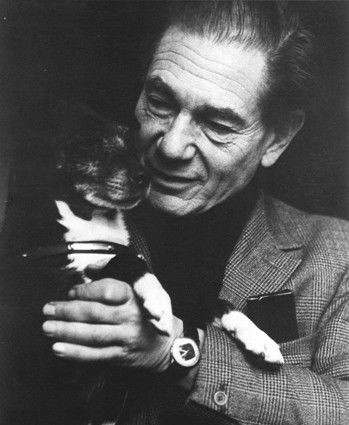
    Henri Goetz

    American-born French painter and printmaker, born on 29 September 1909 in New York, died on 12 August 1989 in Nice.

    Life

    He first studied electrical engineering at MIT, then art history at Harvard, which he left to take painting classes at the Grand Central School of Art in New York. In July 1930 he left for Paris and attended the Montparnasse academies: Colarossi, Julian, the Grande Chaumière. It was there, in September 1935, that he met the Dutch painter Christine Boumeester, whom he married the same year. She introduced him to printmaking and accompanied him towards abstraction.

    From January 1936 Goetz painted non-figurative pictures, a “non-figurative painting of pure invention” to express his inner world without using the objects of the real world. He discovered Surrealism through his friendship with the poet Juan Brea and his wife Mary Low, members of André Breton’s group; the German painter Richard Oelze first told him about Dalí. He then spent time with Raoul Ubac, Benjamin Péret and Óscar Domínguez. Breton met him in 1938, without however inviting him to take part in the movement’s events. His first solo exhibition in Paris took place in 1937 at the Galerie Van Leer.

    During the Occupation the couple took part in the Resistance, notably by forging papers, before taking refuge on the Côte d’Azur. Back in Paris at the Liberation, Goetz taught painting from 1949 at the Académie Ranson, then at the Grande Chaumière, before founding his own academy. He was naturalised French in 1949. He gave his works and those of Christine Boumeester, who died in 1971, to the town of Villefranche-sur-Mer, whose citadel now houses a museum bearing their names.

    The work

    The Surrealist spirit that pervades his painting gave rise to the Chefs-d’œuvre corrigés (Corrected Masterpieces, 1938-1939): on reproductions of famous works, Goetz gave free rein to the associative images they suggested to him. It was on discovering them in 1939 that André Breton gave them this title. On his choice of non-figuration, Goetz wrote:

    “If I choose the non-figurative world, it is because I believe it is vaster than the other. I believe there is more to discover in the unknown than in the known.” (Henri Goetz)

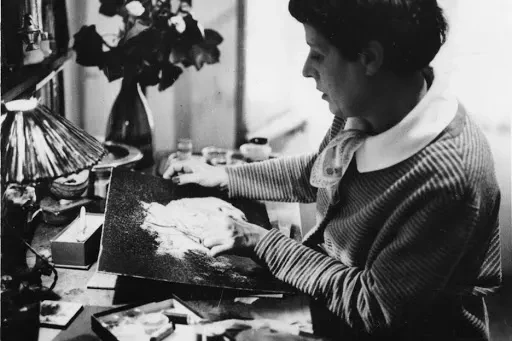
    As a printmaker he practised drypoint, burin engraving, etching and aquatint. In the 1960s he invented carborundum printmaking, a process of relief plates made from powders, which he set out in a treatise published by the Galerie Maeght in 1968, with a preface by Joan Miró. In 1947 Alain Resnais devoted a short film to him, Portrait d’Henri Goetz.

    Exhibitions and collections

    • At the gallery: Sans titre, 1939, oil on panel, 22 x 32 cm, and L’homme aux feuilles, John Wells, 1939, mixed media, 21 x 27 cm, shown in “At the Sources of Convulsive Beauty” (25 October to 30 November 2024)
    • At the gallery: Sans titre, 1942-1943, oil on panel, 61 x 47 cm (2023)
  • Joaquim Vicens Gironella

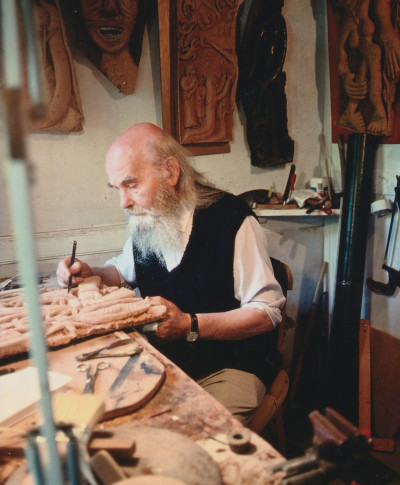
    Joaquim Vicens Gironella

    Catalan Art Brut sculptor and writer, born in 1911 in Agullana (Catalonia), died in 1997 in Toulouse.

    Life

    From a family of cork makers, he learned the working of cork from his parents and practised it himself. He received only a basic education but was drawn to writing early on: as a teenager he published articles and poems devoted to the cork oak in the local press.

    An anti-fascist, he joined the anti-fascist committee and the town council of his village, then enlisted in the Republican army in 1936, where he ran a front-line publication. In February 1939, after Franco’s victory, he crossed into France; arrested in Perpignan, he was interned for more than a year in the camp at Bram (Aude). Settled in Toulouse, he worked in a cork factory and started a family with Paz Santiago Ruiz, a refugee like himself, with whom he had three daughters. Under the Occupation he was sent to the Récébédou camp, then to Le Croisic, where he worked for the Todt Organisation on the Atlantic Wall.

    Jean Dubuffet discovered his sculptures in Paris, in the office of René Lajus, the factory’s manager, and at the end of 1948 devoted an exhibition to him at the Foyer de l’art brut, with the participation of André Breton. Gironella wrote poems, plays and novels all his life, for a long time without a publisher, as well as an autobiographical account, L’exil, mon village et moi (1984).

    The work

    Around 1941 he tried clay, which did not suit him, then devoted himself to cork, which he carved from the block, in the round as well as in low relief. His figures, born of his imagination and nourished by memories of his native Catalonia, play on a whimsical perspective and disproportionate limbs that heighten their expressiveness. He later made wall panels inspired by Catalonia, Islamic art and medieval art. In 1990 he published Exaltació del suro, a collection of poems and images made entirely of cork.

    Exhibitions

    • 1948: solo exhibition at the Foyer de l’art brut, Paris, organised by Jean Dubuffet
    • 1967: “L’art brut”, Musée des Arts décoratifs, Paris
    • 2021: “Dubuffet: Brutal Beauty”, Barbican, London
    • 2022-2023: monographic exhibition at the Museu de l’Exili, La Jonquera, then at the Cork Museum in Palafrugell
    • 2023: exhibition at the Galerie christian berst, Paris
  • Madge Gill

    Madge Gill

    British mediumistic draughtswoman, born Maude Ethel Eades on 19 January 1882 in east London, died in 1961.

    Life

    Regarded as an illegitimate child, she was kept out of sight in her early years. At nine, although her mother was still alive, she was placed in one of Dr Barnardo’s homes at Barkingside. In 1896 she was among the children sent to Canada, where she was put to work as a domestic servant on farms in Ontario. Back in East Ham in 1900, she lived with an aunt who introduced her to spiritualism and astrology, and worked as a nurse at Whipps Cross Hospital.

    At twenty-five she married her cousin Thomas Edwin Gill, a stockbroker. The couple had three sons. The second, Reginald, died of Spanish flu; the following year she gave birth to a stillborn daughter. The illness that followed confined her to bed for several months and left her blind in her left eye. It was then, around 1920, at thirty-eight, that she suddenly began to draw. After the death of her eldest son in 1958 she sank into alcoholism and stopped drawing. Thousands of drawings were discovered in her home at her death.

    The work

    Madge Gill attributed her work to a spirit guide she called Myrninerest (“my inner rest”), the name with which she often signed her works. For fear of displeasing it, she never sold anything. She drew mainly in black ink, on supports ranging from postcards to long rolls of calico, some more than nine metres long; she also knitted, wove and wrote. Prolific, she could complete dozens of drawings in a single night.

    Her compositions repeat oval female faces with large almond eyes, often staring, caught in chequerboards and labyrinthine architectures, the bodies almost absent or hidden beneath heavy clothing. The art historian Roger Cardinal speaks in her regard of “an art of concealment”.

    Exhibitions and collections

    • Whitechapel Gallery, London: exhibitions from 1932 to 1947, including that of 1939 in which she showed a work of some 40 metres covering a whole wall
    • 2006: “Outsider Art”, Tate Britain; 2019: “Myrninerest”, William Morris Gallery, London; 2024: Venice Biennale
    • Collections: London Borough of Newham (main holding); Collection de l’Art Brut, Lausanne; LaM, Villeneuve-d’Ascq (L’Aracine donation, 1999); Centre Pompidou (Bruno Decharme donation, 2021)
    • At the gallery: Sans titre, 1953, 63 x 51 cm, shown in the exhibition “Art Brut” (June-July 2022)
  • Eugène Gabritschevsky

    Eugène Gabritschevsky

    Russian biologist and painter, a figure of Art Brut, born on 3 December 1893 in Moscow, died on 5 April 1979 in Haar, near Munich.

    Life

    The second of five children, he grew up in a well-to-do scientific milieu. His father, Georg Gabritschevsky (1860-1907), an internationally renowned bacteriologist, had worked with Louis Pasteur in Paris and Robert Koch in Germany, and founded the first institute of epidemiology and microbiology in Moscow. The children were taught by some twenty private tutors. According to his brother Georg, Eugen was already drawing when he could barely read and write.

    In 1913 he entered Moscow University to study biology, heredity and entomology. He left the Soviet Union for good in 1924 and arrived in New York in January 1925 to work at Columbia University with Thomas Hunt Morgan, then at the Woods Hole laboratory in 1926. From 1927 to 1929 he pursued his research on insect mutations at the Institut Pasteur in Paris, under Professor Roux. Invited to the University of Edinburgh in 1931, he had to stop in October of that year: his mental health was deteriorating.

    Committed in 1931 to the Eglfing-Haar psychiatric hospital, he spent the rest of his life there, apart from a few stays with relatives. Jean Dubuffet discovered his work in 1948 through his doctor. In 1960, at Dubuffet’s instigation, the Vence gallerist Alphonse Chave travelled to Germany and acquired more than 5,000 sheets. Much of this later passed to the Galerie Daniel Cordier.

    The work

    Over some thirty years he produced thousands of works on paper, mainly in gouache and watercolour, but also in pencil, charcoal and pastel. He used many techniques: frottage, dabbing, scraping, folding, sponge, rag, decalcomania. He painted on salvaged supports: tracing paper, X-ray films, magazine pages, calendars, the hospital’s administrative documents.

    They include peopled or deserted landscapes, cities and crowds, night scenes (carnivals, festivities, concerts), mutating bodies, hybrid beings and bestiaries of fabulous creatures. Max Ernst bought five paintings from him in 1972.

    Exhibitions and collections

    • 2016: retrospective at La maison rouge, Paris (some 250 works), shown again at the Collection de l’Art Brut, Lausanne (2016-2017) and the American Folk Art Museum, New York (2017)
    • Collection de l’Art Brut, Lausanne (works acquired by Dubuffet for the Compagnie de l’art brut)
    • Musée national d’art moderne, Centre Pompidou (Daniel Cordier donation, 1989), on deposit at Les Abattoirs, Toulouse
    • At the gallery: Sans titre, 1960, watercolour and gouache on paper, 20 x 28.5 cm, shown in the exhibition “Art Brut” (June-July 2022); works shown in “Favourites: Art Brut, Naive Art, Art Singulier” (March-April 2024)
  • Johann Fischer

    Johann Fischer

    Austrian Art Brut draughtsman, born on 5 October 1919 in Eggendorf am Wagram (Lower Austria), died on 23 September 2008. He belongs to the group of Gugging artists.

    Life

    The third of seven children, he grew up on a small farm and vineyard. After primary school he trained as a baker, up to master level. Conscripted into the German army in 1940, he was taken prisoner by the Americans. A year after the end of the war he took over the family farm as a winegrower.

    He first saw a psychiatrist in 1957, then worked again as a baker. He later became a permanent patient of the Gugging psychiatric hospital near Vienna (in 1961 according to the Museum Gugging, in 1967 according to the Collection de l’Art Brut). In 1982 he joined the group of residents of the centre for art and psychotherapy founded by the psychiatrist Leo Navratil, today’s House of Artists (Haus der Künstler).

    The work

    It was through contact with the artistic activity of the House of Artists that he began to draw, in pencil and graphite: animals, objects, people caught at their trades. From 1984 he introduced coloured pencils, mostly warm yellows and browns, and his compositions became dense and tightly packed.

    At the end of the 1980s, writing invaded the sheet: a calligraphed text on lines he drew himself, divided into numbered sections to show the reading order. In the end the text dominated, with the image serving only as illustration. His comments, often political, social or religious, speak of family, illness, farming, machines, Catholicism and above all Austria, which he evokes as a patriot without refraining from denouncing its injustices.

    Exhibitions and collections

    • 1983: exhibition of the Gugging artists at the Museum moderner Kunst, Vienna
    • Collection de l’Art Brut, Lausanne
  • Leonor Fini

    Leonor Fini

    Painter, draughtswoman, illustrator and costume designer, born on 30 August 1907 in Buenos Aires, died on 18 January 1996 in Paris.

    Life

    Less than eighteen months after her birth, her mother, who came from Trieste, took her back to that city, where she grew up. In her early teens an eye disease decided her to become an artist. She moved to Milan at seventeen and held her first solo exhibition there in 1929, at the Galleria Barbaroux. At that time she knew Carlo Carrà and Giorgio de Chirico, whose metaphysical painting marked her beginnings.

    She settled in Paris in 1931 and exhibited from 1932 at the Galerie Jacques Bonjean. She spent time with Paul Éluard, Max Ernst, Georges Bataille, Henri Cartier-Bresson, André Pieyre de Mandiargues and Salvador Dalí. Without ever officially joining the Surrealist group, she exhibited alongside its members. In New York the Julien Levy Gallery gave her two exhibitions, in 1936 and 1939, and in 1943 Peggy Guggenheim selected her for Exhibition by 31 Women at the Art of This Century gallery.

    She shared her life with the Italian count Stanislao Lepri, who gave up diplomacy to follow her, then with the Polish writer Konstanty Jeleński, whom she met in Rome in January 1952 and who moved into her Paris flat in October of that year. All three remained inseparable until their deaths.

    The work

    Beyond painting, most of her activity between 1944 and 1972 was devoted to costumes, for theatre, ballet, opera and film: Les Demoiselles de la nuit (1948), the first ballet of Roland Petit’s Ballets de Paris, Le Rêve de Leonor (1949), choreographed by Frederick Ashton to music by Benjamin Britten, with hybrid half-human, half-animal costumes, and the films Romeo and Juliet by Renato Castellani (1954) and A Walk with Love and Death by John Huston (1968). At the end of the 1930s she worked for Elsa Schiaparelli, for whom she designed the bottle of the perfume Shocking.

    She illustrated some fifty books, among them Sade’s Juliette (1944 edition), the Satyricon, texts by Jean Genet, Charles Baudelaire, Edgar Allan Poe and Shakespeare, and Lise Deharme’s Le Poids d’un oiseau (1955). She also wrote, notably the novel Rogomelec (Stock, 1979). She lived surrounded by Persian cats, up to twenty-three at a time.

    Exhibitions and collections

    • 1929: first solo exhibition, Galleria Barbaroux, Milan
    • 1936 and 1939: Julien Levy Gallery, New York
    • 1986: retrospective at the Musée du Luxembourg, Paris, with more than 260 works
    • Public collections: Centre Pompidou and Musée d’Art moderne de Paris, Musée de Grenoble, Museo Revoltella (Trieste), Peggy Guggenheim Collection (Venice), Tate (London), Metropolitan Museum of Art (New York), Art Institute of Chicago

    At the gallery

  • Yolande Fièvre

    Yolande Fièvre

    French painter and sculptor, born on 25 January 1907 in Paris, died in 1983 in Paris.

    Life

    As a young woman, Yolande Fièvre travelled to America and lived for a few years in Egypt. She trained at the École des beaux-arts and the Académie de la Grande Chaumière in Paris, then taught at the École des beaux-arts in Orléans.

    In the 1930s she discovered Surrealism and met André Breton, who led her to abandon landscape for automatism. Her friends included Jean Paulhan, Jean Dubuffet, Raymond Queneau and Bernard Réquichot, whose suicide in 1961 devastated her. Her husband died in 1968.

    The work

    She first practised automatic painting and drawing. In the 1950s she turned to the object and pursued research into often organic materials: driftwood and “shipwrecked stones” (1957-1961), then “relief boxes”, in which fragments of wood, clay and pebbles, sometimes inhabited by small figures, evoke mysterious cities. The Oniroscopes are among her series.

    In 1961 she paid tribute to Réquichot with Rêve pour un jeune mort, an assemblage of driftwood, pebbles, bones, metals, shells and potsherds (93 x 167 x 15.7 cm), which entered the Musée national d’art moderne with the Daniel Cordier donation in 1989.

    Exhibitions and collections

    • Solo exhibitions from 1957, notably at Simone Collinet’s and Daniel Cordier’s in Paris, at the Svensk-Franska Konstgalleriet in Stockholm and at the Galerie Bonnier in Geneva
    • Halle Saint-Pierre, Paris, 2007-2008
    • Collections: Musée national d’art moderne, Centre Pompidou (Hommage à Bernard Réquichot, 1961, on deposit at Les Abattoirs, Toulouse)
    • Galerie Les Yeux Fertiles: “Automatic Paintings, Oniroscopes”, with Ursula, 14 March to 12 April 2025; work shown: Sans titre, c. 1950, automatic painting, 23 x 16 cm

    At the gallery

  • Joaquín Ferrer

    Joaquín Ferrer

    Cuban painter, draughtsman and printmaker, naturalised French, born in 1928 in Manzanillo (Cuba), died in 2022 in Paris.

    Life

    Joaquín Ferrer studied at the School of Fine Arts in Havana and exhibited every year from 1954 to 1958 at the painting salon of the city’s Museum of Modern Art. In the Havana of the late 1950s he became friends with Jorge Camacho, a friendship shared with Agustín Cárdenas and Wifredo Lam.

    With a grant from the Cuban Ministry of Education, he joined Camacho in Paris in 1960, at the Maison de Cuba in the Cité universitaire: this decisive year led them both to settle in France for good. Ferrer then worked in a studio in Pigalle. In 1962 he took part in the major exhibition “Art latino-américain” organised by Jean-Clarence Lambert at the Musée d’Art moderne de la Ville de Paris.

    His meeting with Max Ernst was decisive: in 1968 his first Paris exhibition, with a preface by Ernst, took place at Jean Hugues’s Galerie Le Point Cardinal, which from then on regularly showed his work, alongside that of Ernst, Sima, Michaux, Cárdenas and Sánchez. He spent time with poets such as Alain Bosquet, Lionel Ray, Henri Michaux and Claude Esteban. He was naturalised French in 1979.

    “[…] As for the young, I pity them. How can they not feel that everything has been done before them? It is wrong to make gods of them before they have even had time to express themselves. One of them, Ferrer, is something of a discovery of mine. Far from Pop Art, Mec’Art and their substitutes, he seems to me profoundly authentic […]” (Max Ernst, 1967)

    The work

    A painter, Ferrer also practised printmaking, as the catalogue “Peintures et gravures 1970-1971” of Le Point Cardinal already shows in 1971. Exile and nostalgia for Cuba run through part of his output. Among the works shown by the gallery: Sans titre (c. 1965, oil on paper, 76 x 56 cm), L’arbre S (1979, oil on canvas, 128 x 128 cm) and L’homme obscur (1993, acrylic on panel, 62 x 50 cm). Some of his paintings belonged to Alain Bosquet.

    Exhibitions and collections

    • “Art latino-américain”, Musée d’Art moderne de la Ville de Paris, 1962
    • Galerie Le Point Cardinal, Paris, from 1968 (catalogues in 1971, 1972 and 1977)
    • Retrospective, Maison de l’Amérique latine, Paris, 30 May to 9 September 2017 (catalogue published by Hermann)
    • Monograph published by Éditions Palantines
    • “Joaquín Ferrer: transculturations artistiques”, study day, Maison de l’Amérique latine, Paris, 12 October 2026
    • Galerie Les Yeux Fertiles: “At the Sources of Convulsive Beauty”, 25 October to 30 November 2024; “A Journey through Latin America”, 18 April to 31 May 2025; the gallery’s 25th anniversary exhibition, 22 May to 19 June 2026
  • Anne Ethuin

    Collagist, draughtswoman and poet, born Simone Jaguer in 1921, died in 2009.

    Life

    The wife of the poet and art critic Édouard Jaguer (1924-2006), she founded with him and a few friends, in 1952, the review Phases, around which the movement of the same name formed.

    She adopted the name Anne Éthuin after her 1973 exhibition at the Galerie Les Mains libres in Paris, in tribute to her maternal grandmother.

    The work

    Anne Éthuin made “clothed collages” (collages revêtus) and “dressed objects” (objets habillés), which gave their titles to several of her exhibitions. She also drew and painted.

    Exhibitions

    • Galerie Les Mains libres, Paris, 1973
    • Exhibition of paintings, Galeria Valle Ortí, Valencia (Spain), 1976
    • “Collages revêtus”, Paris, 1980
    • “Collages revêtus, objets habillés”, Paris, 6 November to 12 December 1989
  • Erro

    Erro

    Icelandic painter, born Guðmundur Guðmundsson on 19 July 1932 in Ólafsvík (Iceland), based in Paris since 1958.

    Life

    Erró studied at the Reykjavík School of Painting and Applied Arts from 1949 to 1951, then at the Academy of Fine Arts in Oslo (1952-1954) and the Academy of Fine Arts in Florence (1955-1957). He also studied mosaic, in Ravenna and Reykjavík. In Ravenna he met Jean-Jacques Lebel, who introduced him to Parisian writers and painters. After a stay in Israel in 1957, he settled in Paris in 1958.

    He first signed Ferró, then Erró. He himself tells the story of this change of name:

    “My first artist’s name was Ferro. I found it after a trip to Spain in 1952. I had spent a week in a village, Castel del Ferro. I thought the name very beautiful, all the more so since in Icelandic ‘fer ro’ means ‘the calm that goes away’. But I did not know that in Montmartre there was a Brazilian artist, Gabriel Ferraud. And there is a law in France, from the Vichy period, stating that foreigners may not take the name of an existing artist. So there was a lawsuit, which I lost twice. With Jean-Jacques Lebel we thought of writing the name with three ‘r’s, but that was not accepted. In the end, in court, it was decided to drop the ‘F’. I liked that. And in Icelandic ‘er ro’ means ‘now it is calm’.”

    In 1962, with Éric Duvivier, he made the film Mécamorphoses, followed by Grimaces in 1967. He travelled widely, between Paris, the United States, the USSR and Asia. He was made a Chevalier of the Légion d’honneur in 2010.

    The work

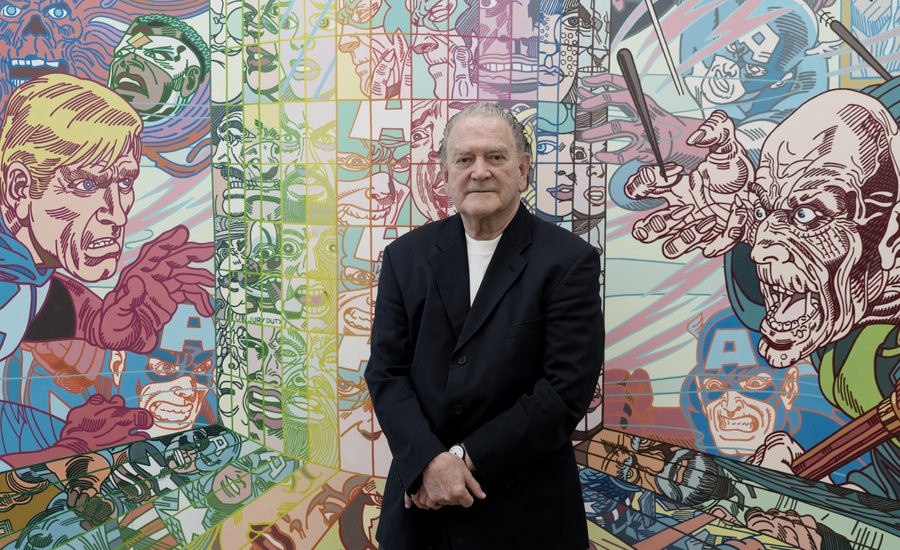
    From 1958-1959 Erró composed mechanical collages that served as models for his paintings. In them he drew on every kind of printed image: anatomical plates, advertising, comics, propaganda posters. These collages belong to the lineage of the Dada photomontages of Raoul Hausmann and John Heartfield.

    His collages predate the birth of Pop Art by two or three years, and he was, with Roy Lichtenstein, one of the first to bring comic-strip characters into painting. His series mark the stages of his career: Carcasses (1955-1957), Mécamasks (1959), Les Galapagos (1959), the portraits of Mayakovsky (1964-1966), Pope Art (1965), American Interiors (1968), then the Chinese Paintings, from 1972, which brought him international renown.

    Exhibitions

    • “Figuration narrative” exhibition, Galerie Creuze, Paris, 1965
    • Galerie Les Yeux Fertiles: the gallery’s 25th anniversary exhibition, 22 May to 19 June 2026