
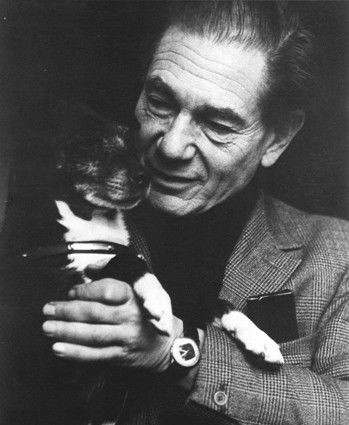
American-born French painter and printmaker, born on 29 September 1909 in New York, died on 12 August 1989 in Nice.
Life
He first studied electrical engineering at MIT, then art history at Harvard, which he left to take painting classes at the Grand Central School of Art in New York. In July 1930 he left for Paris and attended the Montparnasse academies: Colarossi, Julian, the Grande Chaumière. It was there, in September 1935, that he met the Dutch painter Christine Boumeester, whom he married the same year. She introduced him to printmaking and accompanied him towards abstraction.
From January 1936 Goetz painted non-figurative pictures, a “non-figurative painting of pure invention” to express his inner world without using the objects of the real world. He discovered Surrealism through his friendship with the poet Juan Brea and his wife Mary Low, members of André Breton’s group; the German painter Richard Oelze first told him about Dalí. He then spent time with Raoul Ubac, Benjamin Péret and Óscar Domínguez. Breton met him in 1938, without however inviting him to take part in the movement’s events. His first solo exhibition in Paris took place in 1937 at the Galerie Van Leer.
During the Occupation the couple took part in the Resistance, notably by forging papers, before taking refuge on the Côte d’Azur. Back in Paris at the Liberation, Goetz taught painting from 1949 at the Académie Ranson, then at the Grande Chaumière, before founding his own academy. He was naturalised French in 1949. He gave his works and those of Christine Boumeester, who died in 1971, to the town of Villefranche-sur-Mer, whose citadel now houses a museum bearing their names.
The work
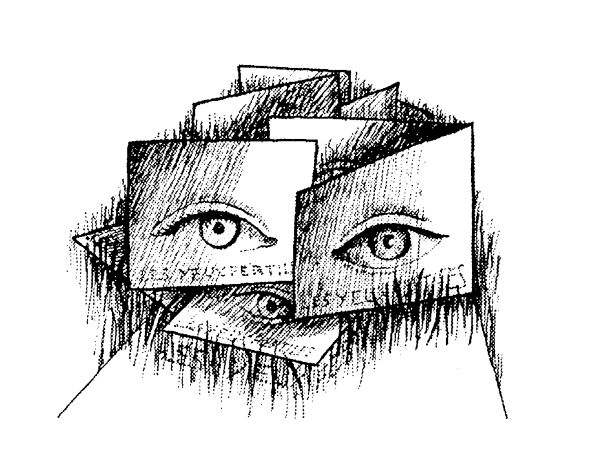
The Surrealist spirit that pervades his painting gave rise to the Chefs-d’œuvre corrigés (Corrected Masterpieces, 1938-1939): on reproductions of famous works, Goetz gave free rein to the associative images they suggested to him. It was on discovering them in 1939 that André Breton gave them this title. On his choice of non-figuration, Goetz wrote:
“If I choose the non-figurative world, it is because I believe it is vaster than the other. I believe there is more to discover in the unknown than in the known.” (Henri Goetz)
As a printmaker he practised drypoint, burin engraving, etching and aquatint. In the 1960s he invented carborundum printmaking, a process of relief plates made from powders, which he set out in a treatise published by the Galerie Maeght in 1968, with a preface by Joan Miró. In 1947 Alain Resnais devoted a short film to him, Portrait d’Henri Goetz.
Exhibitions and collections
- At the gallery: Sans titre, 1939, oil on panel, 22 x 32 cm, and L’homme aux feuilles, John Wells, 1939, mixed media, 21 x 27 cm, shown in “At the Sources of Convulsive Beauty” (25 October to 30 November 2024)
- At the gallery: Sans titre, 1942-1943, oil on panel, 61 x 47 cm (2023)