Category: Surrealism

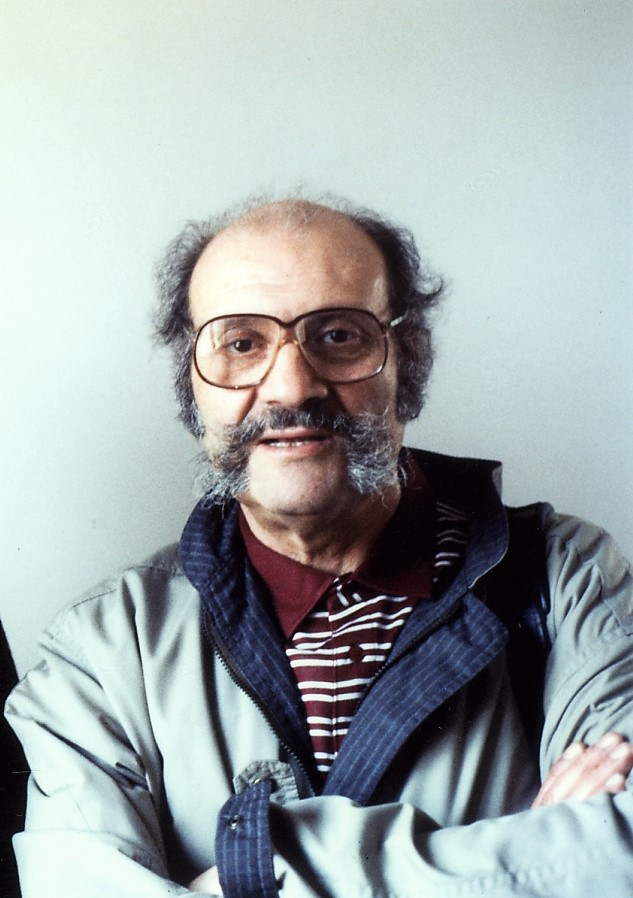
  • Ludwig Zeller

    Ludwig Zeller

    Chilean poet and visual artist, born in 1927 in Río Loa, in the Atacama Desert, died in 2019 in Mexico.

    Life

    The son of an immigrant employed in the mines of northern Chile, Ludwig Zeller was first shaped by German Romanticism, which he studied and translated from the age of twenty; he published Las grandes elegías de Friedrich Hölderlin with the university press in Santiago. From 1952 to 1968 he ran the gallery of the Ministry of Education. In the 1960s he also worked at the Centre for Medical Anthropology of the Faculty of Medicine of the University of Chile.

    In Buenos Aires he met the poets of Argentine Surrealism. With his wife, the artist Susana Wald, he founded the review Casa de la Luna in Santiago and, at the end of the 1960s, organised the exhibition Surrealismo en Chile. In 1971 the couple moved to Toronto with three of their four children; there Zeller set about founding Oasis Publications. In France he was in contact with the Phases movement. The family later left for Mexico and settled in Oaxaca, where he lived until his death. His archive is held at Library and Archives Canada.

    The work

    For Zeller, poetry and image are inseparable. Collage accompanies his entire career, from two collage murals made in 1955 and 1957, now destroyed, to the Oaxaca years, when he devoted himself to it more fully. His books are often objects: Paloma que se sueña (1960) is printed on paper folded into the shape of a dove; Las reglas del juego (1968) appeared in Spanish, English, German and French. The video poem The Alchemical Body (1986), in which his collages and Susana Wald’s paintings are projected onto a naked body, was shown at the 42nd Venice Biennale.

    Exhibitions and collections

    • 42nd Venice Biennale, with The Alchemical Body.
    • Library and Archives Canada: Ludwig Zeller fonds.
    • “At the Sources of Convulsive Beauty”, section “Édouard Jaguer and the international Phases movement”, Galerie Les Yeux Fertiles, 25 October to 30 November 2024.
  • Philip West

    Philip West

    British Surrealist painter, born in 1949 in York, died in 1997 in Zaragoza (Spain).

    Life

    Born after the dispersal of the first British Surrealist group, that of E. L. T. Mesens and Roland Penrose, Philip West took part in the British Surrealist revival: all his work dates from after the early 1970s. He first joined the small group gathered by the writer John Lyle around the review TRANSFORMAcTION, then contributed to the Dutch review Brumes blondes.

    From 1973 he took part in the events of Édouard Jaguer’s Phases movement, in France, the Netherlands, Portugal and Belgium. He then left Britain for Spain, stayed in Venezuela, then returned to Spain, where he pursued Surrealist activities in association with Eugenio F. Granell.

    The work

    A painter of the object and of a highly personal bestiary, Philip West stands in the line of René Magritte and Toyen. His images, drawn from a “bag of rebuses”, pay tribute to “all the prophets of nonsense”, from Lewis Carroll to Benjamin Péret. He also composed compartmented works in which separate scenes unfold. Édouard Jaguer saw him as a fearless explorer of nonsense.

    Exhibitions and collections

    • Phases exhibitions: Brussels, 1974; Estoril, 1977; Lyon, 1980; Montluçon, 1987; “Greffages 2”, Paris, 1989.
    • “Brumes blondes”, Amsterdam, 1977; “Imagination”, Bochum, 1978.
    • Avis Mundi, Zaragoza, 1996.
    • “Philip West. Bestiaire”, Eugenio Granell Foundation, Santiago de Compostela, from 26 September 2008.
    • “At the Sources of Convulsive Beauty”, section “Édouard Jaguer and the international Phases movement”, Galerie Les Yeux Fertiles, 25 October to 30 November 2024: Sans titre, 1981, oil on canvas, 70 x 50 cm.
  • Suzanne Van Damme

    Suzanne Van Damme

    Belgian painter, born on 22 September 1901 in Ghent, died on 11 January 1986 in Ixelles.

    Life

    Suzanne Van Damme trained at the academies of Ghent and Brussels, then at the independent studio L’Effort in Brussels. In Ostend she came under the influence of James Ensor, who became her mentor: she painted his portrait in 1925, and he painted hers in 1938. Her early work belongs to Post-Impressionist painting.

    In the early 1930s she settled in Paris, where she met the Italian painter and poet Bruno Capacci, whom she married. She would then divide her life between Paris, the south of France, London and Florence.

    In 1941 she came into contact with the Surrealists. André Breton photographed many of her first Surrealist canvases. In 1947 she took part in the International Surrealist Exhibition organised in Paris by Breton and Marcel Duchamp.

    The work

    Her paintings of the 1940s are in dialogue with Picasso, De Chirico, Kurt Seligmann and Toyen. Settled in Florence, she turned towards abstraction, then developed a personal language of ideograms composed of “mini-paintings” mingling abstract and figurative elements.

    Exhibitions and collections

    • Venice Biennale, 1935, 1954 and 1962; São Paulo Biennial, 1953.
    • International Surrealist Exhibition, Paris, 1947.
    • United States, 1950s and 1960s: Marshall Field Gallery, Chicago (1959); Thibault Gallery, New York (1961); Calhoun Gallery, Dallas (1961); Saks Gallery, Denver (1969).
    • Museum of Fine Arts, Ghent (MSK): a large Surrealist oil entitled The Oppressor of Silence in the museum’s record, 156 x 122.5 cm, on deposit from the Flemish Community since 1949.
  • Václav Tikal

    Václav Tikal

    Czech painter and ceramicist, born on 24 December 1906 in the Plzeň region, died on 26 November 1965 in Prague.

    Life

    Partly self-taught, Václav Tikal first painted as an amateur, a “Sunday painter”. From 1937 he studied at the Academy of Fine Arts in Prague, until the institution was closed during the war.

    In the midst of the war he joined a circle of young artists, where he met Karel Teige and other Surrealists. After the Liberation he was one of the painters of the Ra group, with Josef Istler, Bohdan Lacina and Václav Zykmund. The group published its founding text and held its first group exhibition in 1947; it was officially banned in 1948.

    After Teige’s death, Tikal withdrew for several years and almost stopped painting. From 1964 he took part in the international Phases movement, as did Josef Istler. In the last years of his life, solo exhibitions and his inclusion in exhibitions of modern art, in Czechoslovakia and abroad, brought him wider recognition.

    The work

    Tikal is one of the leading representatives of post-war Czech Surrealism; he is often likened to Salvador Dalí and Giorgio de Chirico. His landscapes express inner states, with a Romantic colouring. During and after the war they host cruel scenes and fragments of human bodies. Lyricism and a “nostalgia for the marvellous” run through the whole of his work.

    The late works slide towards abstraction: imaginary and constructive elements combine geometry with natural forms. Tikal also designed models for ceramics and porcelain.

    Exhibitions and collections

    • National Gallery Prague: Surrealist Object (Head), 1945; Prometheus Unbound, 1945.
    • “Surrealist Prelude”, Galerie Les Yeux Fertiles, 7 June to 6 July 2024: Sans titre, 1957, graphite drawing, 34 x 23 cm.

    At the gallery

  • Jean Terrossian

    French painter, born in 1931. A member of the Surrealist group from 1961.

    Life

    Armenian was the language of Jean Terrossian’s early childhood; French became the language of his culture. Before calling himself, self-mockingly, a “painter”, he readily lists his failed careers: tap dancer, cook, bar pianist.

    In 1961 he joined the group gathered around André Breton. He took part in the café meetings and collective games, discovered Breton’s poem-objects, and there developed his attention to the “ricochets” of thought. His first published drawing appeared in 1963 in no. 5 of La Brèche, the review edited by Breton. The same year he co-signed the tracts La Voie inique (8 February) and the Lettre ouverte à Messieurs Duhamel, Mauriac, Maurois… (15 April). In December 1965 he appeared in the catalogue of the exhibition L’Écart absolu at the Galerie de L’Œil.

    A painter, illustrator and maker of objects, he was the subject of a retrospective in Maubeuge in 2000 (catalogue La mémoire mise à sac). In 2010 the review L’or aux 13 îles devoted a feature to him.

    The work

    Terrossian himself distinguishes two manners: a first, of graphic and pictorial spontaneity, close to a classical beauty; a second, based on the Surrealist “beautiful as” and on involuntary mechanisms (slips, associations, puns). He paints in acrylic on canvas, sometimes with collage elements repainted by hand, as in Duchamp libre. His subjects come from everyday life: objects he dislikes (sports equipment, telephones), beaches and the sea, tributes to Marcel Duchamp, words painted in French. He is often likened to Narrative Figuration, from which he stands apart.

    “My paintings start from and speak of my daily life, and it is the failures that drive them.” (Jean Terrossian, interview, Contretemps no. 8)

    His work is slow: he sketches several compositions before choosing one, in what he describes as “a process of fermentation, then crystallisation”.

    Exhibitions and collections

    • L’Écart absolu, Galerie de L’Œil, Paris, December 1965.
    • Retrospective, Maubeuge, 2000.
    • Galerie Les Yeux Fertiles, July 2023: Duchamp libre, c. 1974, acrylic on canvas, 117 x 80 cm.
    • “Surrealist Prelude”, Galerie Les Yeux Fertiles, 7 June to 6 July 2024: En chute libre, c. 1965, oil on canvas, 81 x 100 cm.

    At the gallery

  • Virginia Tentindo

    Virginia Tentindo

    Argentine sculptor based in France, born in 1931 in Buenos Aires.

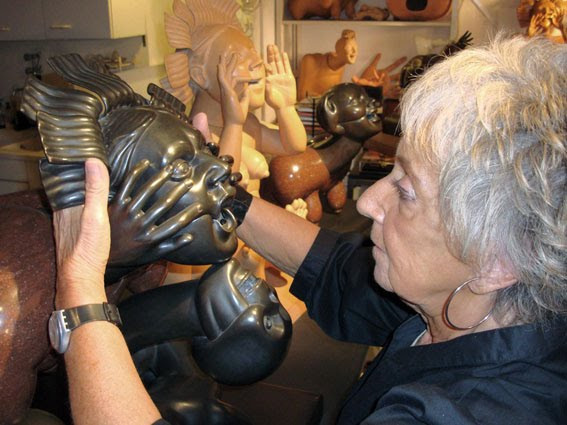
    I met Virginia Tentindo in 1997, when I joined the editorial board of the review Supérieur Inconnu, of which she was a member. I remember, on my first visit to her studio, in the company of Sarane Alexandrian, being struck by the convulsive beauty of this art, in direct contact with the Marvellous. Virginia always welcomed us with rare generosity and a thoroughly Argentine hospitality, like a “priestess of Tierra del Fuego” in her dreamlike sanctuary of terracottas, bronzes and marbles, her fauna and flora, all of it born of a most fertile imagination. In 1986 the Surrealist writer José Pierre described this studio as “the factory of the gods”. Virginia Tentindo’s sculptures, at once sensual and terrible, combine feline heads with the bodies of men and women, whose legs merge into a single one, long and flexible as a snake. These “humanimals”, as Sarane Alexandrian calls them, look like carnivorous plants. They are not hybrids of the kind made by artists given to easy unusual effects, for Virginia’s originality lies precisely in not making arbitrary assemblages. Julio Cortázar could thus write (in Voyage vers un temps pluriel) that with Virginia Tentindo “everything is or may be mandrake, Gorgon, hermaphrodite, phallic rite, hierogamy and why not epiphany”. For nothing is given on a single level, and the multiplicity of essences is, in several of her sculptures, like an invitation to come closer and touch; one then discovers that these pieces neither began nor ended at their visual outline, but that touch is there to open a second, low door. Tentindo’s art is never appearance but always interiority. It is as though, Cortázar writes again, “nature then questions its persistent monotony and seeks through art something more than the imitation Oscar Wilde assigns to it, a renewal capable of tearing us away from genetic routine. There, everything is substitution, completion and opening towards new constellations of forms.”

    Life

    Virginia Tentindo exhibited her first sculptures at sixteen and opened her own gallery in Buenos Aires at eighteen. She took part in the activities of the Buenos Aires Surrealist group and spent time with the Argentine Surrealists Juan Andralis, Julio Silva and Víctor Chab, disciples of the painter Juan Batlle Planas.

    Having settled in Paris in 1953, she joined the Paris Surrealist group and worked as a layout artist, graphic designer and book illustrator. For the cinema she recreated the Coronation of Napoleon in figurines for Abel Gance’s Austerlitz and made the doll burned by the heroine of Nelly Kaplan’s La Fiancée du pirate.

    She returned fully to sculpture in the 1970s and has since worked between her studios at the Bateau-Lavoir in Montmartre and in Pietrasanta, Tuscany. In 2011 a conference, “Chimères surréalistes”, was devoted to her in Florence, and Fabrice Maze dedicated the film Minimes innocences to her.

    The work

    Bronze, terracotta, ceramics, marble: her sculptures, sometimes large, mobile or transformable, stage myths, gods, demons and chimeras, under the sign of eroticism and dream. She also creates jewellery, made between 1978 and 1995 by lost-wax casting and reproducing her large pieces in miniature, as well as book-objects. Her Mandragore (1983) served as the trophy of the 36th Cannes Film Festival.

    El fuego! That is Virginia Tentindo: the tango of the Fire of life and passion; the Fire of desire and poetry; the Fire of metamorphosis and that of the alchemist who brings forth from his Athanor emotional gold in terracotta: an October Cat or a Lioness of the Earth-Moon days.

    Exhibitions and collections

    • Exhibitions in Bochum (1993), at the opening of the Musée de l’Érotisme in Paris (1997), in Venice (2006) and in Tokyo (2016), among others.
    • Nouveau Musée National de Monaco: Ci-gît le verbe (2020, sculpture) and Pour que l’histoire recommence (1980, drawing), acquired in 2022 after the exhibition Monaco-Alexandrie, le grand détour; jewellery shown at the Joya fair, Monte Carlo, 13 to 16 November 2025.
    • The Galerie Les Yeux Fertiles 25th anniversary exhibition, 22 May to 19 June 2026.
  • Claude Tarnaud

    Claude Tarnaud

    French poet and painter, born on 27 May 1922 in Maisons-Laffitte (Yvelines), died on 3 June 1991 in Avignon.

    Life

    During the Second World War, Claude Tarnaud discovered Surrealism and jazz, which helped him break free from a stifling mother. He then wrote the Journal du scorpion, a manuscript now lost. In 1946 he co-founded the review La Révolution la nuit with Yves Bonnefoy and Jaroslav Serpan, soon distanced himself from it, and met André Breton. He was then living in Paris with Claudine Merlin, known as Eaudine.

    A member of the Surrealist group from 1946 to 1948, close to Victor Brauner and Stanislas Rodanski, he took part in the 1947 International Surrealist Exhibition and in 1948 co-founded the review Néon with Rodanski, Sarane Alexandrian, Jindřich Heisler and Véra Hérold. He left the group the same year, during the Matta-Brauner affair, disagreeing with the expulsion of Roberto Matta.

    In 1951 he married Henriette de Champrel, known as Gibbsy, who would illustrate several of his texts, and settled in Geneva as a translator for the UN. His postings then took him to Mogadishu (1953-1959), Addis Ababa, New Delhi and New York, where he lived from 1959 to 1962; there in 1961, with Marcel Duchamp, he organised the exhibition Surrealist Intrusion in the Enchanters’ Domain at the D’Arcy Gallery, and in 1966 he helped bring about the Chicago Surrealist group, around Franklin and Penelope Rosemont. From 1953 to 1966 he took part in Édouard Jaguer’s Phases movement; with François Di Dio he edited the review Positions. He left the UN and in 1969 settled in Salignan, near Apt.

    The work

    A poet, Tarnaud was also a visual artist and maker of picture-objects. His first book, The Whiteclad Gambler, was self-published in Geneva in 1952. It was followed by, among others, La Forme réfléchie (Le Soleil noir, 1954, preface by Ghérasim Luca), Orpalée (1965, lithographs by Jean-Pierre Vielfaure), Les Cendres de l’eau (1974, drawings by Jacques Lacomblez) and, posthumously, L’Aventure de la Marie-Jeanne ou le Journal indien (2000, drawings by Jorge Camacho). He contributed to the reviews Edda, La Brèche, Phases and Supérieur Inconnu.

    Exhibitions and collections

    • André Breton archive: manuscript L’Iris tournoyant (16-17 February 1948) and letters from Tarnaud to Breton.
    • Donc te voilà nyctalope !, retrospective, Paris, 2009.
    • Surrealist Prelude, Galerie Les Yeux Fertiles, 7 June to 6 July 2024.

    At the gallery

  • Jan Švankmajer

    Jan Švankmajer

    Czech animation filmmaker and visual artist, born on 4 September 1934 in Prague.

    Life

    Jan Švankmajer studied stage design at the Higher School of Applied Arts in Prague (1950-1954), then directing and stage design in the puppetry department of the Theatre Faculty of the Academy of Performing Arts (1954-1958). After the Theatre of Masks, around 1962 he joined the Laterna Magika, where until 1964 he ran the black-light theatre company. His first film, The Last Trick, dates from 1964.

    He married Eva Dvořáková, the painter Eva Švankmajerová, with whom in 1970 he joined the Czechoslovak Surrealist group led by Vratislav Effenberger. From 1972 to 1979 he was banned from filming for refusing to give way over the editing of The Castle of Otranto, and worked at the Barrandov studios as a designer and special-effects maker. In 1991, with Jaromír Kallista, he founded the Athanor studio in a former cinema in Knovíz. Eva Švankmajerová died in 2005, shortly before the release of Lunacy.

    The work

    After many short films, including Dimensions of Dialogue, awarded the Golden Bear in Berlin and the Grand Prix at Annecy in 1983, he made his feature films: Alice (1988), Faust (1994), Conspirators of Pleasure (1996), Little Otik (2000), Lunacy (2005), Surviving Life (2010) and Insect (2018).

    In his visual work, collage has been central since the 1960s (the Svank-meyers Bilderlexikon, begun in the early 1970s). From 1974 he carried out tactile experiments, which he summed up in 1983 in a book circulated in samizdat, Touching and Imagination; tactile objects became one of the major parts of his work.

    Exhibitions and collections

    • Crystal Globe of the Karlovy Vary festival for his contribution to world cinema (2009).
    • The Subversion of Images, Galerie Les Yeux Fertiles, January to March 2025, with a Sans titre (2009, collage made from material for the film Surviving Life, 45 x 54 cm).

    At the gallery

  • Max Walter Svanberg

    Max Walter Svanberg

    Swedish painter, printmaker and illustrator, born in February 1912 in Malmö, died on 28 May 1994.

    Life

    Max Walter Svanberg first dreamed of becoming a violin maker. In 1929 he joined the advertising studio of the Palladium cinema in Malmö, attended the Skånska Målarskolan in 1931 and 1932, then, having been turned down by the Royal Academy of Fine Arts in Stockholm in 1933, Otte Sköld’s painting school. Struck by polio in the autumn of 1934, he first exhibited in 1935, at Ekström’s in Stockholm. In 1940 he married Gunni Sjöström, his companion since 1931, who died in 1982.

    In 1943 he exhibited with the Minotaur group at Malmö town hall, then founded the Imaginists group (Imaginisterna) with C. O. Hultén and Anders Österlin, for which he wrote declarations in 1949 and 1950. André Breton discovered his work in 1953: in 1954 issue no. 3 of the review Médium, which he illustrated, opened with Breton’s “Hommage à Max Walter Svanberg”, and in 1955 the Galerie À l’Étoile scellée exhibited him with a preface by Breton. He appeared in L’Art magique (1957), took part in the International Surrealist Exhibitions in Paris (Galerie Daniel Cordier, 1959), New York (1960) and Milan (1961), and only met Breton in 1964.

    He represented Sweden at the 8th São Paulo Biennial in 1965. He received the Prince Eugen Medal (1965), joined the Royal Swedish Academy of Fine Arts (1968) and received the Légion d’honneur in 1969.

    The work

    The female body, intermingled with plant and animal elements, is the central motif of his work. A painter, notably in gouache, he made prints from 1945, published an album of eight lithographs in 1950 and practised collage (a suite exhibited in 1964). He illustrated Rimbaud’s Illuminations (1958) and in 1970 designed the sets and costumes for Molière’s Le Misanthrope at the Royal Dramatic Theatre in Stockholm.

    Exhibitions and collections

    • Moderna Museet and Nationalmuseum (Stockholm), Malmö Museum, Göteborgs Konstmuseum; Tate Modern and British Museum (London); Museum of Modern Art (New York); National Gallery of Art (Washington).
    • Retrospective at the Göteborgs Konsthall (1967); memorial exhibitions at the Nationalmuseum and the Malmö Konstmuseum (1995); centenary in 2012.
    • Surrealist Prelude, Galerie Les Yeux Fertiles, 7 June to 6 July 2024, with a Sans titre (1960, gouache on paper, 45 x 37.5 cm).

    At the gallery

  • Ugo Sterpini

    Ugo Sterpini

    Italian painter, born in 1927 in Rome, died in October 2000 in Cavriago (Reggio Emilia).

    Life

    Trained at the Accademia del Nudo, Ugo Sterpini drew close to the abstract research of the Forma 1 group and took part in the international exhibitions of the Art Club of Rome. In 1951 he was included in Arte astratta e concreta in Italia at the Galleria Nazionale d’Arte Moderna in Rome, then joined the Origine group. He exhibited at the 8th Rome Quadriennale (1959) and, in 1962, at the Galleria La Nuova Pesa, in a solo exhibition conceived by Enrico Crispolti.

    André Breton welcomed him into the Surrealist movement. In 1964, with Fabio De Sanctis, he founded the Officina Undici, which produced Surrealist furniture until 1966. He also worked for the theatre in Rome and for cinema, notably with Elio Petri (A Quiet Place in the Country, 1968; Todo modo). In 1977, in Reggio Emilia, he came into contact with Fluxus through Rosanna Chiessi.

    The work

    After the cycle of Iterazioni cromatiche of the early 1950s, which broke with post-Cubist abstraction, then the Liste di simbolismi and the Sabbie (1955), Sterpini returned in 1959 to a highly material figuration. Then came the cycles of the Giardini and the Fantasia femminile (1966). From 1967 assemblage dominated (plastic objects, paintings in relief, drawings), and a character inspired by Max Ernst, the Pesce mummia (mummy fish), occupied his work until the end of the 1970s. The 1980s were marked by a cycle devoted to Pulcinella.

    Exhibitions and collections

    • CSAC, Centre for Communication Studies and Archives, University of Parma: gift of the artist (1998) and his heirs (2002).
    • Surrealist Prelude, Galerie Les Yeux Fertiles, 7 June to 6 July 2024.

    At the gallery