Author: admin

  • Lou Dubois

    Lou Dubois

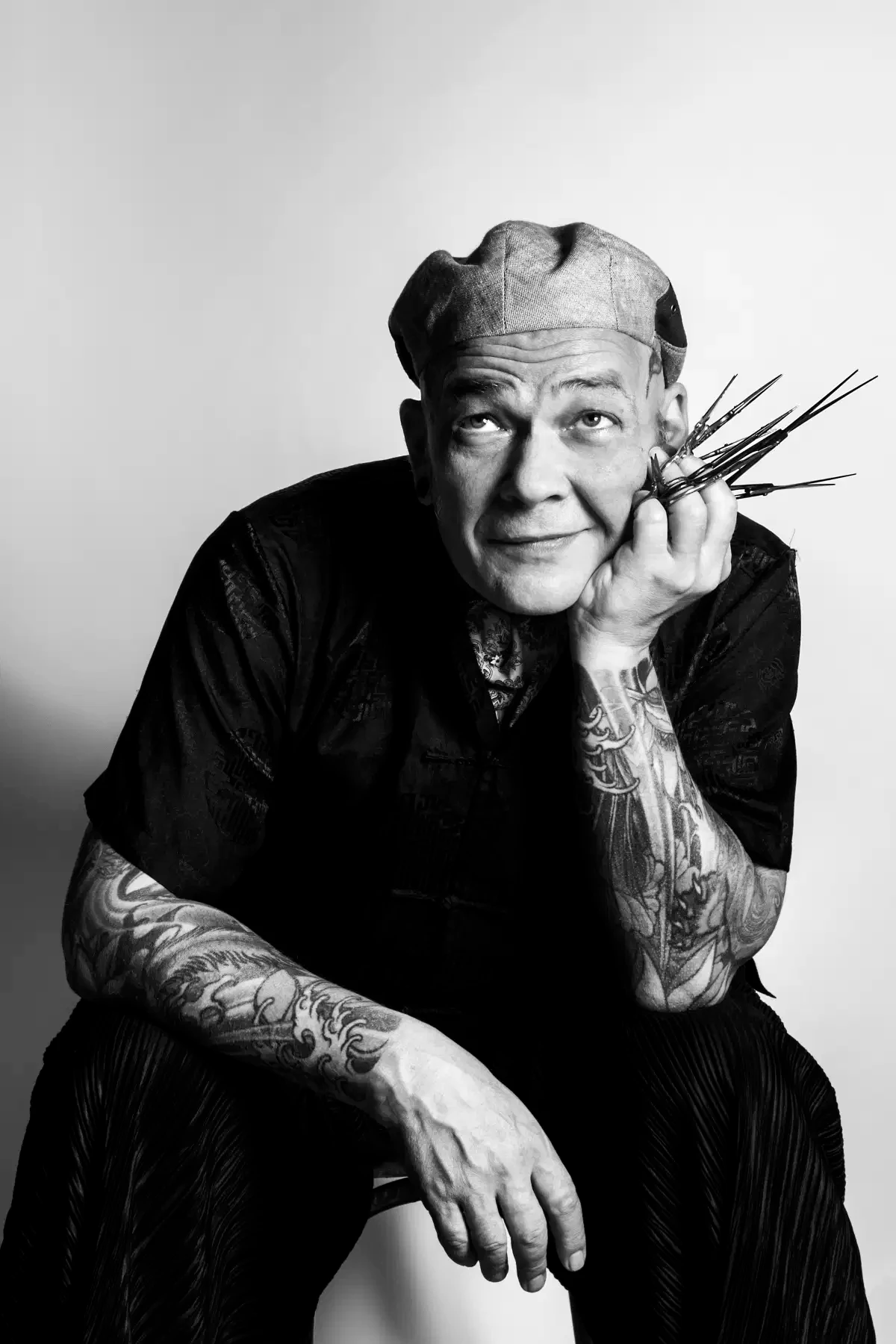
    Poet and visual artist, maker of collages, boxes and assemblages, based between Paris and Andalusia since 1982.

    The work

    An underrated entomologist, suffering from acute and incurable punnitis, young Lou Dubois went off to look elsewhere. Poet and artist, he opens worlds of infinite vastness in compressed cabinets of curiosities. Lou Dubois stands in the line of Max Ernst and Jacques Prévert: collages, boxes, trophies, assemblages. Each work is a microcosm in which, as in cabinets of curiosities, the viewer is led into a fabulous and disconcerting world that defies all bearings.

    Collage is first of all cutting. Edited like films, the images tip over into the great void and receive some sharply felt comments. He folds Lautré-amont for you into an umbrella, a sewing machine, an écorché and a few glasses. He shows a discreet and courteous eroticism but takes a dim view of mothers-in-law, decking them out with turgescent crucifixes and dangling sausages. Brains are occupied by inappropriate objects. A melancholy scholar, he amuses and moves with his brilliant tomfooleries. But the worst of it is that he cuts up children to make pictures of them.

    Serious again, he contributed to the late review Supérieur inconnu, and exhibits at the Galerie Les Yeux Fertiles. A poet in words and images, Lou Dubois has lived between Paris and Andalusia since 1982.

    Exhibitions

    • “Triscénoramas & Co”, December 2022 to January 2023, extended owing to its success; works shown: Triscénorama iconique (2022, 50 x 39.3 x 6 cm), Merci pour l’escargot (2021, 22.5 x 29.2 x 4.2 cm), Réouverture des Boîtes (2021, 52 x 34 x 10 cm), Cibo lichen si beau nombril de Vénus (2022, 39 x 26 x 5.2 cm), Le chant d’un argonaute (2022, 39 x 30 x 4.6 cm)
    • “At the Sources of Convulsive Beauty”, section “The permanence of the contemporary Surrealist gaze”, with Mr. Djub and Yoan A. Gil, 25 October to 30 November 2024
    • The gallery’s 25th anniversary exhibition, 22 May to 19 June 2026
  • Mirabelle Dors

    Mirabelle Dors

    Painter and sculptor of Moldavian origin, based in France from 1952, died in November 1999.

    Life

    Mirabelle Dors came from Moldavia in 1952 with the Romanian poet Ghérasim Luca, then her partner. Welcomed in Paris by André Breton, she settled first in Montmartre. Her date of birth, often given as 1913, remains uncertain; the sale catalogues that give her death as 1991 are mistaken.

    In the early 1950s she met the painter Maurice Rapin (1927-2000), whom she married in 1954. The couple settled in Vélizy-Villacoublay. Together they led artists’ collectives outside the official circuits, the Jeune Peinture and then Figuration critique, and from 1971 to 1980 co-signed joint publications with the Tendance populaire surréaliste led by Rapin.

    The work

    Her work fills space with masks, totems, dolls and chimeras. The “populations of images”, which recur throughout her work, are its most characteristic form; the auction house responsible for her studio describes this work as surreal, repetitive and “popular”. She worked in low and high relief, sculpture, mixed media, heightened collage and oil on panel or hardboard.

  • Yves Doaré

    Yves Doaré

    French painter and printmaker, born in 1943 in La Roche-Bernard (Morbihan). He lives and works in Quimper.

    Life

    Yves Doaré spent his childhood and went to school in Quimper. He exhibited in France from 1966. In 1969 and 1970 he attended evening classes at Jean Delpech’s printmaking studio in Montparnasse.

    From 1976 to 1978 he was a resident at the Casa de Velázquez in Madrid. He then pursued his career in Paris, then in Quimper, with solo exhibitions in Paris, Orléans, Rome, New York and Belgium.

    The work

    A printmaker first and foremost, Yves Doaré was largely self-taught in copper engraving in the 1970s. With burin and etching he built a fantastical imagery in which the lessons of Dürer and of Surrealism can be recognised. Having settled in Quimper in the early 1980s, he took up painting and developed an Expressionist style centred on the human body.

    From the 1990s he turned to woodcut: simpler images built around the sign, colourful narrative, a tone at once epic and full of humour. From one technique to another, his subject remains the human condition, from birth to death, confronted with landscapes, imaginary cities and primordial chaos.

    Public collections

    • Bibliothèque nationale de France, Paris
    • Musée d’Annecy
    • Musée de Morlaix
    • Fine Arts Museums of San Francisco
    • Centre de la gravure et de l’image imprimée, La Louvière (Belgium): Procession, 1994
  • Mr. Djub

    Mr. Djub

    French collagist, lives and works in Paris.

    Life

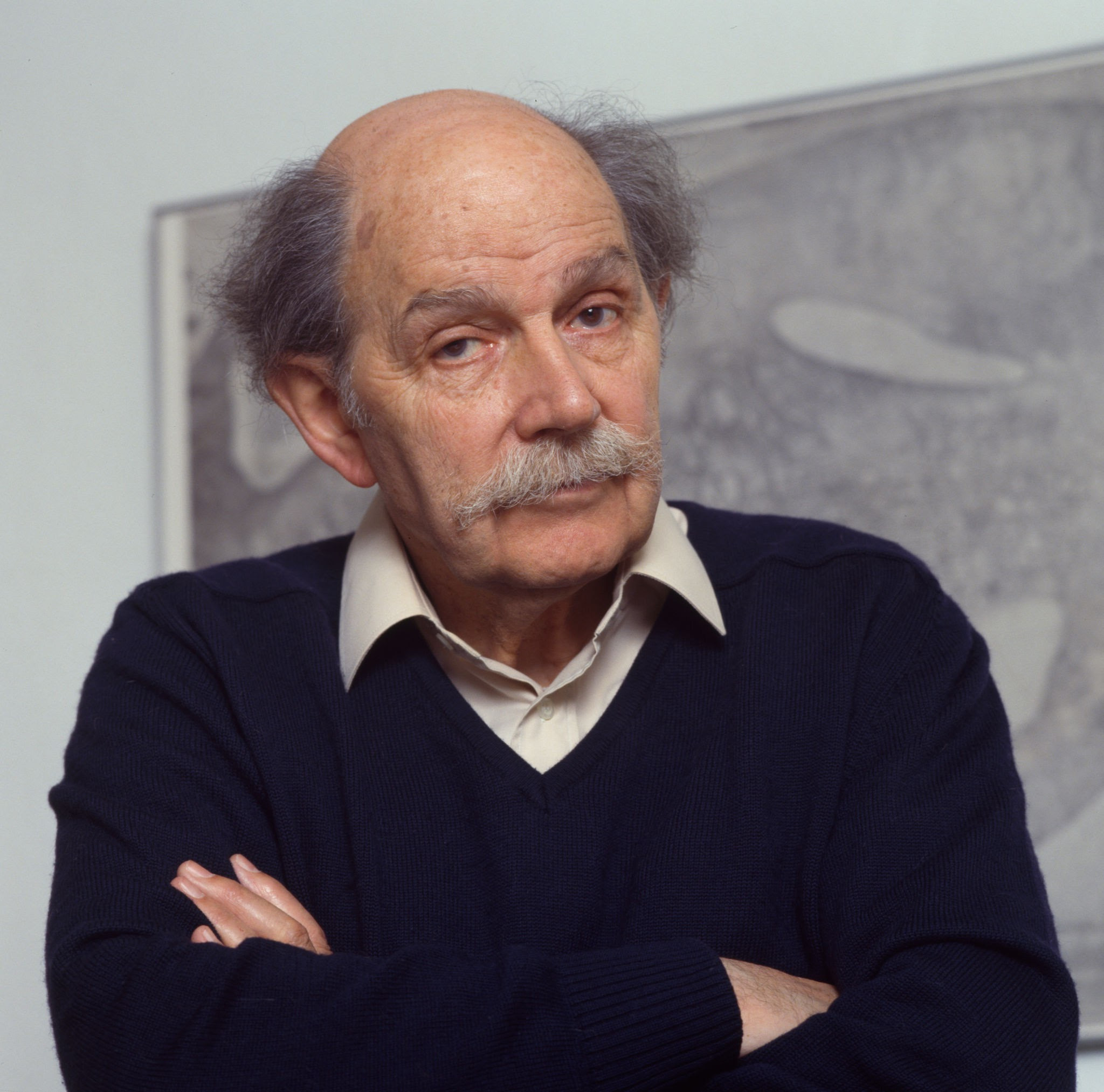
    Mr Djub lives and works in Paris (France). He made his first collages in 1983. Claude Roffat, recognised and respected for his work with French singular artists and founder of the reference review of Art Singulier and Art Brut L’Œuf sauvage, exhibited the artist in his Paris gallery at the very end of the 1980s. From 2010 Mr Djub made his collage technique more complex, deciding to create solely with “old papers”: engravings printed between 1840 and 1890 in popular publications covering art, culture, politics and news items. Seeking the truth of a weakened paper that is generally hard to preserve, his creations reject any gesture (reprography, colour rebalancing, ink highlighting) other than those imposed by a pair of scissors and a scalpel. Mr Djub is also Djubaka (music programmer for the national radio station France Inter) and one half of the activist duo Anne & Julien, founders of the art project HEY! modern art & pop culture in 2010.

    Text: Anne Richard

    The work

    “I made my first collage in 1983. I was fourteen, I was a punk, I made fanzines. It was a time when all layouts were made the traditional way… In France the punk and Situationist legacy was already well rooted. So collage was a natural practice, but applied above all to politics, in the spirit of the slogan. Collage has a fascinating history. Some trace it back to Charles Dufresny in the eighteenth century. For my part, I am emotionally connected to the Dadaists Raoul Hausmann, Hannah Höch and John Heartfield, and of course to the Surrealists, particularly Max Ernst: it is that precise period I am most attached to. Then I love the way Art Brut people moved things on by combining techniques, going from paper to objects to tell their stories. Collage is more a shared practice than a movement as such; it is a reality. On the other hand, one state of mind binds collagists together: the Stakhanovism of the business. They are all scalpel fanatics who want to make a new meaning, a mischievous diversion, spring from foreign material. And the real trick remains how far you are able to push the exercise. I also think one must know how to distinguish collagists from computer addicts and digital assemblage. I work only on newspapers published between 1840 and 1880, for reasons of coherence. One of the advantages of collage is precisely its lack of landmarks. In that sense no dogma confines its practice, so it has no defined school, and I love that, since I proudly claim to be self-taught, having been thrown out of the state education system at sixteen. Ernst said: ‘If it is the feathers that make the plumage, it is not the glue that makes the collage.’ In art, nothing can be reduced to a technique.” (Mr. Djub)

    Further reading: Les Mondes Promis, illustrations by Mr Djub, texts by Rosita Warlock (Éditions Rackham).

    Exhibitions

    • Galerie Les Yeux Fertiles: “At the Sources of Convulsive Beauty”, section “The permanence of the contemporary Surrealist gaze”, with Lou Dubois and Yoan A. Gil, 25 October to 30 November 2024 (closing event with “Le Mage Mr. Djub”)
    • Galerie Les Yeux Fertiles: “Charivari”, a small cabinet shown with “Didier Mazuru, Surrealist Fragmentations”, 5 June to 4 July 2025, alongside the exhibition “Paname” with the artist 13bis at the Galerie Roger-Viollet, 6 rue de Seine
    • Galerie Les Yeux Fertiles: the gallery’s 25th anniversary exhibition, 22 May to 19 June 2026
  • Fred Deux

    Fred Deux

    French draughtsman and writer, born on 1 July 1924 in Boulogne-Billancourt, died in 2015.

    Life

    Born into a working-class family, Fred Deux took evening classes at the Conservatoire national des arts et métiers and trained as an electrician. In 1943-1944 he joined a group of FTP partisans, then the Doubs maquis; after the Liberation he served with the Moroccan goums.

    From 1947 to 1949 he worked in Marseille at the Clary bookshop, where he discovered Surrealist literature and became involved with Les Cahiers du Sud. In 1948 a Paul Klee catalogue sparked his first “stains” on paper. Having settled in Paris in 1951, he met Cécile Reims, who became his partner, as well as André Breton and Hans Bellmer. Jean Cassou wrote a text on his drawings. He exhibited in 1952 at the Galerie À l’Étoile scellée, then alone in 1953 at the bookshop-gallery Le Fanal (“La Fenêtre des yeux”), before distancing himself from the Surrealist group in 1954.

    In 1958, under the pseudonym Jean Douassot and with the support of Maurice Nadeau, he published La Gana, an autobiographical novel. The couple settled in the Ain, at Corcelles then Lacoux, and in 1971 founded a contemporary art centre; in 1985 they settled in La Châtre, in the Indre. From 1975 Cécile Reims engraved Fred Deux’s drawings.

    The work

    The first stains (bicycle paint, inks, prints on fabric) were followed by black or coloured Indian ink heightened with watercolour, then graphite on pearlescent Japan paper and coloured pencils. Fred Deux also made some forty “unique books” combining drawings and handwritten texts. The series of “coloured sperms”, in the early 1970s, combines graphite and cellulose paint: La Membrane (1972), L’Inexistence (1973), L’Élan (1974).

    As a writer he published, among others, Sens inverse (1960), La Perruque (1969), Lettres à mon double (1983) and Terre mère (1999), as well as a spoken autobiography, À vif (1994).

    “The years are counted in drawings.” (Fred Deux, Le Don, 2007)

    Exhibitions and collections

    • “Fred Deux, L’alter ego”, Centre Pompidou, Paris, 10 April to 14 June 2004, some eighty drawings from the artist’s donation to the Musée national d’art moderne
    • “Fred Deux. Le For intérieur”, Musée Jenisch, Vevey, 20 February to 25 May 2015
    • Collections: Musée national d’art moderne, Centre Pompidou; Musée Jenisch, Vevey; Musée de l’Hospice Saint-Roch, Issoudun
    • The Galerie Les Yeux Fertiles represented Fred Deux exclusively from 1999 until his death in 2015. During the exhibition “Drawing, the Unknown” (2025), Jean-Jacques Plaisance presented De l’autre le cristal, a unique book by Fred Deux from André Breton’s collection. La fin n’est pas la fin (1974) was included in “The Subversion of Images” (2025)
  • Philippe Dereux

    Philippe Dereux

    French creator, born in 1918 in Lyon, died in 2001, known for his peelings pictures.

    Life

    Philippe Dereux was born into a modest family of small shopkeepers. A primary school teacher by training, he taught at a school in Villeurbanne until his retirement in 1973.

    In the summer of 1955, in Vence, he met Jean Dubuffet. He collected butterflies for him and helped him make his assemblages of butterfly wings and leaves. In 1959 he began composing his own works from plant residues.

    The work

    Dereux made abstract and decorative compositions, but also portraits, from fruit and vegetable peelings and assorted seeds. He coloured them with walnut stain, oil or gouache. In 1966 he published, with Julliard, the Petit Traité des épluchures (Little Treatise on Peelings), in which he set out his approach.

    Among his works: Paris la nuit (1973), paint on a collage of peelings on panel, 64 x 48.5 cm; L’Idole aux mains tendues (1973), acrylic and collage on wood, 73 x 52 cm.

    Exhibitions

    • Galerie Les Yeux Fertiles: “Favourites. Art Brut, Naive Art, Art Singulier”, 15 March to 13 April 2024, including Paris la nuit (1973)
  • Gabriel Der Kevorkian

    French painter of Armenian origin, born in 1932 in Paris.

    Life

    Gabriel Der Kevorkian joined the Surrealist group in the mid-1960s and remained a member until 1969. He took part in the International Surrealist Exhibition “L’Écart absolu” in 1965 and published in the reviews La Brèche (1964-1965) and L’Archibras (1969).

    After the Paris group dissolved, he continued the adventure with the Surrealists gathered around the Bulletin de liaison surréaliste (BLS), in whose contents he appears in 1973 and 1976, then the review Surréalisme (1977). He also took part in the Phases movement. In 1973 a solo exhibition at the “Aaa” gallery was prefaced by Jean-Louis Bédouin, Jean Benoît and Vincent Bounoure; in 1975 he was included in the group exhibition “Armes et bagages”.

    The work

    The critical commentary collected by the Mélusine database places his painting under the sign of a humour that “wrings the neck of eloquence”.

    Exhibitions

    • “L’Écart absolu”, International Surrealist Exhibition, Paris, 1965
    • Solo exhibition, “Aaa” gallery, 1973
    • “Armes et bagages”, 1975
    • Galerie Les Yeux Fertiles: “Surrealist Prelude”, 7 June to 6 July 2024

    At the gallery

  • Irena Dedicova

    Painter of Czech origin, born Irena Dědičová on 12 February 1932 in Prague, died in 1990 in Paris.

    Life

    Irena Dedicova belonged to the orbit of Surrealism and of the Phases movement led by Édouard Jaguer, in which she took part notably at the Phases exhibition in Ixelles (Belgium) in 1974. She appears in the review Arsenal and in several group exhibitions devoted to Surrealism and the fantastic, among them “Surrealismus in Europa” and “Le Fantastique contemporain”.

    In 1977 the Maison de la culture et des loisirs in Saint-Étienne-du-Rouvray devoted the exhibition “Irena Dedicova: peintures 1967-1977” to her (7 April to 8 May), with a catalogue. It included Les Vases communicants II (1974), Le Crépuscule des dieux and Machine à ombres (1975), Deux soleils, Rêve d’un paysage and New York III (1976).

    Exhibitions

    • Phases exhibition, Ixelles, 1974
    • “Irena Dedicova: peintures 1967-1977”, Maison de la culture et des loisirs, Saint-Étienne-du-Rouvray, 1977
    • Galerie Les Yeux Fertiles: “Surrealist Prelude”, 7 June to 6 July 2024

    At the gallery

  • Louis Auguste Déchelette

    Self-taught French painter, born in 1894 in the Lyon area, died in 1964.

    Life

    Louis-Auguste Déchelette drew from childhood. A plasterer and house painter, he travelled around France as a journeyman (compagnon) between the ages of sixteen and thirty-one. Supported by Georges Henri Rivière, he was exhibited twice during the war by Jeanne Bucher, who showed his clandestine so-called “resistance” paintings. After the war Jean-François Jaeger exhibited him several times between 1947 and 1960.

    The State bought some ten canvases from him between 1943 and 1965, including Église Saint-Étienne-du-Mont. Paris, acquired in 1949, the very year it was painted, and now in the Musée national d’art moderne.

    The work

    Déchelette painted mainly allegories on social and political subjects, served by puns and a very lively humour. His paintings of the Occupation denounce Fascism, Nazism and, more broadly, social conflict; Nonchalant was painted in 1943, at the height of the resistance to Nazism in Paris. In 1949 he painted a wedding in front of the façade of Saint-Étienne-du-Mont (oil on canvas, 92 x 65 cm).

    Exhibitions and collections

    • Galerie Jeanne Bucher, Paris, two exhibitions during the Second World War
    • Galerie Jeanne Bucher, under the direction of Jean-François Jaeger, several exhibitions between 1947 and 1960
    • “Compagnons de route”, Galerie Jeanne Bucher Jaeger, Paris, 23 May to 20 July 2019
    • Collections: Musée national d’art moderne, Centre Pompidou (Église Saint-Étienne-du-Mont. Paris, 1949)
  • Adrien Dax

    Adrien Dax

    French painter, theorist and writer, anarchist and Surrealist, born on 27 October 1913 in Toulouse, died on 29 August 1979 in the same city.

    Life

    Adrien Dax drew close to the Surrealist group in 1947 and became a member in 1950, remaining until 1969. By February 1949, André Breton already kept in his library a handwritten text by Dax on Malcolm de Chazal, slipped into a copy of Sens-plastique and annotated in his own hand: “Communicated by Adrien, February 1949”.

    His name appears on the movement’s collective tracts from the post-war years to the end of the 1960s. He contributed to many reviews: Néon (1949), the Almanach surréaliste du demi-siècle published by La Nef (1950), L’Âge du cinéma (1951), Le Libertaire and La Rue (1952), Médium (1953-1955), Le Surréalisme, même (1956-1959), Bief, La Brèche, L’Archibras (1968-1969), then Coupure (1970). He also took part in Édouard Jaguer’s Phases movement.

    In 1960 he signed the Declaration on the Right to Insubordination in the Algerian War, known as the Manifesto of the 121.

    The work

    Dax was the discreet inventor of two techniques derived from automatism: the “relief print” (impression de relief) and the “interpreted poster” (affiche interprétée). In the 1970s he illustrated Jean Malrieu’s Le Château cathare (1972) and took part in the collective publications of Éditions Maintenant, including Lecture en blanc (1974) and Objets d’identité (1976).

    Exhibitions

    • “Mostra surrealista”, Milan, 1961
    • “Solstice de l’image” (1961) and “La Cinquième Saison” (1962), Galerie Le Ranelagh, Paris
    • Phases exhibitions, Buenos Aires (1963) and São Paulo (1964)
    • “L’Écart absolu”, International Surrealist Exhibition, Paris, 1965
    • “A Phala”, São Paulo, 1967
    • Galerie Les Yeux Fertiles: “Surrealist Prelude”, 7 June to 6 July 2024

    At the gallery