Author: admin

  • Isabelle Jarousse

    Isabelle Jarousse

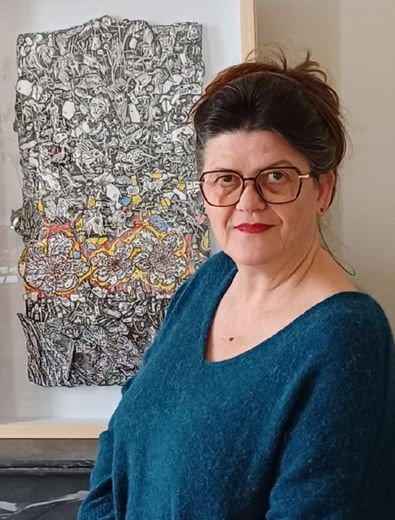
    French draughtswoman, born in 1964.

    The work

    Isabelle Jarousse draws in Indian ink on paper she makes herself, from pure rag pulp. The Centre Pompidou holds several of her works, which entered the collection in 2010 with Daniel Cordier’s donation and are on deposit at Les Abattoirs in Toulouse, including a Sans titre dated 31 May 2005 (Indian ink on pure rag paper pulp, 14 x 14 x 2 cm).

    She describes her work as follows:

    “My drawings are made up of animals, plants, human beings, but also abstract forms such as strokes, dots and curves, a graphic alphabet that evolves over time. I make the paper on which I draw meticulously, slowly, with a brush full of black ink. On this white matter, a knotted, hollow or flat matrix, I inscribe my writing, I structure my language, I obey creation. Immaculate white, slightly glossy, wet folds, voluptuous matter. To exist for an instant, in the desire to be reborn, to live despite the ‘failures’. New drawings cover the older ones; several layers are thus added to the original support, palimpsests of a writing repressed, rejected, corrected, worked to saturation.” (Isabelle Jarousse)

  • Vojislav Jakić

    Vojislav Jakić

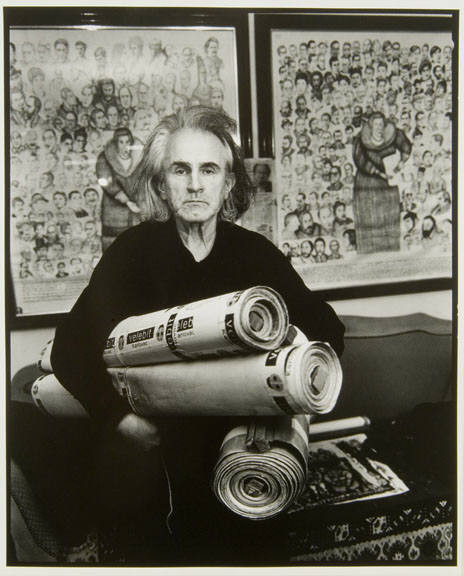
    Serbian Art Brut draughtsman, born in 1932 in Veliki Radobilj, near Bitola (Macedonia), died in 2003.

    Life

    The son of an Orthodox priest from Montenegro, he grew up in a very religious and strict household. Around 1935 the family moved to Despotovac, a small town in central Serbia. Before he was eight he lost his elder sister and younger brother, carried off by diphtheria and scarlet fever; on his father’s death he lived with his mother in great poverty, on her pension alone. As a child he watched his father conduct the funerals of the dead brought to the church. At eight he drew a Portrait of the Mother; as a teenager he earned a little money by making portraits of the deceased for their families.

    At around twenty, in 1952, he left for Belgrade to study drawing and sculpture, but the school served mainly as a shelter for the night. He frequented studios and tried to exhibit, without success: a provincial artist, untrained and penniless, he found the doors closed. After about five years he went back to live with his mother, and later married.

    The work

    He drew in ballpoint pen, gouache, ordinary pencils and wax crayons. From 1970 he made large formats, including scrolls more than fifty metres long. His very dense compositions are peopled with insects, embryonic figures and human beings.

    Exhibitions and collections

    • 1979: solo exhibition, Collection de l’Art Brut, Lausanne (13 June to 16 September)
    • Collection de l’Art Brut, Lausanne: notably Les effrayants insectes cornus (1970) and Svetogrde II (Sacrilège II) (2002)
  • Édouard Jaguer

    Édouard Jaguer

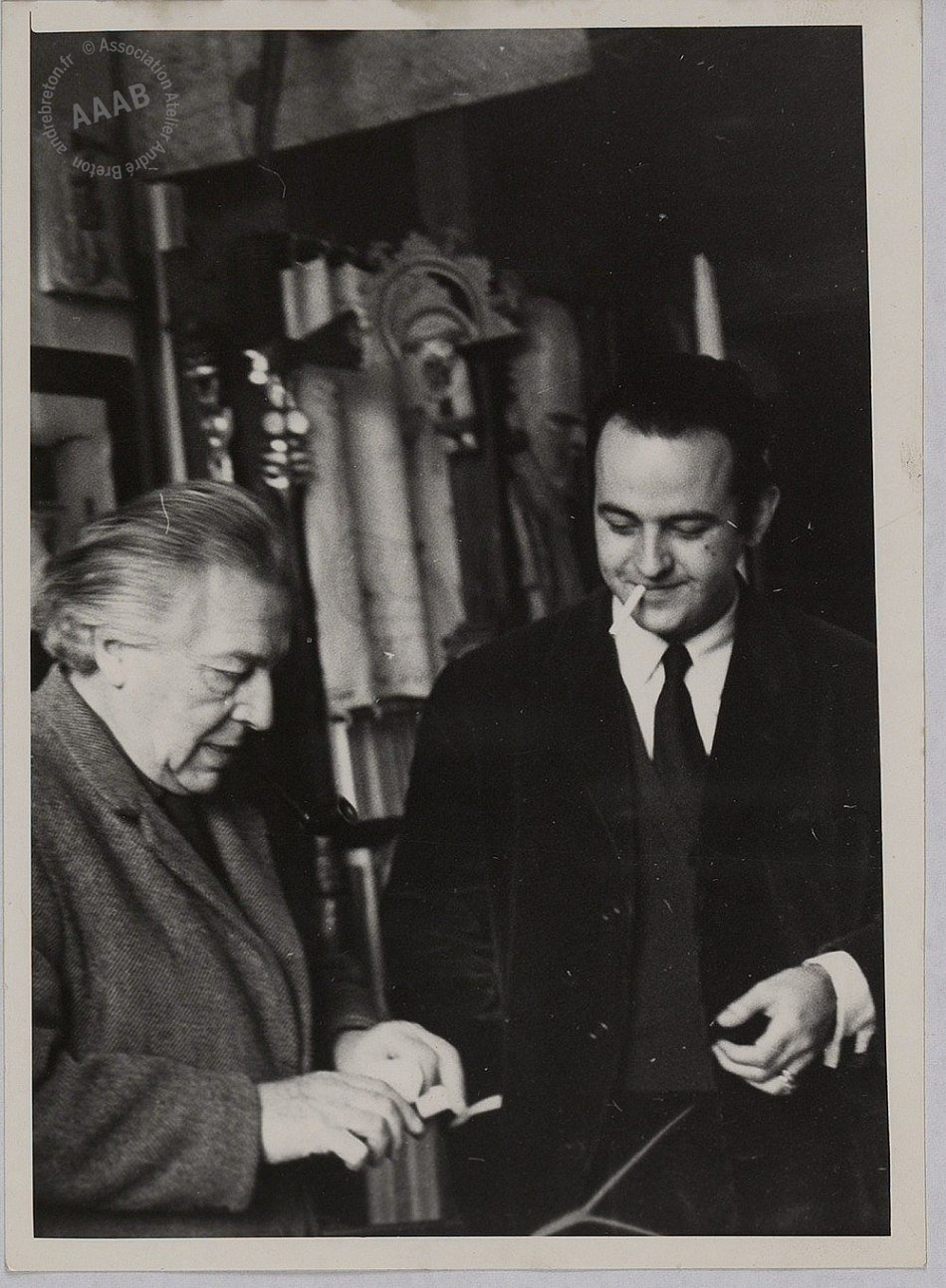
    French poet, art critic and draughtsman, born Édouard Petit on 8 August 1924 in Paris, died on 9 May 2006 in Paris. Founder of the review and movement Phases.

    Life

    In 1937 he discovered Surrealism and non-figurative painting, and in 1939 began to draw and write. His first poems appeared in 1943 in the semi-clandestine review La Main à plume. After the war he worked with Yves Bonnefoy on La Révolution la nuit and, in Brussels, on Christian Dotremont’s Les Deux Sœurs. From 1948 to 1951 he was the French editor of the review Cobra; in 1949 he co-founded the review Rixes with Max Clarac-Sérou and Jaroslav Serpan.

    The end of Cobra and Rixes in 1951 led him to gather their artists around a new project, conceived with his wife, Anne Éthuin. The title Phases was chosen in 1953 and the first issue appeared in 1954. Around the review an international movement formed, bringing together young abstract painting and post-war Surrealism: Pierre Alechinsky, Camille Bryen, Corneille, Asger Jorn, Karl Otto Götz, Henri Goetz, Enrico Baj and many others. Jaguer coordinated its exhibitions and publications in many countries; Jacques Lacomblez established it in Belgium in 1956, and sister reviews were born in Malmö, Milan, Brussels and Buenos Aires.

    From 1959 he drew close to André Breton and took part in the activities of the international Surrealist movement; with him he co-organised the exhibition “Surrealist Intrusion in the Enchanters’ Domain” in New York (1960). Phases moved away from it in 1963. In 1960 Jaguer signed the Manifesto of the 121 on the right to insubordination in the Algerian War. The review ceased publication in 1975, but the group continued its exhibitions and publications until its founder’s death.

    The work

    As a poet he published, among others, La Poutre creuse (1950), La Nuit est faite pour ouvrir les portes (1955), Le Mur derrière le mur (1958) and L’Envers de la panoplie (2000). As a critic he wrote Les Mystères de la chambre noire (Flammarion, 1983), devoted to Surrealist photography, Le Surréalisme face à la littérature (1989) and Cobra au cœur du XXe siècle (Galilée, 1997), as well as monographs on Alechinsky, Baj, Joseph Cornell, Lacomblez, Perahim, Oelze and Remedios Varo.

    Exhibitions and collections

    • At the gallery, 2024: his works were included in “Surrealist Prelude” (7 June to 6 July); a section “Édouard Jaguer and the international Phases movement” of the exhibition “At the Sources of Convulsive Beauty” (25 October to 30 November) brought together works by Guido Biasi, Jacques Lacomblez, Jules Perahim, Philip West and Ludwig Zeller

    Looking back at their exhibitions

  • Daisuke Ichiba

    Daisuke Ichiba

    Japanese draughtsman and painter, born in 1963. He lives and works in Tokyo.

    Life

    Daisuke Ichiba began painting seriously in the 1980s. In 1990 he self-published his first book, 37 Year Old Bastard, and has since published roughly one book a year, outside mainstream publishing and institutional circuits. His work caught the attention of the manga artist Takashi Nemoto and of Pakito Bolino of the Marseille workshop Le Dernier Cri. He is shown by several galleries in France and the United States.

    The Galerie Arsenic devoted a first major monograph to him, Daisuke Ichiba, l’art d’équilibrer les dissonances, with a preface by Philippe Dagen and a long analysis by Xavier-Gilles Néret, who places his work between the Japanese and French underground graphic scenes.

    The work

    Trained in printmaking, he mostly draws in black, keeping colour for a few details. His images, at once violent and delicate, draw on Japanese folklore (supernatural creatures, samurai), horror cinema, otaku countercultures, manga, Art Brut and collage. Schoolgirls grappling with monsters, decomposing or beheaded bodies, ghosts, three-eyed or headless hybrid beings: youth and sex mingle there with corruption and death. He himself says he projects into them “chaos, anarchy, anguish, the grotesque, the absurd and the irrational”.

  • Stanislav Holas

    Czech mediumistic draughtsman (1905-1989), from the spiritualist circle of South Moravia.

    Life

    A cooper by trade, he was also a policeman. He drew for almost his whole life, alternating long pauses with very fertile periods; the most prolific followed his wife’s death in 1969. His drawings were shown in several spiritualist exhibitions, including one in New York in 1937.

    The work

    His first drawings, around 1920, are still figurative. In the 1940s figuration disappeared in favour of vibrating objects in delicately graded warm colours, or round, undulating forms. Some sheets bear spiritualist writings. A series of the 1960s draws on the ornaments of South Moravian folk costume. He worked notably in graphite on paper.

  • Josef Hofer

    Josef Hofer

    Austrian Art Brut draughtsman, born in 1945 in Wegscheid (Bavaria), in the last weeks of the Second World War. He lives and works in Ried im Innkreis (Upper Austria).

    Life

    Physically and mentally disabled and almost totally deaf following ear infections, Josef Hofer never went to school or learned sign language. He grew up with his parents and his brother, also disabled, on a small farm in the north of the Mühlviertel, in Upper Austria. In 1982, a few years after his father’s death, the family moved to Kirchschlag. From 1985 he spent his days at a centre run by the Lebenshilfe association in Linz, and since 1992 he has lived in a residence run by the same association in Ried im Innkreis.

    In 1997 he met the art historian Elisabeth Telsnig, who runs a drawing workshop in Ried and became his mentor. It is through her gifts that the Collection de l’Art Brut in Lausanne has gathered some hundred of his works. He often signs with the nickname “Pepi”.

    The work

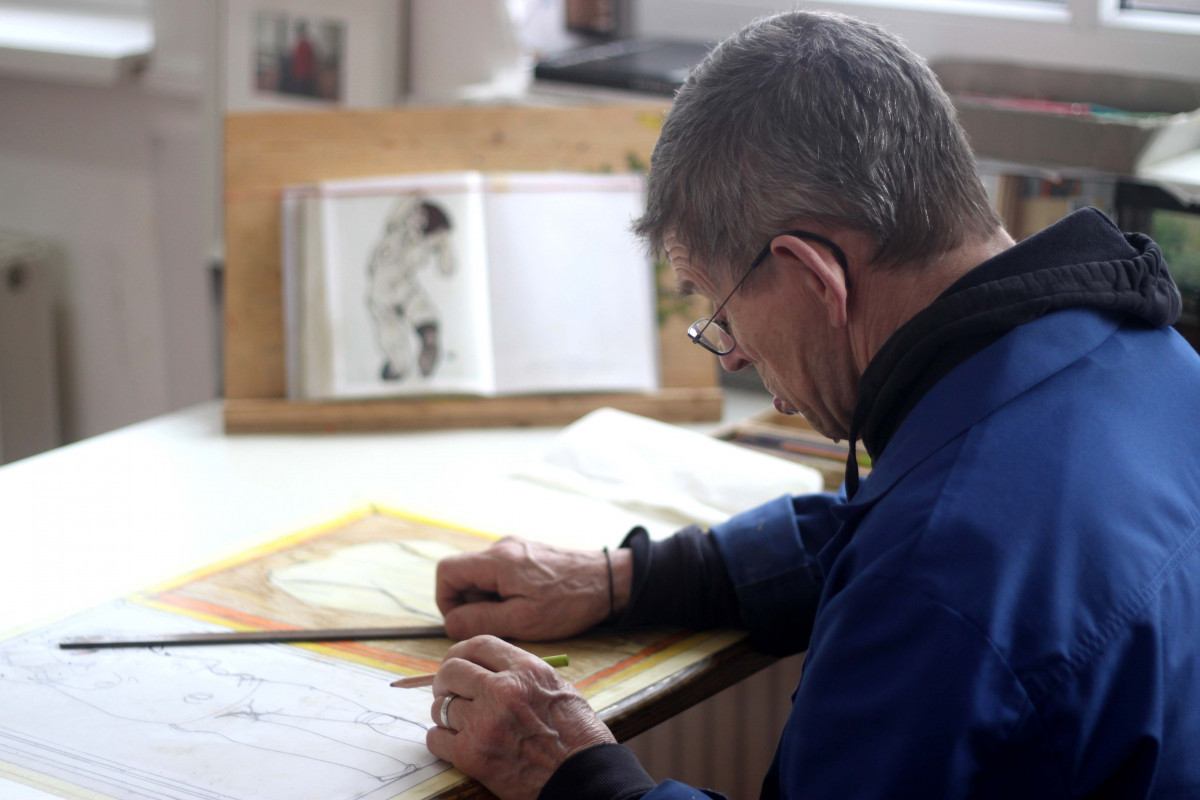
    He draws in graphite, tracing his lines along a wooden stick that serves as a ruler, then in coloured pencils. He works very slowly. His central subject is the male figure, almost always naked, and sexuality, depicted without euphemism: self-portraits, often fragmented, deprived of a head or lower limbs. A mirror placed on the floor opposite his bed, in which he observes himself for hours every day, becomes in his drawings a large rectangular frame around the figures. These frames appeared in 2002, became systematic in 2003 and filled the whole sheet by around 2011; he colours them in constant hues, preferably orange and yellow. He also draws horses, objects from his surroundings and, later, female nudes.

    Exhibitions and collections

    • 2003: first solo exhibition, Collection de l’Art Brut, Lausanne
    • 2004: euward prize
    • 2011-2012: “alter ego”, Galerie christian berst, Paris; Galerie am Stein, Schärding
    • 2012: “Josef Hofer et le miroir”, Collection de l’Art Brut, Lausanne (some fifty drawings, curated by Sarah Lombardi)
    • Collections: Collection de l’Art Brut, Lausanne; Centre Pompidou (Bruno Decharme donation, 2021); The Museum of Everything; Arnulf Rainer, Hannah Rieger and Treger-Saint Silvestre collections
  • Yoshiko Hirasawa

    Yoshiko Hirasawa

    Japanese painter based in Paris, known as Yoshiko (Hirasawa Yoshiko, 平沢淑子).

    Life

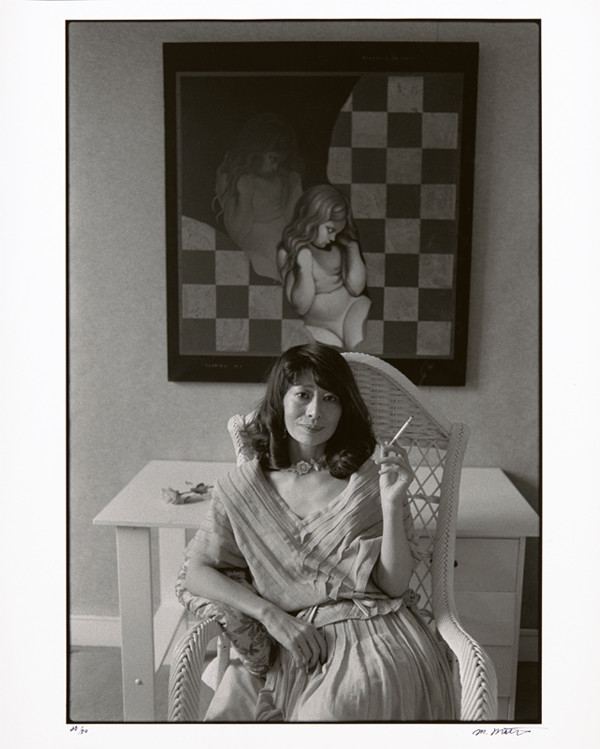
    At first a presenter on the Japanese public broadcaster NHK, she gave up this career and moved to Paris in 1974 to devote herself to painting. There she exhibited notably in 1980 at the Galerie Le Triskèle, then in the United States, Russia, Egypt and Japan. In 1985 the photographer Michiko Matsumoto photographed her in Paris for her series of portraits of women artists, now held at the Tokyo Photographic Art Museum.

    Exhibitions and collections

    The gallery showed her canvases in the exhibitions marking the centenary of Surrealism: “Surrealist Prelude” (7 June to 6 July 2024), then “The Subversion of Images” (24 January to 8 March 2025), with Pour Rodogune, 1986, oil on canvas, 110 x 100 cm.

  • Jacques Hérold

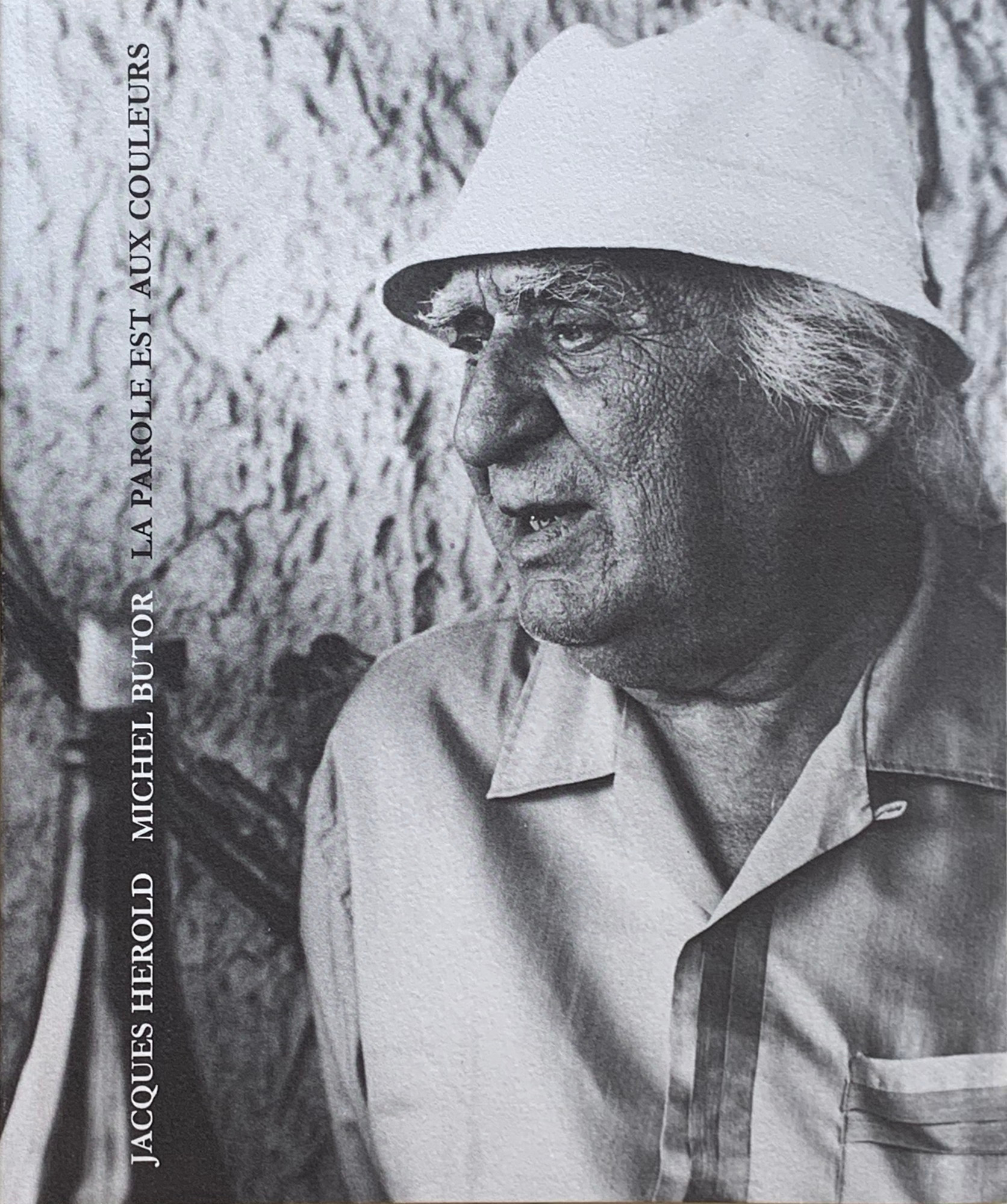
    Jacques Hérold

    Romanian-born French painter, sculptor and illustrator, born Herold Blumer on 10 October 1910 in Piatra Neamț (Romanian Moldavia), died on 11 January 1987 in Paris.

    Life

    Born into a Jewish family, he spent most of his childhood in Galați, a port on the Danube. From 1925 to 1927 he studied at the École des beaux-arts in Bucharest, against his father’s wishes. In 1928 he discovered Surrealism through the young poets of the review Unu, who published his first drawings alongside those of Victor Brauner.

    He reached Paris by sailing up the Danube, in 1929 according to Alain Jouffroy, in 1930 according to other sources, and took the name Jacques Hérold. He worked for Constantin Brâncuși, cooking for him, and met Marcel Duchamp, Man Ray and James Joyce in his studio. Introduced to Yves Tanguy, who became a friend, he joined André Breton’s group through him, took part in its games and spent time with Brauner and Giacometti.

    His first solo exhibition took place in 1947, the year of the International Surrealist Exhibition. He left Breton’s group in 1951. In 1958 he published Maltraité de peinture and received the Copley Foundation prize the same year. The Tate Gallery exhibited his work in 1959, the Abbaye de Royaumont devoted a monographic exhibition to him in 1972, and he took part in the Venice Biennale in 1986.

    The work

    During his Surrealist period, Hérold sought to connect pictorial representation with the world of crystal. His sculpture Le Grand Transparent (1946-1947) combines bronze, mirror and quartz crystals. After 1951 his painting moved towards an abstraction linked to Lyrical Abstraction and Tachism. He illustrated or designed the covers of more than eighty books, by Gherasim Luca, Tristan Tzara and Sade, among others. He said:

    “Painting is like love: it can only be done in intimacy.” (Jacques Hérold)

    Exhibitions and collections

    • Loans from the gallery: Le Grand Transparent, 1946-1947, bronze, mirror and quartz crystals, 183 x 92 x 53 cm, no. 1/6, Susse foundry cast 1971, signed on the base, shown in “À flanc d’abîme : surréalisme et alchimie” (Maison André Breton and Espace Rignault, Saint-Cirq-Lapopie, 2023), then in “Dreamworld: Surrealism at 100” (Philadelphia Museum of Art, November 2025-February 2026)
    • Public collections: Centre Pompidou, Paris (Le rouge en flamme, le noir en voûte, 1947); Musée d’Art moderne de Paris; Musée Cantini, Marseille; Musée d’Art moderne de Céret; Museum of Modern Art, New York; Royal Museums of Fine Arts of Belgium, Brussels; Israel Museum, Jerusalem
  • Karel Havlíček

    Karel Havlíček

    Czech draughtsman, born in 1907 in Berlin, died in 1988 in Kadaň (Bohemia).

    Life

    He grew up in a family of artists: his father, Karel Havlíček, was a painter and theatre designer, and his cousin, the architect Josef Havlíček, was connected with the Prague Surrealists. After school in Berlin he followed his parents to Prague in 1923, finished secondary school, then the law faculty of the German University in Prague, where he obtained his doctorate in 1934.

    From 1936 to 1949 he was a lawyer and police official in several Bohemian towns, and headed the regional police in Kadaň. Removed after the Prague coup of 1948, he was arrested twice by the secret police between 1949 and 1955. He then worked as a draughtsman and painter in a porcelain factory in Klášterec nad Ohří (1949-1955), then as a labourer in ceramics, a quarry and construction until 1970.

    In 1945 he decided to devote his life to drawing and from November imposed on himself a daily practice, in the evenings, which he kept up for decades. The theorist Karel Teige devoted a long analysis to him; the exhibition he was preparing for him in 1948 was banned. Under the Communist regime his work was hardly shown, championed by a few close friends such as Teige, Vratislav Effenberger and Ivo Pondělíček. His first solo exhibition took place in 1963, at the Mánes hall in Prague. The municipal gallery in Kadaň now bears his name.

    The work

    He drew mostly in black and white, in pencil and graphite, sometimes in coloured pencils: one dominant motif per sheet, with titles that steer the meaning of the image. In them he deployed a personal mythology of dreamlike creatures, plants and monsters, on the side of the monstrous and the grotesque. Teige partly likened his work to Art Brut. An exhibition at the Wilhelm Lehmbruck Museum in 1998 presented his drawings under the title Imaginäre Skulpturen (imaginary sculptures).

    Exhibitions and collections

    • 1963: first solo exhibition, Mánes hall, Prague
    • 1980: Museum moderner Kunst, Vienna; 1983 and 1985: Museum Ludwig, Cologne; 1991 and 1998: Wilhelm Lehmbruck Museum, Duisburg
    • 2002: “L’art brut tchèque”, Halle Saint-Pierre, Paris; 2004: “abcd, une collection d’art brut”, Pavillon des arts, Paris
    • Collections: Muzeum umění Olomouc; Centre Pompidou, Musée national d’art moderne (Bruno Decharme donation, 2021)
  • Guy Harloff

    Guy Harloff

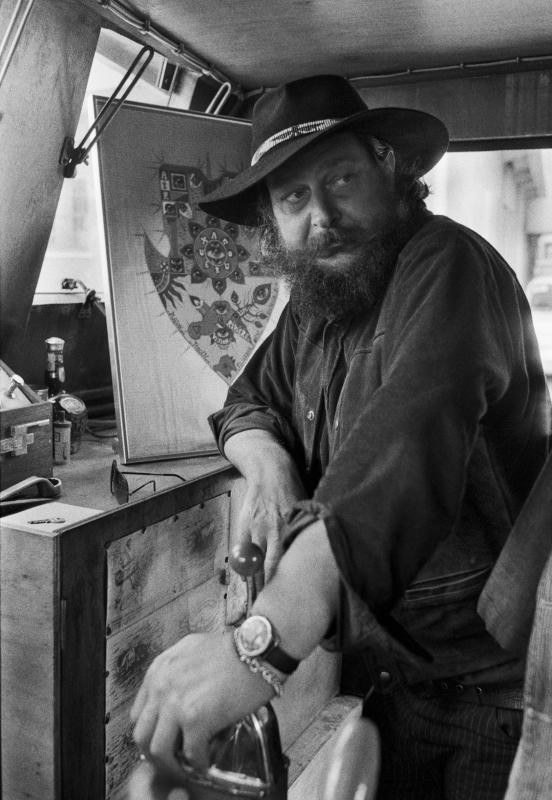
    Painter, draughtsman and collagist, born on 4 June 1933 in Paris, died in 1991 in Galliate (province of Novara, Italy).

    Life

    As a child he travelled around Europe with his parents, then grew up in Paris, which he left as a teenager, abandoning family and studies. In 1950 he settled in Rome and worked at the Centro Sperimentale di Cinematografia; passionate about cinema, he worked with Vittorio De Sica and made two short films that remained unreleased until 2019. In the early 1950s he began to draw, close to Surrealism, and composed collages from salvaged materials.

    In Rome he met the writers of the Beat Generation (Allen Ginsberg, Peter Orlovsky, Gregory Corso, William Burroughs) and developed a passion for jazz; he was later to spend time with Ornette Coleman and Charles Mingus. In 1959-1960 he was supported in Italy by Carlo Cardazzo and Arturo Schwarz. He travelled in the Persian Gulf, lived for a time in Morocco and journeyed through Africa as far as Sudan. In the early 1960s, in Milan, he mixed with Roberto Crippa and Lucio Fontana and worked with the gallerist Renzo Cortina.

    Dividing his time between Milan, Paris and London at the end of the 1960s, he lived in New York from 1970. Harald Szeemann invited him to documenta 5 in Kassel in 1972. Back in Italy, he lived in Galliate, where he died suddenly of a heart attack in 1991.

    The work

    He worked in collage, coloured ink and pencil on paper, as a miniaturist, through the accumulation of signs. Steeped in alchemy, Tantrism, Sufism and the Kabbalah, his work crosses Surrealist, Symbolist and Neo-Dada references with Jewish, Eastern and Arab allegories. Recurring motifs include mandalas, letters of the alphabet, the vessels of the “great journey”, books of knowledge, Persian carpets, the heart, the tree of life and the alchemists’ “Royal Way”, with inscriptions and dates accompanying the image. Dino Buzzati saw him as a “gentle giant, painter and alchemist”.

    “The concept is that of the Royal Way of the Alchemists. To make a spiritual journey. Each work is therapy. Repetition. Rite. Discovery and possession.” (Guy Harloff, 1974)

    Exhibitions and collections

    • 1972: documenta 5, Kassel
    • 1974: anthological exhibition at the Permanente, Milan, with a concert by Ornette Coleman
    • 1977: 10th Rome Quadriennale
    • 2019: “Guy Harloff (1933/1991). Alchimie e sinestesie”, Centro Culturale di Milano
    • At the gallery: Painting=Alchemy Painting=Terapia, 1963, ink and gouache on paper, diameter 40 cm, shown in the gallery’s summer exhibition (10-26 July 2025)