
Austrian Art Brut draughtsman, born in 1945 in Wegscheid (Bavaria), in the last weeks of the Second World War. He lives and works in Ried im Innkreis (Upper Austria).
Life
Physically and mentally disabled and almost totally deaf following ear infections, Josef Hofer never went to school or learned sign language. He grew up with his parents and his brother, also disabled, on a small farm in the north of the Mühlviertel, in Upper Austria. In 1982, a few years after his father’s death, the family moved to Kirchschlag. From 1985 he spent his days at a centre run by the Lebenshilfe association in Linz, and since 1992 he has lived in a residence run by the same association in Ried im Innkreis.
In 1997 he met the art historian Elisabeth Telsnig, who runs a drawing workshop in Ried and became his mentor. It is through her gifts that the Collection de l’Art Brut in Lausanne has gathered some hundred of his works. He often signs with the nickname “Pepi”.
The work
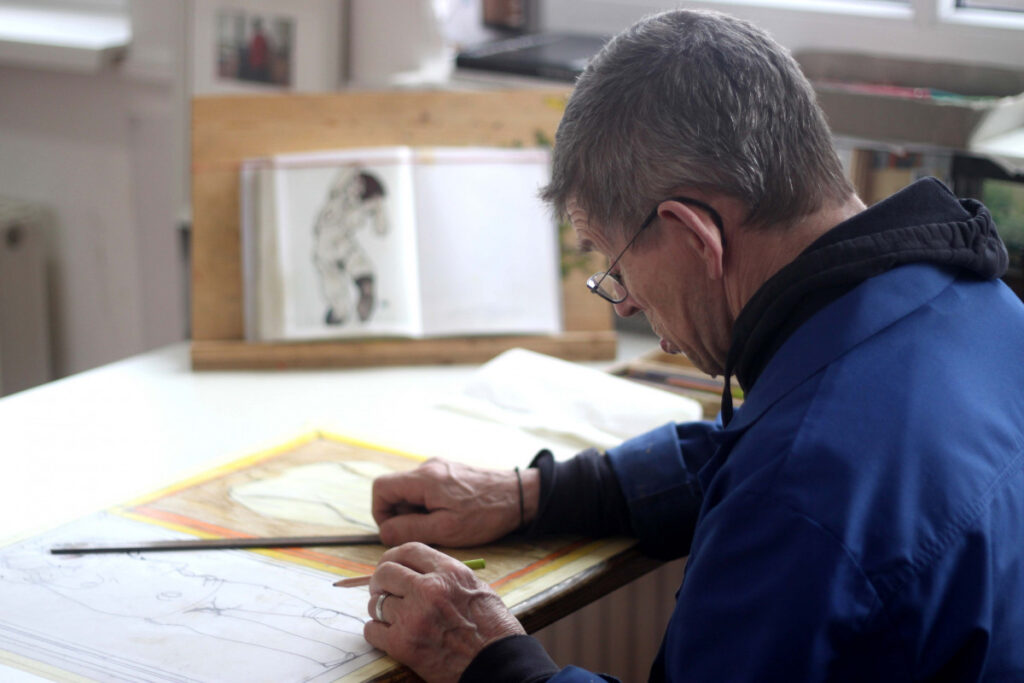
He draws in graphite, tracing his lines along a wooden stick that serves as a ruler, then in coloured pencils. He works very slowly. His central subject is the male figure, almost always naked, and sexuality, depicted without euphemism: self-portraits, often fragmented, deprived of a head or lower limbs. A mirror placed on the floor opposite his bed, in which he observes himself for hours every day, becomes in his drawings a large rectangular frame around the figures. These frames appeared in 2002, became systematic in 2003 and filled the whole sheet by around 2011; he colours them in constant hues, preferably orange and yellow. He also draws horses, objects from his surroundings and, later, female nudes.
Exhibitions and collections
- 2003: first solo exhibition, Collection de l’Art Brut, Lausanne
- 2004: euward prize
- 2011-2012: “alter ego”, Galerie christian berst, Paris; Galerie am Stein, Schärding
- 2012: “Josef Hofer et le miroir”, Collection de l’Art Brut, Lausanne (some fifty drawings, curated by Sarah Lombardi)
- Collections: Collection de l’Art Brut, Lausanne; Centre Pompidou (Bruno Decharme donation, 2021); The Museum of Everything; Arnulf Rainer, Hannah Rieger and Treger-Saint Silvestre collections