Category: Art Brut

  • Carlo Zinelli

    Carlo Zinelli

    Italian Art Brut creator, born on 2 July 1916 in San Giovanni Lupatoto (province of Verona), died on 27 January 1974 in Verona.

    Life

    The sixth child of Alessandro Zinelli, a carpenter, and Catterina Manzini, who died in childbirth in 1918, Carlo Zinelli worked in the fields from the age of eight. At eighteen his father sent him to work at the municipal slaughterhouse in Verona; he loved music and dancing.

    Called up in May 1938 to the 11th Alpini regiment, in March 1939 he joined the Italian volunteer corps sent to support Franco’s troops; landing in Cádiz on 25 March, he left Spain thirteen days later. The first signs of schizophrenia appeared at this time. Demobilised in December 1941, he was committed in 1947 to the San Giacomo alla Tomba psychiatric hospital in Verona.

    In 1957 the sculptor Michael Noble opened a free-expression studio in the hospital, with the psychiatrist Mario Marini and the agreement of the director, Cherubino Trabucchi. Zinelli painted there for up to eight hours a day. The psychiatrist Vittorino Andreoli studied his work and brought it to the attention of Jean Dubuffet. In 1969 the hospital’s move to Marzana disoriented him: he painted far less until his death from pneumonia at the Chievo sanatorium.

    The work

    Some 1,900 paintings and a few sculptures. Zinelli worked in tempera and coloured pencils on white paper. From 1962 to 1968 he painted his sheets on both sides, which read like continuous narratives. Profiled silhouettes, often pierced with holes in place of eyes, repeated until they saturate the ground; primary colours; memories of the countryside of his childhood.

    Exhibitions and collections

    • Galleria La Cornice, Verona, 1957; Insania Pingens, Kunsthalle Bern, 1963.
    • Touring exhibition in France: Musée international des arts modestes, Sète (2004); LaM, Villeneuve-d’Ascq (2005); Musée de l’Abbaye Sainte-Croix, Les Sables-d’Olonne (2005-2006).
    • American Folk Art Museum, New York, 2017; “Recto Verso”, Collection de l’Art Brut, Lausanne, 2019.
    • Collections: Collection de l’Art Brut, Lausanne; LaM; Zander Collection, Cologne; Fondazione Culturale Carlo Zinelli, San Giovanni Lupatoto.
    • “Art Brut” exhibition, Galerie Les Yeux Fertiles, 10 June to 23 July 2022: Sans titre, 1966, gouache on paper, double-sided, 70 x 50 cm.
  • Frantz Zéphirin

    Haitian painter, born in December 1968 in Cap-Haïtien.

    Life

    The son of an architect and a nurse, Frantz Zéphirin was brought up by his grandmother, an embroiderer; as a very small child he was already drawing flower motifs. He began painting in 1973, at the age of five, with his uncle, the painter Antoine Obin, a master of the Cap-Haïtien school. At seven he was selling small landscapes to tourists from cruise ships.

    In 1983 he went to continue his schooling in Port-au-Prince, then gave up his studies to devote himself to painting and joined the Galerie Monnin. From 1988, at the Centre d’Art in Port-au-Prince, he asserted his own themes and style. A Vodou priest, he lives and works in his temple, the Temple of the Seven Virgins, on a mountain above Mariani, on the outskirts of Port-au-Prince.

    The work

    Zéphirin draws on history, politics, the environment, the Bible, Creole culture and Vodou. His dense, brightly coloured compositions bring together human figures with the heads of wild or domestic animals (monkeys, elephants, crocodiles, giraffes), mystical characters and parallel worlds. Through them he caricatures Haitian society, and above all its ruling class. He describes himself as a “historical animalist”.

    His paintings have been on the covers of The New Yorker, Time, The New York Times and Smithsonian Magazine.

    Exhibitions and collections

    • Swiss Prize and European Prize for modern primitive painting, Kasper Pro Arte, Morges (Switzerland), 1994; gold medal at the 3rd Biennial of Caribbean and Central American Painting, Museum of Modern Art, Santo Domingo, 1996.
    • Sacred Arts of Haitian Vodou, Fowler Museum, Los Angeles, 1995, then a tour of the United States.
    • Le dernier voyage d’André Malraux en Haïti, Musée du Montparnasse, Paris, 2009.
    • Kafou: Haiti, Art & Vodou, Nottingham Contemporary, 2012-2013; In Extremis, Fowler Museum, UCLA, 2012-2013.
    • Collections: Afrika Museum, Berg en Dal (Netherlands).
  • Jean-Michel Wuilbeaux

    Jean-Michel Wuilbeaux

    Painter born in 1968 in Valenciennes. Since 1990 he has worked at the La Pommeraie studio in Belgium.

    Life

    Since 1990 Jean-Michel Wuilbeaux has attended the visual arts studio of La Pommeraie in Belœil, in Hainaut. Founded in 1972, La Pommeraie is a residential centre for adults with disabilities, spread across several villages, including Ellignies-Sainte-Anne. Its studio, whose artists are promoted by the Fondation Paul Duhem, has exhibited in France, Hong Kong and Russia.

    The Trinkhall Museum in Liège devoted his first monographic exhibition to him, organised with the Fondation Paul Duhem and Bruno Gérard, head of the La Pommeraie studio.

    The work

    Wuilbeaux paints and writes, directly on the canvas as on loose sheets. Paintings, drawings and words circulate freely there, between received ideas and awareness.

  • Scottie Wilson

    Scottie Wilson

    British draughtsman, born Louis (or Lewis) Freeman in Glasgow in 1891 (1888 according to some sources), died in London on 26 March 1972.

    Life

    From a modest Jewish family in Glasgow, Scottie Wilson left school at eight to help his family. Enlisting in the Scottish Rifles in 1906, he served in India and South Africa, left the army in 1911, then re-enlisted in 1914 and fought on the Western Front.

    After the war he emigrated to Canada, landing in 1920, before settling for good in Toronto in 1932. A junk dealer, he kept a small shop on Yonge Street. It was there that he began to draw, with a fountain pen taken from his stock. Supported by the collector Douglas Duncan, he first exhibited in Toronto in 1943.

    In 1945 he moved to London and a few months later exhibited at the Arcade Gallery. Yet he continued to sell his drawings in the street, for a fraction of gallery prices. In the early 1950s, at Jean Dubuffet’s invitation, he stayed in France; Dubuffet and Picasso owned works by him. In the 1960s he designed a dinner service for Royal Worcester inspired by totem poles, produced until 1965. He died in Kilburn, in north London.

    The work

    Meticulous pen drawings, peopled with characters of his invention, the “evils” and the “greedies”, set against symbols of goodness and truth: fish, birds, flowers, trees, self-portraits, totem figures. The Surrealists admired his work.

    Exhibitions and collections

    • Tate, London; National Galleries of Scotland, Edinburgh; National Gallery of Canada, Ottawa; Carleton University Art Gallery, Ottawa.
    • Collection de l’Art Brut, Lausanne; Metropolitan Museum of Art, New York; Zander Collection, Cologne.
  • August Walla

    August Walla

    Austrian Art Brut creator, born on 22 June 1936 in Klosterneuburg, near Vienna, died on 7 July 2001 in Gugging.

    Life

    After his father’s death, August Walla was brought up by his mother, Aloisia, and his grandmother, Rosina. At sixteen, after threatening suicide and setting fire to the house, he was committed. On his release he lived with his mother, who watched over him, in several successive flats in Klosterneuburg; he covered their walls with inscriptions, emblems and signs, as he did the family allotment on the banks of the Danube.

    In 1970 he was admitted to the Maria Gugging psychiatric hospital. In November 1983 he moved with his mother into the House of Artists (Haus der Künstler) at Gugging, where he lived and worked until his death.

    The work

    Walla built himself a private mythology, with its own language, symbols and deities. At its centre stand the “Ewigkeitende” (the end of eternity) and Satttus, protector god of humanity; around them, gods, demons, saints, prophets and miracle workers. This struggle against death runs through the whole of his work. He collected dictionaries of foreign languages, drew words from them which he combined to coin his own terms, and closely intertwined drawing and writing.

    He set no hierarchy between media: easel painting, mural painting, drawing, text, sculpture, installation, photography, performance. He painted the walls and ceiling of his room, his furniture and objects, the walls of the hospital and neighbouring houses, and drew in chalk on the road. For him, his works were talismans against spirits, people and death.

    Exhibitions and collections

    • Collection de l’Art Brut, Lausanne (permanent collection).
    • “From the World of Darkness to Rebirth through Creation and Art”, Galerie Les Yeux Fertiles, 10 June to 23 July 2022: World flow, double-sided drawing, black and coloured pencils, 38 x 28 cm.
  • Germain Van der Steen

    Germain Van der Steen

    French painter, born in 1897 in Versailles, died in 1985.

    Life

    As a teenager, Germain Van der Steen (or Vandersteen) was already drawing and painting in watercolour. Called up during the First World War, he was gassed and suffered lasting after-effects, including sleep disorders.

    Between the wars he ran an artists’ colour shop in Paris with his wife (from 1925 according to Le Delarge, from 1931 according to the museum in Laval) and painted at night. Encouraged by the critic Anatole Jakovsky, he exhibited at the Salon d’automne from 1944, then at the Galerie Louise in Paris (1950) and at Hutter in Basel (1951). His work was later shown in France, Belgium, Germany, Austria, the former Yugoslavia, the United States, Brazil and Israel.

    The work

    Self-taught, classed sometimes among the naive painters, sometimes among the authors of Art Brut, Van der Steen went through three periods: a non-figurative period inspired by the music of the composers of his time; that of imaginary plants, trees or flowers with detached, many-coloured leaves and drapery stretched between the trunks; and finally that of the bestiary, above all cats and birds, which sometimes earned him the nickname “emperor of cats”. His palette is very bright.

    Deprived of sleep by the after-effects of the war, he said he painted the dreams he could no longer have, seeing suffering as the source of “the true creation of the mind”.

    Exhibitions and collections

    • Salon d’automne, Paris, from 1944.
    • Centre Pompidou, Musée national d’art moderne: Entente cordiale, before 1955, oil on cardboard, 54 x 65 cm, given by the artist to the State in 1955.
    • Musée d’art naïf et d’arts singuliers (MANAS), Laval: Le Chat à la pelote, 1944, oil on plywood; Le Bureau de tabac de Chatenay, 1944, oil on panel; Oiseau fantastique, gouache and oil on hardboard; Chat, pastel.
    • Croatian Museum of Naive Art, Zagreb.
  • Damian Valdes Dilla

    Damian Valdes Dilla

    Cuban Art Brut creator, born in 1970 in Havana.

    Life

    Damián Valdés Dilla left school at seventeen because of serious psychological disorders; schizophrenia was diagnosed in adolescence. Under treatment, he held various jobs, irregularly. After the failure of his marriage he went back to live with his mother in a small flat in Alamar, a dormitory suburb of Havana made up of five-storey Soviet-style blocks.

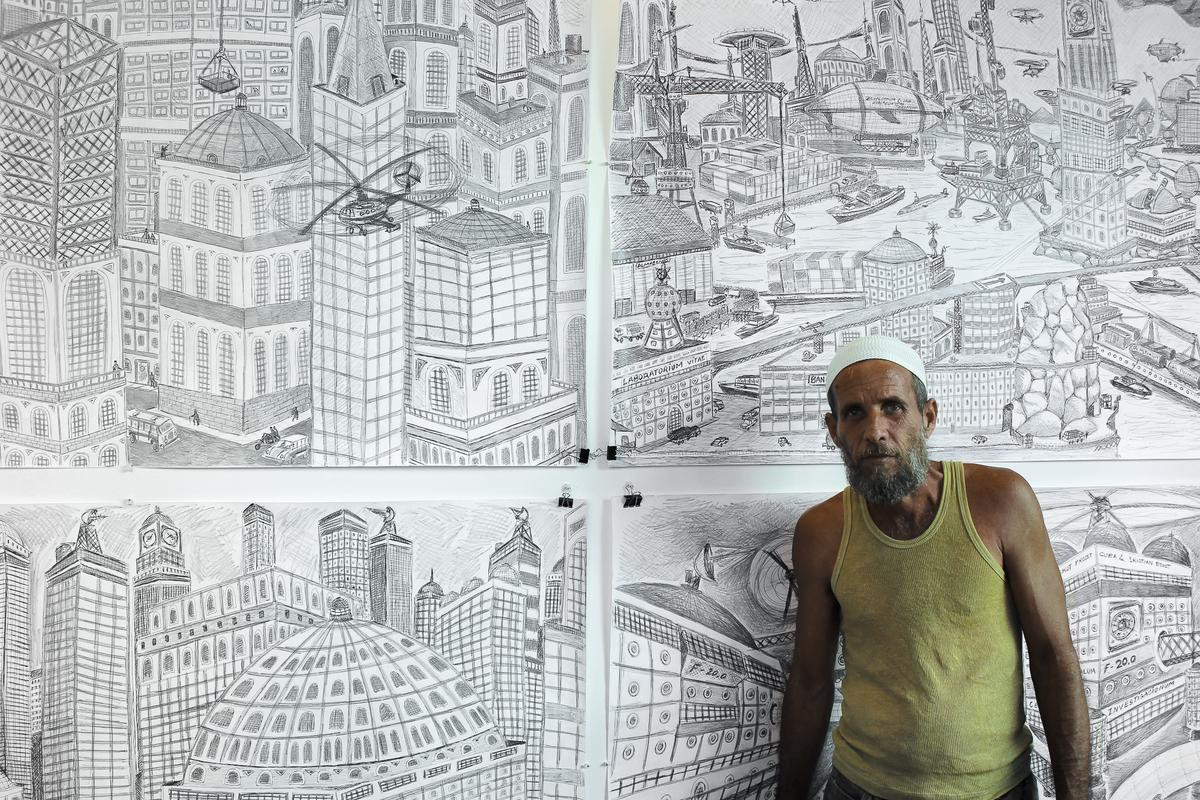
    A convert to Islam, which he has adapted to his own philosophy, he always carries a Koran, a prayer mat and a prayer cap.

    The work

    He began by building models of cities from small pieces of wood, then, as wood became hard to find, from salvaged materials: buildings, towers, blocks of flats and a whole fleet of flying machines assembled from scraps picked up in the street, perhaps intended to save his island, which he depicts as sinking.

    Since 2014 he has been drawing, in ballpoint pen, meticulous and orderly cities, the opposite of the disorder of his assemblages: tightly packed towers topped with pyramidal roofs and clocks, monumental metropolises with fantastical perspectives, vehicles of every kind (aeroplanes, helicopters, ships, buses). No human figure ever appears.

    Exhibitions and collections

    • Collection de l’Art Brut, Lausanne: Sans titre, 2015, ballpoint pen on paper, 40.5 x 100.8 cm; exhibition “Art Brut CUBA”, 6 December 2024 to 27 April 2025.
    • Musée national d’art moderne, Centre Pompidou: untitled assemblages (c. 2000) from Bruno Decharme’s abcd collection, donated in 2021.
  • Sol (Solange Lantier)

    Self-taught French draughtswoman, Solange Lantier, known as Sol, whose known work dates from the second half of the 1970s.

    Life

    With her husband, Solange Lantier ran in turn a restaurant, a tobacconist’s and a general store. When he was struck by paralysis, she devoted herself to him for many years.

    Her drawings were shown several times at the Atelier Jacob, and in 1978 she took part in the exhibition Les Singuliers de l’art at the Musée d’Art moderne de la Ville de Paris. Jean Dubuffet acquired several of her drawings for the Collection de l’Art Brut. An article was devoted to her in the Fascicule de l’Art Brut no. 10.

    The work

    Sol combined dry pastel, coloured pencil, ink, wash and varnish, on cardboard or paper. Her titles, sometimes inscribed on the sheet, set the tone: Un cauchemar (1978), Personnages sur fond bleu (1979), Les autres se reposent, moi je travaille, Où sont-ils.

    Exhibitions and collections

    • Collection de l’Art Brut, Lausanne.
    • LaM, Villeneuve-d’Ascq: some twenty drawings dated 1976 to 1980, L’Aracine donation (1999), including Un cauchemar (1978, dry pastel, wash, ink and varnish on laid paper, 50 x 32.6 cm) and Personnages sur fond bleu (1979, dry pastel, coloured pencil, ink and varnish on cardboard, 65 x 50 cm).
    • Les Singuliers de l’art, Musée d’Art moderne de la Ville de Paris, 1978.
  • Lewis Smith

    Lewis Smith

    Self-taught American draughtsman, born in 1907 in Ohio (United States), died in 1998.

    Life

    Lewis Smith began drawing in 1920. His father, Howard E. Smith, worked for a railroad company, which gave him a pass to travel free by train: he criss-crossed Ohio and the rest of the country, recording what he saw in notebooks and drawings. Four small diaries, kept from 1904 to 1941 (the oldest by his father, the other three by him), are held in the archives of the American Folk Art Museum in New York.

    He lived and drew in solitude, to the point of painting his figures even on the walls of his house, barn and outbuildings, in rural Ohio. He did not show his work in his lifetime; New York’s American Primitive Gallery made it known after his death, at the end of the 1990s.

    The work

    Smith drew in graphite and coloured pencils on salvaged supports: grocery bags, flattened cardboard, biscuit boxes, often on both sides and sometimes incorporating the printed brand names. He depicted locomotives and railway details, alleys, counters and diners, and above all tall, muscular women, as boxers or wrestlers, inspired by the sporting contests he attended on his travels. Passionate about current affairs, he also collected newspapers, objects, documents and photographs relating to the American railroad.

    Exhibitions and collections

    • Collection de l’Art Brut, Lausanne (notably School to school and Free 4 all, room 123); 3rd Art Brut Biennial, Corps, 17 November 2017 to 29 April 2018.
    • American Folk Art Museum, New York (archive: Lewis Smith’s diaries).
  • Ursula Schultze-Bluhm

    Ursula Schultze-Bluhm

    German painter, draughtswoman and poet, known as Ursula, born on 17 November 1921 in Mittenwalde (Brandenburg), died on 9 April 1999 in Cologne.

    Life

    The daughter of Erwin Bluhm, Ursula worked at the Amerika-Haus in Frankfurt, where in 1949 she met the painter Bernard Schultze, whom she married in 1955. She began painting and writing in 1950, starting from the abstraction of Willi Baumeister, then found a personal path between naive painting, Art Brut and the Informel. For almost fifty years the couple shared the same studio, each following their own path.

    In 1954 she met Jean Dubuffet, with whom she formed a lasting friendship; her works entered the Collection de l’Art Brut in Lausanne. Self-taught, she nonetheless remains unclassifiable: in 1961, in the review La Brèche, André Breton linked her work to “the automatism of mediums”. She took part in documenta 6 in Kassel in 1977. Settled in Cologne with her husband, she lived there until her death.

    The work

    Ursula made ink drawings, large paintings and, from the late 1950s, assemblages in soft materials, notably fur, studded with drawing pins and razor blades; around 1970 she also created installations occupying space, then called “environments”. Her sinuous compositions, built up from patterns of dots and lines, are peopled with beings that dance, fly and metamorphose (Andrew Russeth, The New York Times, 16 May 2023).

    “The image is lodged in my mind and waits to be released into the outside world, onto the canvas.” (Ursula)

    Among the works shown at the gallery: Bouquet fleurs (c. 1955, oil on panel, 75 x 52 cm, CR 50er/001), La Femme de Potiphar (1983, oil on canvas, 120 x 180 cm, CR 83/001), Cauchemar (1984, oil and furs on canvas, 79 x 99 x 4 cm, CR 84/007), Les Deux Gardiens (1986, oil and varnish on wood, double-sided, 175 x 57 and 175 x 58 cm, CR 86/102).

    Exhibitions and collections

    • Collection de l’Art Brut, Lausanne; Nationalgalerie, Berlin; Staatliche Kunstsammlungen, Dresden; Museum für Moderne Kunst, Frankfurt am Main; Musée national d’art moderne, Centre Pompidou, Paris.
    • documenta 6, Kassel, 1977.
    • Ursula: That’s Me. So What?, first major retrospective, Museum Ludwig, Cologne, 2023, curated by Stephan Diederich; the gallery lent five works.
    • It’s Me, Ursula! Paintings, Drawings, Boxes, with Yolande Fièvre, Galerie Les Yeux Fertiles, 14 March to 12 April 2025.
    • Monograph and catalogue raisonné: Evelyn Weiss, Ursula, Hirmer, 2007.