Author: admin

  • Dado

    Dado

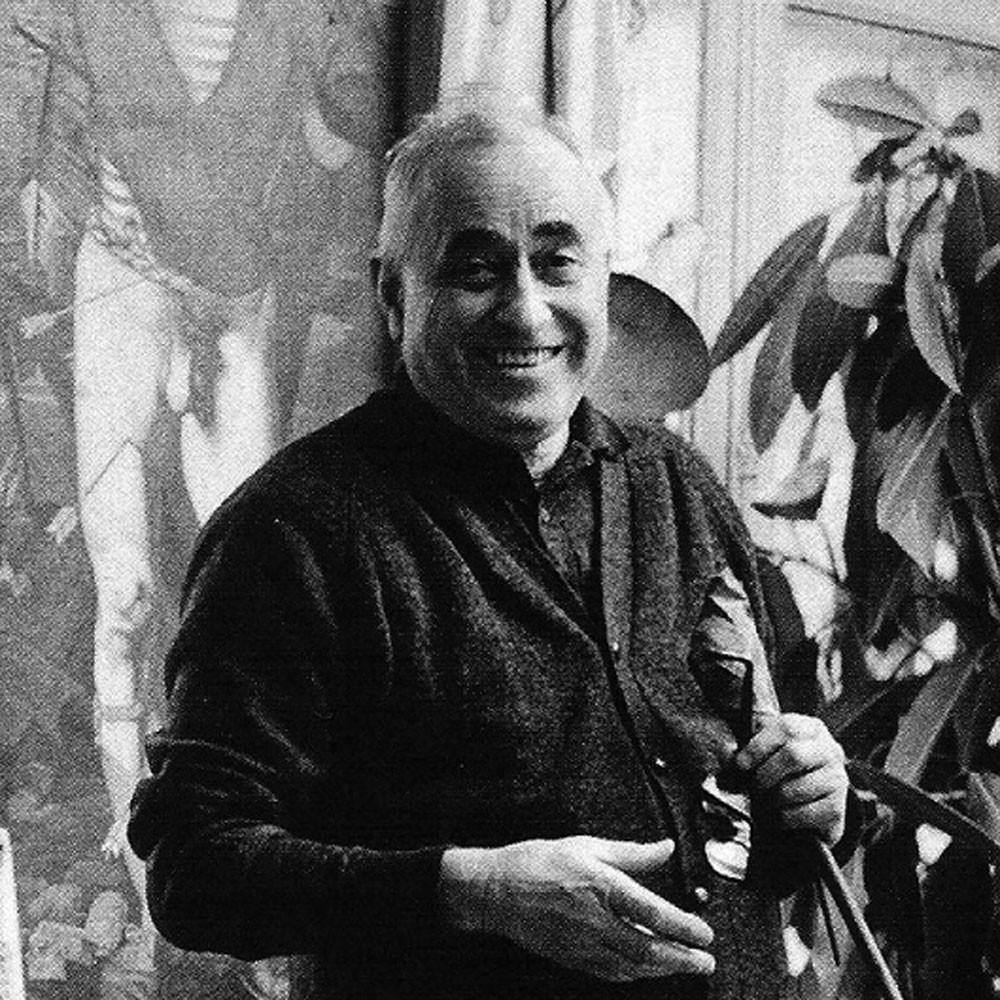
    Painter, draughtsman, printmaker and sculptor, born Miodrag Đurić on 4 October 1933 in Cetinje (Montenegro, then Yugoslavia), died on 27 November 2010 in Pontoise, based in France from 1956.

    Life

    Dado studied fine art in Herceg Novi from 1947 to 1951, then in Belgrade, in the class of Marko Čelebonović, who encouraged him to leave for Paris. He settled there in 1956 and worked in Gérard Patris’s lithography workshop, where he met Jean Dubuffet. Dubuffet introduced him to the dealer Daniel Cordier, who organised his first solo exhibition in 1958 and launched his career.

    In 1960 he settled in a former mill at Hérouval, in the Vexin, which remained his home and workplace until his death. He was close to Bernard Réquichot, who died in 1961. In 1962, in New York, he met the Cuban artist Hessie, who became his wife. He was made a Chevalier des Arts et des Lettres in 1984.

    The work

    A painter above all, in oil on canvas, Dado took up drypoint in 1966, then copper engraving with Alain Controu from 1967. His first sculpture, in 1962, was made of cattle bones; most of his sculpture dates from the 2000s. He also practised collage, digital from 1996, ceramics and fresco, which from the 1990s spread over walls and abandoned buildings.

    His early canvases look towards Giorgio De Chirico, Carlo Carrà and the first Surrealists. He illustrated many books, including Georges Perec’s Alphabets (1976) and Kafka’s Le Terrier (1985), as well as texts by Barbey d’Aurevilly, Pierre Bettencourt and Claude Louis-Combet.

    Exhibitions and collections

    • Galerie Daniel Cordier, Paris, 1958
    • Venice Biennale, 2009
    • “Miodrag Dado Đurić” Gallery, National Museum of Montenegro, Cetinje, opened in 2012
    • Retrospective, Musée des Beaux-Arts de Pau, 2018
    • Collections: Musée national d’art moderne, Centre Pompidou; Bibliothèque nationale de France (prints)
    • Galerie Les Yeux Fertiles: summer exhibition, 10 to 26 July 2025
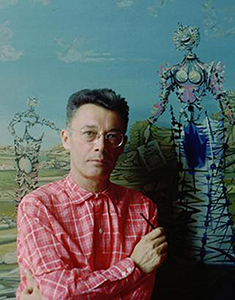
    At the gallery

  • Lucien Coutaud

    Lucien Coutaud

    French painter, printmaker, theatre designer and tapestry designer, born in 1904 in the Gard, died in 1977 in Paris.

    Life

    The son of Adrien Coutaud, a jeweller, Lucien Coutaud attended the École des beaux-arts in Nîmes from October 1920 to June 1924, where the engraver Armand Coussens probably introduced him to printmaking. Having moved to Paris in October 1924, he frequented the independent academies of Montparnasse, then entered the École des arts décoratifs. Charles Dullin gave him his first theatre design, for Aristophanes’ The Birds adapted by Bernard Zimmer: its success launched his career as a set and costume designer, continued notably with Paul Claudel’s Le Soulier de satin in 1943.

    After his military service in the Rhineland, he held his first solo exhibition in 1931, at the Galerie des Quatre Chemins. In 1936 he married Denise Bernollin, a printmaker and illustrator. Close to the Surrealists, whose texts he read and whose events he followed, he never joined the group, and from 1940 described his art as “surreal” (surréel).

    After the war he took part in the revival of Aubusson tapestry alongside Jean Lurçat, designing among others tapestries for the liner France (1962). He ran the printmaking studio of the École nationale supérieure des beaux-arts from 1964 to 1975. Alain Resnais devoted a documentary to him in 1948. He received the Grand Prix des Beaux-Arts of the City of Paris in 1967.

    The work

    The grey-blue landscapes of the Rhineland years were followed, in the early 1930s, by bouquets and esoteric compositions. During the war his figures became skeletal, fragmented and faceless, close to the mannequin or the automaton. Coutaud then invented “Éroticomagie”, based on metamorphoses with sexual connotations, and developed the series of Taureaumagies, nourished by bullfighting. Figures, vegetal or mineral houses, flat irons and vast landscapes make up his repertoire.

    As a printmaker he illustrated Gilbert Lely’s Ma civilisation (1948), Rimbaud’s Une saison en enfer (1951) and Cyrano de Bergerac’s Voyage dans la Lune (1971).

  • Alfred Courmes

    Alfred Courmes

    French painter, born in 1898 in the Var, died in 1993.

    Life

    The son of a naval officer who encouraged his vocation, Alfred Courmes was educated in Monaco. In 1919, in a sanatorium where he was being treated for a lung condition, he met Roger de La Fresnaye, some thirteen years his senior, who taught him his craft in a relationship closer to that of father and son than of master and pupil. From 1925 he sent his canvases to the Salon des indépendants and the Salon d’automne.

    In 1927 he settled in Ostend, the home town of his wife, the Belgian Henriette Van de Put. There he discovered the Flemish Primitives, the Expressionism of James Ensor and Constant Permeke, and Surrealism; he also met Félix Labisse. L’Homme blessé (1929) dates from this period. Back in Paris, he lived on rue des Écluses-Saint-Martin, and the Canal Saint-Martin became one of his recurring settings.

    In 1936 he received the Prix Paul Guillaume. He painted Le Toucher for the 1937 International Exhibition and produced, on commission, a large fresco, La France heureuse, for the dining room of the French Embassy in Ottawa. In 1991 he painted the official portrait of Jack Lang.

    The work

    Courmes subverted mythology, religious history and advertising imagery with biting irony; he attacked social, religious and militarist forces, and desire is one of his constant themes. André Breton nicknamed him “the Angel of Bad Taste”; Jean Cassou saw him as an “eccentric, bizarre and grating” figure.

    His Saint Sébastien (1934, oil on canvas laid down on hardboard, 164 x 59 cm), shown at the 1935 Salon des indépendants, depicts the saint in sailor’s dress in front of the naval port of Toulon. One panel of an unfinished triptych, it has a companion piece, Saint Roch natif de Montpellier (1936). Critics found it in turn “scandalous”, “splendid” and “anachronistic”. He returned to the theme in 1961 with 45 % (de) B.A. (dit : Saint-Sébastien camembert).

    Exhibitions and collections

    • “Masculin / Masculin”, Musée d’Orsay, Paris, 2013
    • “Alfred Courmes. La rétrospective”, Espace Niemeyer, Paris, 29 March to 4 June 2023, then Musée de l’Ardenne, Charleville-Mézières, 7 October 2023 to 7 January 2024
    • Collections: Musée national d’art moderne, Centre Pompidou (Saint Sébastien, acquired in 1984); Musée de l’Hospice Saint-Roch, Issoudun (Saint Roch)

    At the gallery

  • Roger Chomeaux

    Roger Chomeaux

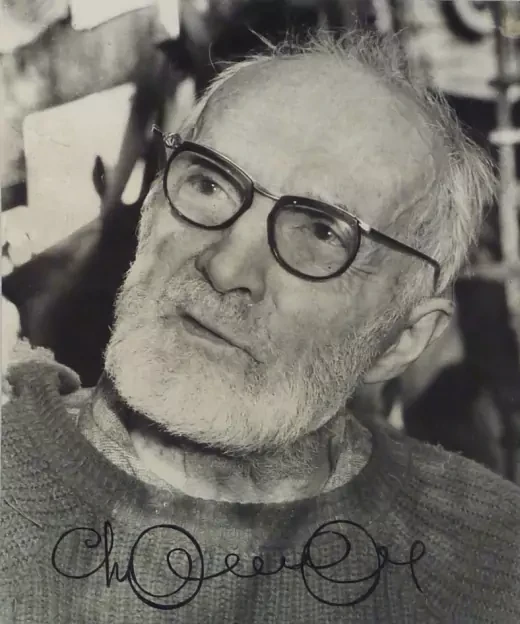
    French painter, sculptor, architect, poet and filmmaker, born Roger Chomeaux on 28 January 1907 in Berlaimont (Nord), died on 19 June 1999 in Achères-la-Forêt (Seine-et-Marne).

    Life

    Roger Chomeaux studied at the art school in Valenciennes from 1921 to 1925, then at the École des beaux-arts in Paris from 1926 to 1928. To earn a living he worked as a carpet designer for a firm in the Paris region. Taken prisoner during the Second World War, he was deported to Poland. After the war he took up gouache and ceramics and tried his hand at film.

    In May 1960 the Galerie Jean Camion, 8 rue des Beaux-Arts, showed his Burnt Woods (Bois brûlés) under the title “Expressions noires”. The exhibition drew a large public, including André Breton, Salvador Dalí and Picasso, but Chomo, furious at the commercial success that was looming, torpedoed it. At fifty-three he broke with the art of his time and adopted the name Chomo.

    He withdrew to Achères-la-Forêt, in the forest of Fontainebleau, on a plot his wife had bought twenty years earlier, in a prefabricated house without running water or heating. Having become “the Hermit of the Fontainebleau forest”, he lived there alone for some forty years and built his Village d’art préludien.

    The work

    Salvage and recycling are at the heart of his practice. Fascinated by lightning and combustion, Chomo let fire carve into wood, which he then tarred and painted: these are the Burnt Woods. In the forest he raised three architecture-sculptures, the Refuge, the Church of the Poor and the Sanctuary of the Burnt Woods (begun in 1961, the constructions completed in 1963), using plaster, wire mesh, bottles, dead wood and plastic waste mixed with earth and stone.

    For Michel Thévoz, he prefigures “in a utopian mode a dissolution of art through its extension into reality”. At eighty he began filming Le Débarquement spirituel. Images de lumière with the director Clovis Prévost, lit by Jean-Pierre Nadau; a forty-minute version, edited by Frédéric Michaudet, was released in 2019.

    “We must recreate a clean religion, a religion of purity. We must start again from zero.” (Chomo)

    Exhibitions and collections

    • “Expressions noires”, Galerie Jean Camion, Paris, 1960
    • Village d’art préludien, Achères-la-Forêt: a site preserved since 2015 by the Association des Amis de Chomo, open to visitors
    • Galerie Les Yeux Fertiles: “Josette Rispal and Chomo”, 27 November 2025 to 8 January 2026, in collaboration with Maître Aymeric Rouillac; works shown: Totem, c. 1960, burnt wood, 87 x 35 x 26 cm; Fétiche à clous, c. 1960, burnt wood and metal, reworked in the 1990s, h. 123 cm
  • Mario Chichorro

    Mario Chichorro

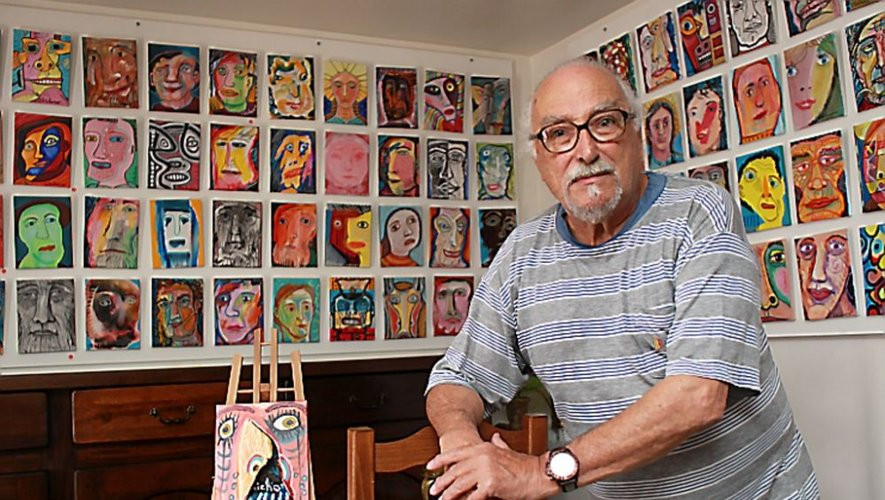
    Portuguese painter and sculptor, born in 1932 in Portugal, died in 2023, based in France from 1963.

    Life

    Mário Chichorro studied architecture at the School of Fine Arts in Porto. In 1963 he settled in Perpignan, and from then on pursued most of his career in France. In 1968 he lost his job after being recognised at a demonstration against the employers: he then devoted himself entirely to his art.

    His first Paris exhibition took place in 1974 at the Atelier Jacob, with the support of Jean Dubuffet, who included him in his “annexe collection”, today’s Neuve Invention collection in Lausanne. In his lifetime he never exhibited in Portugal: a posthumous tribute was paid to him at the Centre for Arts and Performance in Figueira da Foz, with a space devoted to his brother, the painter Heitor Chichorro.

    The work

    His work oscillates between painting and low-relief sculpture. Bright colours, absence of perspective, irreverent humour: his compositions combine figures and scenes in an allegorical imaginary, sometimes tinged with eroticism.

    “I am for irreverence, insubordination, unrealism, reverie, utopia, desire.” (Mário Chichorro, translated from the Portuguese)

    Exhibitions and collections

    • Atelier Jacob, Paris, 1974
    • “Lusofolia: A Beleza Insensata”, Centro de Arte Oliva (Portugal), 9 November 2019 to 11 October 2020
    • Posthumous tribute, Centre for Arts and Performance (CAE), Figueira da Foz (Portugal)
    • Collections: Collection de l’Art Brut, Lausanne; La Fabuloserie (France); Centro de Arte Oliva (Portugal)
  • Kashinath Chawan

    Kashinath Chawan

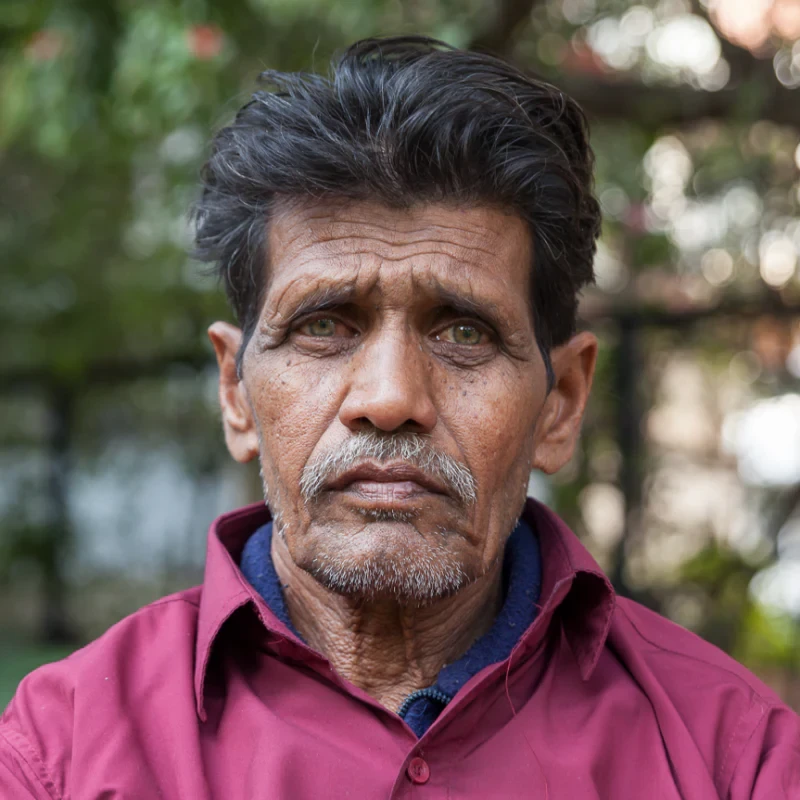
    Self-taught Indian draughtsman, shoeshiner and cobbler in the state of Maharashtra (India).

    Life

    Kashinath Chawan comes from a family of cobblers: his grandfather and father already practised the trade, which he himself has followed since the age of fifteen. He lives in a slum and keeps a small shoeshine stall in town. Illiterate, he has received no artistic training and harbours no artistic ambition: he draws to soothe his worries.

    In the 1980s, knocked off his bicycle by a lorry, he suffered a triple fracture and for a time lost the use of his right arm. Drawing also served as rehabilitation: the repeated movements of the pen loosened his injured arm. He draws on the pavement, sitting cross-legged, mostly during the slack hours of the afternoon, and often at night, when his family is asleep.

    The work

    Chawan draws in ballpoint pen, often coloured, on pieces of cardboard torn from old shoeboxes or on papers picked up in the street. Far from seeing them as obstacles, he regards the flaws of these supports as a resource.

    He makes no preparatory sketch. The line, light at first, is gone over in successive passes and gradually densifies: from this he draws chiaroscuro effects and great graphic softness. His subjects come from Indian tradition: Hindu deities (Shiva), spiritual masters (Swami Samarth, Sant Gajanan Maharaj, Sai Baba), scenes from the Mahabharata and the Ramayana, but also political figures and Bollywood stars.

    Exhibitions

    • “summer variations #2”, Galerie christian berst, Paris, 5 to 26 July 2025
  • Gerardo Chávez

    Gerardo Chávez

    Peruvian painter and sculptor, born on 16 November 1937 in Trujillo (Peru), died on 22 June 2025 in his home town.

    Life

    Gerardo Chávez López graduated from the National School of Fine Arts of Peru. By 1960, at twenty-two, he had already exhibited more than five times in his own country and shown his work in Chile, Argentina and Brazil. He also exhibited in Europe, notably in Florence (Galleria Lo Sprone), Rome, Paris (Galerie Jacques Desbrières) and Amsterdam.

    In Trujillo he became a leading cultural figure. With María Ofelia Cerro Moral he initiated the Trujillo Contemporary Art Biennial, created in 1981 and revived in 2024. In 2001 he opened a Toy Museum, and he founded a Museum of Modern Art and a cultural space named Angelmira, in tribute to his brother. He is seen as an heir of the Grupo Norte, a circle of intellectuals and artists born in Trujillo.

    He was made a Grand Officer of the Order of the Sun of Peru in 2006. In 2022 he published his memoirs, Antes del olvido, in which he looks back on a childhood marked by the loss of his mother.

    The work

    His painting is peopled with mythical beings. In the 1970s he painted in oil on canvas, before working with earth on jute. In 1995 he produced La procesión de la papa, a set of six pieces in which the Andean potato is carried in procession.

    Chávez described himself as an intuitive painter and acknowledged affinities with the arts of Africa, Oceania and the Americas. “Mythology is universal,” he used to say.

    Exhibitions

    • “A Journey through Latin America”, with Jorge Camacho, Joaquín Ferrer, Roberto Álvarez Ríos, Ramón Alejandro, Mauro Mejiaz and Jorge Vigil, 18 April to 31 May 2025
  • Jacques Carelman

    Jacques Carelman

    French painter, illustrator, sculptor and theatre designer, born in 1929 in Marseille, died in 2012 in Argenteuil.

    Life

    Jacques Carelman settled in Paris in 1956. There he practised as a dentist, alongside a highly varied artistic activity: humorous drawing, book illustration, painting, sculpture.

    From 1962 he designed sets and costumes for the theatre, notably for plays by Molière, Gogol, Dostoevsky and Raymond Queneau. In 1966 he adapted Queneau’s Zazie dans le métro as a comic strip, published by Gallimard. One of the posters of May 1968, showing a menacing riot policeman, truncheon in hand, is attributed to him.

    He joined the Collège de ‘Pataphysique in 1969, where he became a Regent, holder of the chair of Helicology (the study of the gidouille, the spiral adorning Père Ubu’s belly). In 1980 he was one of the founders of the Ouvroir de peinture potentielle (OuPeinPo), the pictorial counterpart of the Oulipo.

    The work

    He is best known for the Catalogue d’objets introuvables (Catalogue of Unfindable Objects), published by Balland in 1969: a parody of the Manufrance mail-order catalogue, listing absurd objects such as the radiator-armchair, the converging tandem or the coffee pot for masochists, its spout turned towards the person pouring. The book was translated into nineteen languages and reissued by Le Cherche Midi in 1999 and 2010. It was followed by the Petit supplément à l’Encyclopédie (1971) and the Catalogue de timbres-poste introuvables (1972), reissued by Cartouche in 2011.

    Carelman also built sculpture-machines based on literature: Mécaniques pour Cyrano (1965), La Hie et le Diamant after Raymond Roussel, Machine à inspirer l’amour after Alfred Jarry, Machine de la colonie pénitentiaire after Kafka (1975). For the OuPeinPo he invented variable-symmetry painting, chronological collage and quarter-turn painting (La Rose des têtes). As an illustrator he provided images for The Thousand and One Nights, La Fontaine’s Fables in rebus form and texts by Noël Arnaud, François Caradec and Claude Roy.

    Exhibitions

    • Unfindable objects made in three dimensions, Vieille Charité, Marseille, November 1974 to January 1975
    • “Les Machines célibataires” (The Bachelor Machines), touring exhibition conceived by Harald Szeemann, 1975
    • Galerie Les Yeux Fertiles: La Machine à inspirer l’amour after Jarry, in “At the Sources of Convulsive Beauty”, 25 October to 30 November 2024
  • Raimundo Camilo

    Brazilian Art Brut creator, born in 1939 or 1943 (sources differ) in the state of Ceará, in north-eastern Brazil, died in 2015.

    Life

    As a young man, Raimundo Camilo left his native region for Rio de Janeiro, where he went from one precarious job to another on building sites and in kitchens. When an employer refused to pay him, he found himself on the street, penniless and disoriented.

    In 1964 he entered the Colônia Juliano Moreira, a psychiatric hospital in Rio, where he stayed for some fifty years before being taken in by his sister. There he mixed with Arthur Bispo do Rosário, interned in the same institution and since recognised as the major figure of Brazilian Art Brut.

    The work

    Camilo drew imaginary banknotes, often on both sides, kneeling in front of his bed. He worked on whatever came to hand: packaging, administrative forms, printed papers. He used felt-tip, ballpoint, gouache and colours he made himself, from coffee for instance.

    Each note bears a head, sometimes that of a king, sometimes that of a cangaceiro, the nomadic bandit of the Nordeste who became a folk hero. He readily gave these notes to members of staff he liked, especially women. He himself refused to speak of art: he said he was simply doing his “duty”.

    Exhibitions and collections

    • Museu Oscar Niemeyer (Brazil), 2005, alongside Arthur Bispo do Rosário
    • First presentation in Europe: exhibition “objet trouvé”, Galerie christian berst, Paris, 2008
    • “Living in Art Brut”, Hannah Rieger collection, museumkrems (Austria), 2017
    • “Art brut. Dans l’intimité d’une collection. La Donation Decharme au Centre Pompidou”, Grand Palais, Paris, 2025
    • Public collections: Musée national d’art moderne, Centre Pompidou (Bruno Decharme donation, 2021); LaM, Villeneuve-d’Ascq; Museu Oscar Niemeyer
  • Jorge Camacho

    Jorge Camacho

    Cuban painter associated with Surrealism, born on 5 January 1934 in Havana, died on 30 March 2011.

    Life

    Jorge Camacho gave up his law studies in the early 1950s to devote himself to painting, with no artistic training. In 1953 he left for Mexico, where he lived for a year and became friends with José Luis Cuevas; both were interested in the sources of Maya culture. He exhibited in Havana in 1955 and 1958, and received an honourable mention at the São Paulo Biennial in 1959.

    In the Havana of the late 1950s he became friends with Joaquín Ferrer, Agustín Cárdenas and Wifredo Lam. In 1960 Camacho and Ferrer met again in Paris, at the Maison de Cuba in the Cité universitaire, and spent a decisive year there: both chose to settle in Paris for good. In 1962 they took part in the major exhibition Art latino-américain organised by Jean-Clarence Lambert at the Musée d’Art moderne de la Ville de Paris.

    Camacho met André Breton in 1961, at an exhibition of Toyen, and joined the Surrealist group; Breton wrote the preface for one of his exhibitions. René Alleau introduced him to esotericism.

    The work

    Esotericism and alchemy nourish his painting, championed in their day by the galleries of Jacques and Thessa Herold in Paris and Joan Prats in Barcelona. His passion for ornithology gave rise to an exhibition of bird paintings at the Galerie Maeght; a journey to Peru inspired his sand landscapes, shown in 1984 at the Galerie Albert Loeb. Éditions Palatines devoted a major monograph to him, and his illustrated books are the subject of a book by Christian Nicaise (L’Instant perpétuel, 2009).

    “Todo el mundo habla de surrealismo, pero son muy pocos los que lo comprenden” (“Everyone talks about Surrealism, but very few understand it”). Jorge Camacho

    Exhibitions and collections

    • Art latino-américain, Musée d’Art moderne de la Ville de Paris, 1962
    • Retrospective, Maison de l’Amérique latine, Paris
    • Jorge Camacho and Joaquín Ferrer, Two Cuban Friends in Paris from 1960, Galerie Les Yeux Fertiles, 26 January to 9 March 2024 (including Cendres, 1972, oil on canvas, 130 x 97 cm, and L’Engoulevent, 1972, oil on canvas, 98 x 130 cm)
    • A Journey through Latin America, Galerie Les Yeux Fertiles, 18 April to 31 May 2025 (including Le Joueur de tours, 1998, pastel and Indian ink on canvas, 215 x 73 cm)