
Icelandic painter, born Guðmundur Guðmundsson on 19 July 1932 in Ólafsvík (Iceland), based in Paris since 1958.
Life
Erró studied at the Reykjavík School of Painting and Applied Arts from 1949 to 1951, then at the Academy of Fine Arts in Oslo (1952-1954) and the Academy of Fine Arts in Florence (1955-1957). He also studied mosaic, in Ravenna and Reykjavík. In Ravenna he met Jean-Jacques Lebel, who introduced him to Parisian writers and painters. After a stay in Israel in 1957, he settled in Paris in 1958.
He first signed Ferró, then Erró. He himself tells the story of this change of name:
“My first artist’s name was Ferro. I found it after a trip to Spain in 1952. I had spent a week in a village, Castel del Ferro. I thought the name very beautiful, all the more so since in Icelandic ‘fer ro’ means ‘the calm that goes away’. But I did not know that in Montmartre there was a Brazilian artist, Gabriel Ferraud. And there is a law in France, from the Vichy period, stating that foreigners may not take the name of an existing artist. So there was a lawsuit, which I lost twice. With Jean-Jacques Lebel we thought of writing the name with three ‘r’s, but that was not accepted. In the end, in court, it was decided to drop the ‘F’. I liked that. And in Icelandic ‘er ro’ means ‘now it is calm’.”
In 1962, with Éric Duvivier, he made the film Mécamorphoses, followed by Grimaces in 1967. He travelled widely, between Paris, the United States, the USSR and Asia. He was made a Chevalier of the Légion d’honneur in 2010.
The work
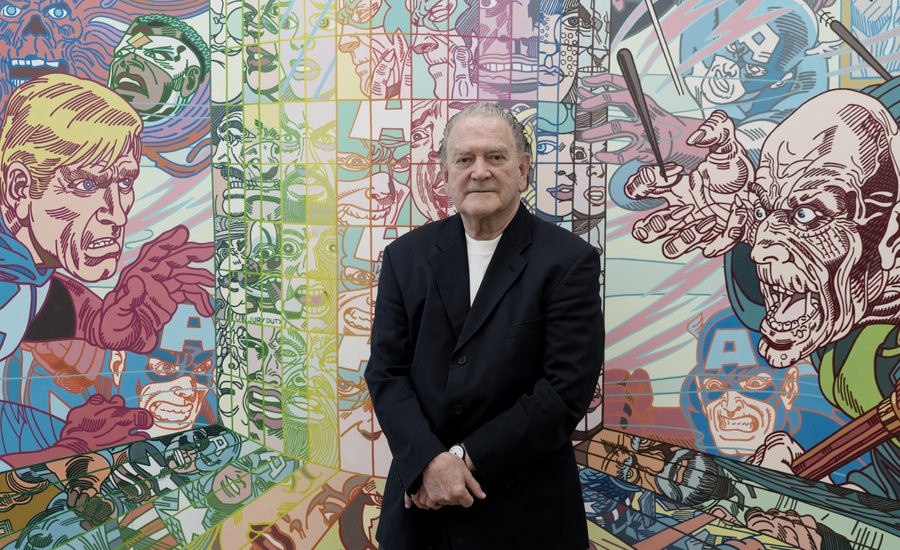
From 1958-1959 Erró composed mechanical collages that served as models for his paintings. In them he drew on every kind of printed image: anatomical plates, advertising, comics, propaganda posters. These collages belong to the lineage of the Dada photomontages of Raoul Hausmann and John Heartfield.
His collages predate the birth of Pop Art by two or three years, and he was, with Roy Lichtenstein, one of the first to bring comic-strip characters into painting. His series mark the stages of his career: Carcasses (1955-1957), Mécamasks (1959), Les Galapagos (1959), the portraits of Mayakovsky (1964-1966), Pope Art (1965), American Interiors (1968), then the Chinese Paintings, from 1972, which brought him international renown.
Exhibitions
- “Figuration narrative” exhibition, Galerie Creuze, Paris, 1965
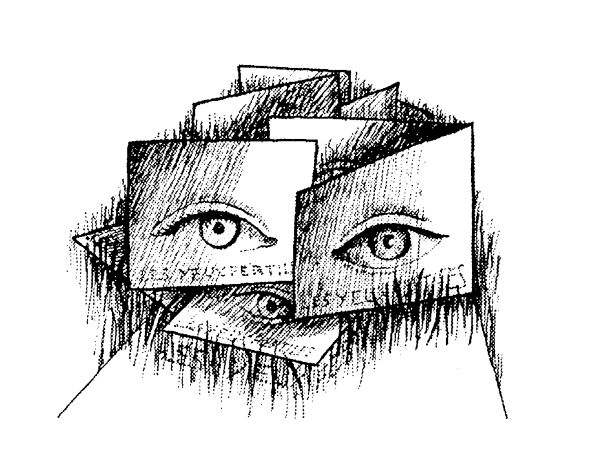
- Galerie Les Yeux Fertiles: the gallery’s 25th anniversary exhibition, 22 May to 19 June 2026