Author: admin

  • Mr. Djub, Hôtel Moderne

    Mr. Djub, Hôtel Moderne

    From 7 December 2023 to 12 January 2024
    Galerie Les Yeux Fertiles, 27 rue de Seine, Paris 6e

    Opening on Thursday 7 December 2023, 6 to 10 pm

    Hôtel Moderne will be Mr Djub’s third solo show at the Galerie Les Yeux Fertiles. Mr Djub is also known as Djubaka, music programmer and columnist on France Inter. For this exhibition he will present for the first time his paper theatre: scalpelled, cut out and glued from nineteenth-century printed paper. On this occasion Éditions Venus d’ailleurs will publish a limited-edition book of this miniature theatre.
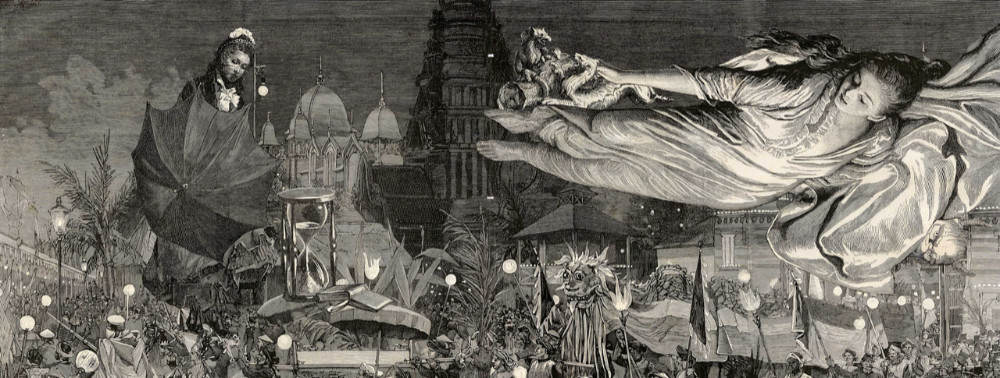
    “Time is elastic. The sources of my collages are drawings and engravings from the golden age of the illustrated and popular press, newspapers published between 1860 and 1900, a world straddling the Second Empire, the beginnings of the Third Republic and the first steps of the Belle Époque. My new playground for this exhibition centres on the last twenty-five years of the nineteenth century. We are in Paris, a world city opening up to every modernity. While Paname already has more than two million inhabitants, the 1878 World’s Fair will see sixteen million pilgrims file past, hungry for modernity and dreams. Hotels, luxurious or humble, become dens of stories; Paris undergoes an upheaval of stone and soul; movement is perpetual. Hôtel moderne tells the secrets and lies of characters who, between two destinations, set down their bags in an iconoclastic, heterogeneous, disparate and monstrously welcoming city. Here, night never ends. For a time the upper bourgeoisie rubs shoulders with petty crooks, artists of the stage and the easel swarm, the art movements of the Zutistes, the Hydropathes and the Arts Incohérents lead the dance and offer a real counterculture. Secret societies recruit wholesale. The wonders and oddities of nature take to the stage and fill the halls. Paris is a magnet for re-enchantment. The fifty collages of Hôtel moderne were conceived in the spirit of an exquisite corpse crossed with Oulipo. The constraint of the printed images and the story that brings them forth push towards encounter. Each collage harbours a scrap of lie or a hidden truth. It was also in this state of mind, and without necessarily meaning to, that the draughtsmen and engravers from whom I borrow and remix images worked. Their role was to tell of the extraordinary without ever having seen it, a testimony by proxy. Others had witnessed the dramas they had to recount and sketch. Unlike journalists, their desire to inform was not necessarily meant to be truthful or precise. Their space was that of extravagance, their mission to give realism to the unknown. This counter-truth was then entrusted to the newspaper’s engraver, to whom the drawing henceforth belonged. He had the power to modify it, to go on feeding this imagination, a fake news with no intent to harm. This fabulation of daily life becomes mine. The past catches up with us. Paris is a moveable feast; we had almost forgotten.”

    Performances of the paper theatre

    • Saturday 23 December 2023, at 5 pm and 7 pm (first performance)
    • Saturday 30 December 2023, at 5 pm and 7 pm
    • Saturday 6 January 2024, at 3 pm, 5 pm and 7 pm

    Owing to its success, the exhibition was extended on Thursday 11 and Friday 12 January 2024, with a few chronicles by Mr. Djub and a galette des rois on the Friday from 6 pm. Thanks to Bénédicte Philippe of Télérama and Lucie Servin of L’Humanité.

    Works shown

    • Mr. Djub, Une riche nature, 2022, collage, unique piece, 23 x 17 cm
    • Mr. Djub, Le mangeur d’orchidées, 2022, collage, unique piece, 29.5 x 42 cm
    • Mr. Djub, Graine de cimetière, 2023, collage, unique piece, 36.5 x 27 cm
    • Mr. Djub, Les pieds dans les nuages, 2023, collage, unique piece, 30 x 26 cm
    • Mr. Djub, Les escrocs du gros caillou, 2022, collage, unique piece, 28 x 43 cm
    • Mr. Djub, On perd toujours à la guerre, 2022, collage, unique piece, 30 x 24 cm
    • Mr. Djub, La clef de verre, 2022, collage, unique piece, 30 x 22 cm

    Artist: Mr. Djub

  • Visions on Every Floor

    Visions on Every Floor

    From 2 November to 1 December 2023
    Galerie Les Yeux Fertiles, 27 rue de Seine, Paris 6e

    Opening on Thursday 2 November 2023

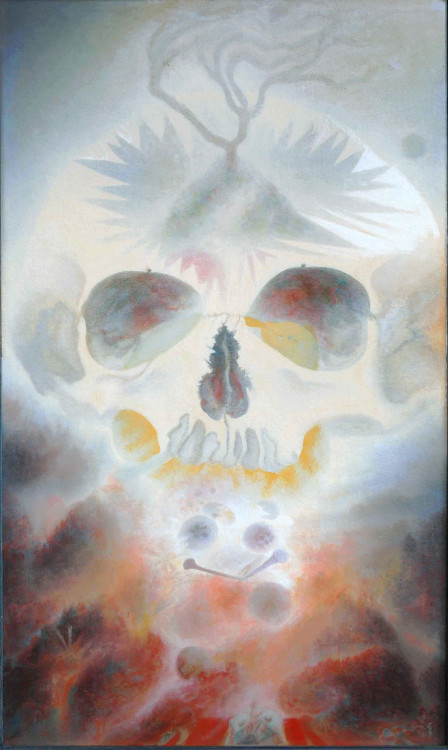
    Artists close to the “Visionary” current as defined by Michel Random:
    Stanislao Lepri, A. Courmes, Dado, E. Desmazières, L. Fini, F. Labisse, Ljuba, J. Le Maréchal, D. Mazuru, L. Missir, M. Prassinos, C. Verlinde, among others.

    As the exhibition went on, a few new works joined the hanging of the visionaries: works by Henri Michaux and Pierre Curie, then by Jean Peyrissac.

    Works shown

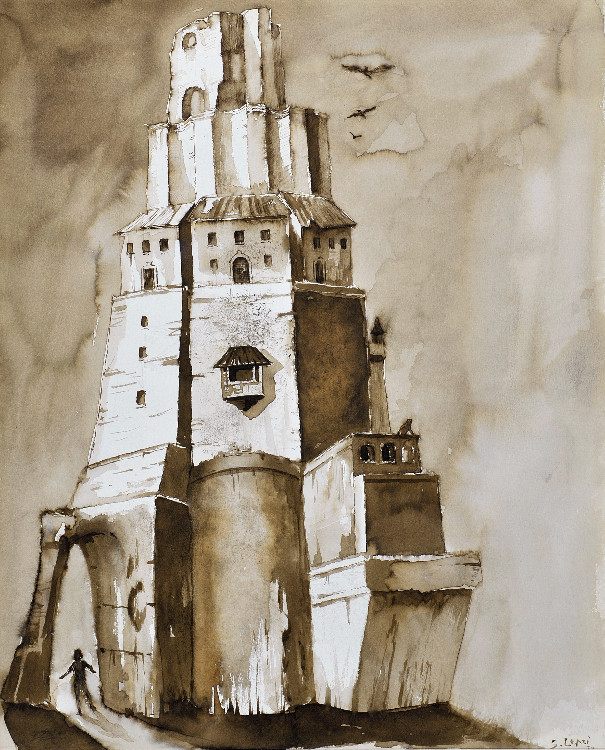
    • Stanislao Lepri, Survivre, 1977, oil on canvas, 73 x 117 cm
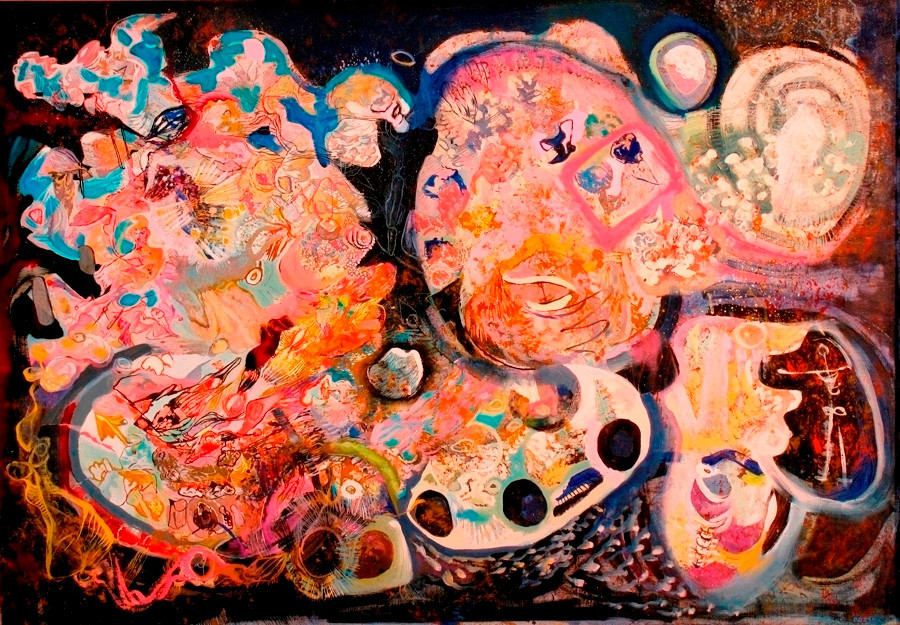
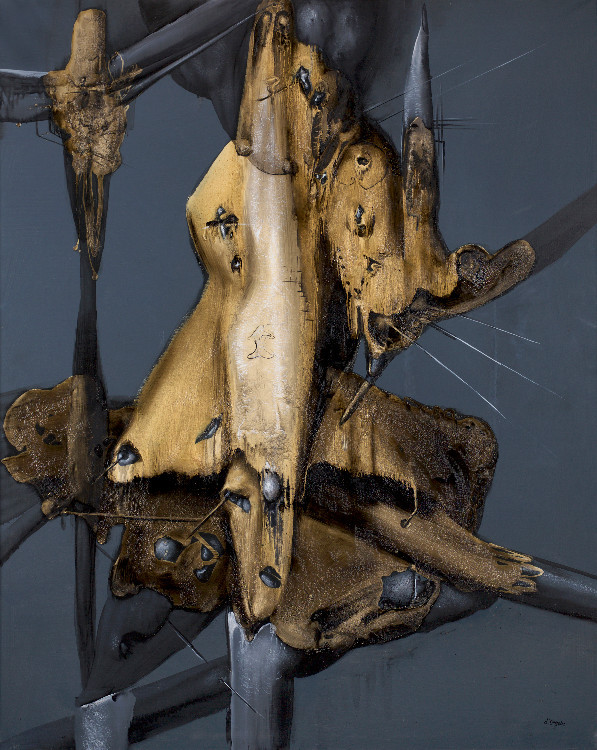
    • Ljuba, Trois points, 1980, oil on canvas, 162 x 130 cm
    • Jacques Le Maréchal, Là où plane le héron gris, 1991-92, watercolour and gouache, 25.3 x 32.6 cm
    • Henri Goetz, Sans titre, 1942-43, oil on panel, 61 x 47 cm
    • Henri Michaux, Sans titre, circa 1958, Indian ink and watercolour on paper, 39 x 29 cm
    • Pierre Curie, Radiographic image of the hand of Marcelle Tinayre, 1903, 18 x 12.5 cm
    • Jean Peyrissac, Signes magiques, Soleil d’été, August 1936, gouache and wax crayons on paper, 14.5 x 27 cm
    • Mario Prassinos, Prétextat n° 9, 1973, oil on canvas, 130 x 162 cm

    Artists: Stanislao Lepri, Alfred Courmes, Dado, Leonor Fini, Ljuba, Jacques Le Maréchal, Didier Mazuru, Mario Prassinos, Claude Verlinde, Henri Goetz

  • Endre Rozsda in Saint-Germain, 60 Years On

    Endre Rozsda in Saint-Germain, 60 Years On

    From 5 to 28 October 2023
    Galerie Les Yeux Fertiles, 27 rue de Seine, Paris 6e

    Opening on Thursday 5 October 2023, 4 to 9 pm

    In 1963, six years after the first exhibition Simone Kahn Collinet had organised for Rozsda in her Galerie Fürstenberg in 1957, with a preface by André Breton, Rozsda held his last solo exhibition, again at Simone’s, this time presented by Joyce Mansour.

    From 5 to 28 October 2023, the Galerie LES YEUX FERTILES presents the exhibition: Rozsda in Saint-Germain, 60 Years On.

    Paintings showing the artist’s development from 1939 to 1999, together with a most interesting selection of drawings.
    A tribute was paid to Simone Kahn (Breton, then Collinet).

    Events

    • Thursday 19 October 2023 at 6 pm: lecture by Monique Sebbag on Simone Breton-Collinet. “It is time to underline Simone Breton’s role in the invention of Surrealism. André’s supporter and passionate partner for eight years, Surrealism is after all her child, a child conceived collectively at 42 rue Fontaine, of which she was the heart. This explains the fervour with which, having become Simone Collinet, she remained its ambassador and promoted young talents, among them Rozsda, whom she regarded as a master.” Monique Sebbag
    • Friday 27 and Saturday 28 October 2023, 2 to 7 pm: closing event with a screening of the documentary Rozsda, la peinture, la vie by Pierre Boutang (1999, Arte Métropolis), with David Rosenberg and Annabelle Le Doeuff.

    Works shown

    • Endre Rozsda, Trompé par la brume, 1977, oil on cardboard
    • Endre Rozsda, Pisa, 1974, oil on canvas

    Artist: Endre Rozsda

  • Jacques Le Maréchal, The Imperceptible Abyss

    Jacques Le Maréchal, The Imperceptible Abyss

    From 1 June to 1 July 2023
    Galerie Les Yeux Fertiles, 27 rue de Seine, Paris 6e

    Opening on Thursday 1 June 2023, as part of “Chromatisme”. A major monograph, published by Venus d’ailleurs, appears on this occasion.

    Jacques Le Maréchal was born in 1928 in Paris.

    After writing poems, Jacques Le Maréchal made, from 1952, “inextricable” drawings, then paintings at once transparent and dense, which André Breton noticed. He nonetheless remained independent of the Surrealist group.

    During a stay in London in 1955-1956, he discovered printmaking and its techniques through Robert Erskine.

    His first exhibition was organised in London in 1955.

    Some have regarded him as the “leader” of the informal movement known as “visionary”, which includes, among others, Didier Mazuru, who photographed many of his works, Georges Rubel, who was his “pupil”, Jean-Pierre Velly, Yves Doaré, Mordecai Moreh…

    Events

    • Saturday 17 June 2023 at 11 am: screening of the documentary devoted to Jacques Le Maréchal by Véronique Faure and Delphine Genest, at the Ciné Club Christine, followed by a visit to the exhibition at the gallery.
    • Thursday 22 June 2023, 5 to 9 pm: late opening at the gallery with the publisher Venus d’ailleurs for the presentation of no. 4 of the review Alcheringa, readings and stories with the review’s team (Yoan, Sylwia, Joël and Guy), and presentation of the publications issued for the inaugural exhibitions of the Maison André Breton, International Centre for Surrealism at Saint-Cirq-Lapopie: René Alleau, Rêveur définitif and Lettres scellées, correspondance René Alleau-André Breton.

    Artist: Jacques Le Maréchal

  • Christian d’Orgeix, Metamorphoses

    Christian d’Orgeix, Metamorphoses

    From 20 April to 27 May 2023
    Galerie Les Yeux Fertiles, 27 rue de Seine, Paris 6e

    Opening on Thursday 20 April 2023

    An exhibition featuring mainly pieces from the 1950s and 1960s, the artist’s finest periods. A catalogue of the works has been published.

    Christian d’Orgeix comes from a noble family of the Ariège (the Thonel d’Orgeix), Orgeix being a small commune near Ax-les-Thermes.

    At first close to post-Cubism, he drew inspiration from Albert Gleizes. Having moved to Paris at the end of the 1940s, he worked there with Hans Bellmer and assisted him in creating his second Doll (1949). This encounter was decisive, as it allowed Christian d’Orgeix to frequent the Surrealists in Paris. He also mixed with Anna de Noailles and Henri-Pierre Roché.

    Exhibited in Germany before being shown in France (from 1955), he discovered in Berlin the painting of Friedrich Schröder Sonnenstern and Richard Oelze. Later he became friends with Wols and Sam Francis, and became the mentor of Konrad Klapheck. He was also close to Roberto Matta and to Simon Hantaï, his former roommate. In the post-war context, d’Orgeix chose neither true membership of Surrealism nor true commitment to the artists of the Informel. This non-choice left Christian d’Orgeix’s painting somewhat outside the expected history of art, but it embodies at its best the pictorial issues being worked out in the Paris of the 1950s and 1960s.

    Christian d’Orgeix took part in documenta II (1959) and documenta III (1964) in Kassel. He also took part in the “Phases” group.

    D’Orgeix’s pictorial world seems at first sight dreamlike, while possessing a quality of fleshly texture close to that of Francis Bacon. But the content of his works, always revealed by very precise, though often humorous, titles, is deliberately anchored in reality. His painting Le Général is a ferocious attack on Charles de Gaulle, who is easily recognisable. His painting also strikes a balance between the different tendencies encountered by the avant-gardes in post-Second World War Paris. At once abstract, or at least non-figurative painting, that is, close to the Informel artists, the mechanical or biomorphic motifs glimpsed here and there also undeniably link his painting to a Surrealist-leaning conception. Gesture is present, and the grounds are most often built up using the automatism Hans Bellmer had taught him. This oscillation between Lyrical Abstraction and the painting of the marvellous places d’Orgeix’s work at the crossroads of these very different pictorial currents and gives it its aesthetic interest.

    As a sculptor, d’Orgeix recycled found objects, pebbles or stones whose shape inspired him, often obtaining astonishing results. In the manner of Joan Miró, the found stones are interpreted in paint to give them a poetic dimension. This poetics recalls the work of André Breton, who placed stones within the Surrealist workshop.

    Article by Philippe Dagen in Le Monde on the exhibition.

    Works shown

    • Christian d’Orgeix, Sans titre, c. 1955, gouache and collage on paper, 27 x 35 cm

    Artist: Christian d’Orgeix

  • Didier Mazuru, The Ineffable

    Didier Mazuru, The Ineffable

    From 17 March to 15 April 2023
    Galerie Les Yeux Fertiles, 27 rue de Seine, Paris 6e

    Opening on Thursday 16 March 2023

    At the heart of the matter

    Art expresses human life in what is at once personal and universal about it. In art, what is beautiful is the truthful, the authentic, achieved without concession or compromise. It is not a matter of the artist forcing himself to be original, a superficial notion, but rather of managing to be himself without worrying about any outside opinion, favourable or not.
    Seeking the truth amounts to giving meaning to existence. Beauty can be defined as the fruit of a quest for meaning. From this point of view, I am convinced that art that seeks only to please touches no one deeply. Does Miyazaki not say that had he sought to please, his films would already be forgotten!
    The sense of beauty is linked to an individual’s faculty of perception and bears witness to his development; it is, in short, the result of a life’s journey.
    Aesthetics is more closely linked to culture and style, and so remains a formal question. Yet it was by this path that I approached the world of art and that, under the influence of the great masters of the past and also of Surrealism, I embarked on my pictorial research. I was studying architecture at the time. I worked carefully on drawing, composition and painting technique, multiplying preparatory sketches, anxious for formal and technical perfection.
    During the 2000s a transformation gradually took place, which took me from a studious, controlled approach to painting to one that is deliberately improvised and spontaneous.
    The perfection I seek to attain today does not depend on the result obtained, but on the attitude to work, which I want to be right, simple and natural, hard to describe from the outside. It depends on a state of presence to oneself, in which attentive listening marked by kindness, by the absence of desire or expectation, is the rule that alone allows the giving of oneself: it is then that true life flows through the artist without resistance, without jolts, whatever happens.
    That is the state I seek to reach today when I set to work. In the best of cases the result comes about unexpectedly and surprises even me.
    Didier Mazuru, Stockholm, 29 April 2019


    My vision of art:

    Art is above all a field of experience for the one who makes it, as for the one who discovers it. It is not so much a matter of understanding or liking as of learning to connect with the world one approaches.
    There is no creativity without discovery, and therefore without astonishment. Astonishment is at the heart of the creative act.
    To my mind, creating means managing to surpass oneself while remaining true to oneself, and therefore acting without compromise.
    Likewise, for the viewer, encountering an authentic pictorial world means above all managing to go beyond one’s own limits.
    Thus the fact that we are all different is a real wealth, provided we manage to open up and listen to one another.

    The function of major art is therefore not so much to seek to please as to disturb (among other things, as I have already stressed, by leading us to flirt with our limits). For seeking only to please steers us in a very superficial direction.
    And when Picasso was asked what beauty meant to him, he replied that in his work he was not seeking beauty but truth.
    This is, to my mind, that singular, many-faceted truth buried deep within us.

    The artist was present at the gallery on Saturday 8 April 2023. A short video was made as a preview of the exhibition.

    Works shown

    • Didier Mazuru, La progression des pierres, 2017, acrylic and Indian ink, 37.5 x 33 cm
    • Didier Mazuru, Fruits non défendus, 2019, acrylic on wood, 65 x 54 cm

    Artist: Didier Mazuru

  • Bernard Saby, The Intimacy of the World

    Bernard Saby, The Intimacy of the World

    From 26 January to 25 February 2023
    Galerie Les Yeux Fertiles, 27 rue de Seine, Paris 6e

    Some twenty exceptional, previously unseen works by Bernard Saby: the seventh exhibition of his remarkable work at the gallery in fifteen years.

    It is always intriguing, when speaking of abstract painting, to imagine the word “intimacy”. After 1945, for obvious reasons, in music as in writing or painting, many tried to imagine new writings of rupture. Bernard Saby embodies this challenge. First a mathematician, then a member of the twelve-tone movement with René Leibowitz and Pierre Boulez, he finally chose painting and sought what a new writing of the sensible might be. In an interview with Michel Butor, master of the Nouveau Roman, he describes very precisely the tension born of the possibility of depth.

    Bernard Saby
    Well, one day a depth began to appear in my paintings, and I went into it, I threw myself headlong into exploring it
    Michel Butor
    How did this depth come about?
    Bernard Saby
    I tried to organise my works through symmetries, then through homologies. That is, I set one form in play with another similar but larger or smaller one. As soon as the eye identified a series of similar forms, increasing or decreasing, they automatically arranged themselves in space.
    Michel Butor
    So at the origin there is a notion of variation, which may well explain how you moved from music to painting and what essential kinship links your work to that of the most inventive composers of your time.
    Bernard Saby
    Everything comes from an element, a fundamental figure, a theme that can be defined as two vertical lines of equal length joined by an oblique line, a kind of crank. If you add its mirror image with respect to a horizontal line, you get something like a crankshaft; if you add, at some distance, its mirror image with respect to a vertical axis, you get on one side a kind of bottle, on the other a kind of glass, and if you vary the dimensions of these elements in relation to one another you generate an infinite number of figures.

    From a technical point of view, what interested me above all was that here was a very powerful means of binding the different parts of the painting to one another. It forms figures that fit into each other. Right and left are thus linked to one another as if by a series of dovetails.

    The eye always tends to straighten this oblique; the figure, especially when grouped with others like it, tends to unfold in space. The oblique will tend towards a horizontal, and one of the two verticals will come forward or move back from the other.

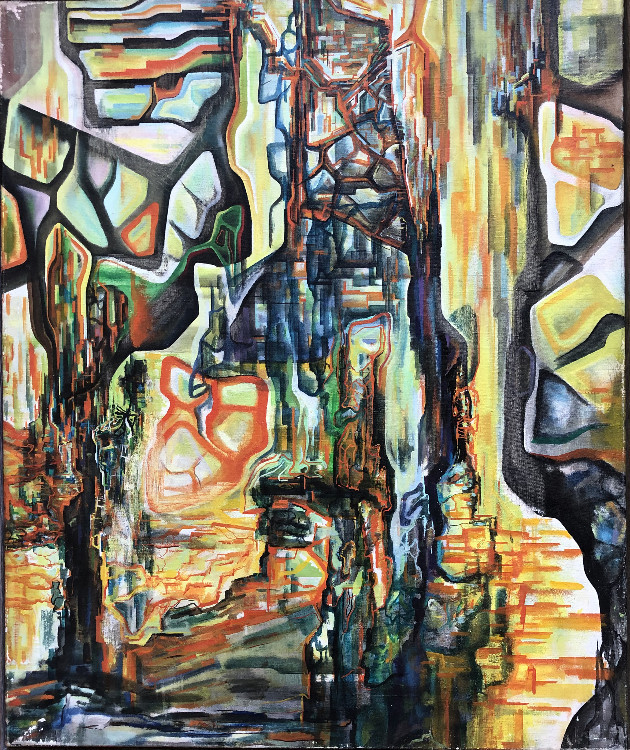
    I made walls, crystalline and vitrified caves, which sometimes opened onto a sky. Going deeper, I quite naturally settled into that opening, and so I painted landscapes.

    Talks

    • Friday 3 February 2023, 6 to 8 pm: presentation and talk with Stéphane Gatti on previously unseen works by Bernard Saby. Where does he come from?
    • Friday 17 February 2023, 6 to 8 pm: a further talk with Stéphane Gatti, on the writings of André Berne-Joffroy and Paul Valéry.

    “Imagine yourself in a world painted in pure colours. These colours follow one another in measure over bodies, the sky and so on. With sudden entrances of incandescent suns, black nights falling like lightning, etc., capsizings of forms that would behave like rivers. And the changes I speak of carried at musical speed.” Paul Valéry, Chemin d’André Berne-Joffroy pour arriver à Bernard Saby.

    Works shown

    • Bernard Saby, Sans titre, 1967, oil on canvas, 54 x 46 cm
    • Bernard Saby, Sans titre, oil on canvas laid down on aluminium, 61 x 50 cm
    • Bernard Saby, Sans titre, circa 1954, oil on paper laid down on wood, 61 x 50 cm

    Artist: Bernard Saby

  • Lou Dubois, Triscénoramas & Co

    Lou Dubois, Triscénoramas & Co

    From 8 December 2022 to 12 January 2023
    Galerie Les Yeux Fertiles, 27 rue de Seine, Paris 6e

    An underrated entomologist, suffering from acute and incurable punnitis, young Lou Dubois went off to look elsewhere. Poet and artist, he opens worlds of infinite vastness in compressed cabinets of curiosities.
    Collage is first of all cutting. Edited like films, the images tip over into the great void and receive some sharply felt comments. He folds Lautré-amont for you into an umbrella, a sewing machine, an écorché and a few glasses.
    He shows a discreet and courteous eroticism but takes a dim view of mothers-in-law, decking them out with turgescent crucifixes and dangling sausages. Brains are occupied by inappropriate objects. A melancholy scholar, he amuses and moves with his brilliant tomfooleries. But the worst of it is that he cuts up children to make pictures of them.
    Serious again, he contributed to the late review Supérieur inconnu, and exhibits at the Galerie Les Yeux Fertiles.

    Owing to its success, the exhibition was extended on the Tuesday, Wednesday and Thursday afternoons of the week of 10 January 2023.

    Works shown

    • Lou Dubois, Triscénorama iconique, 2022, 50 x 39.3 x 6 cm
    • Lou Dubois, Merci pour l’escargot, 2021, 22.5 x 29.2 x 4.2 cm
    • Lou Dubois, Réouverture des Boîtes, 2021, 52 x 34 x 10 cm
    • Lou Dubois, Cibo lichen si beau nombril de Vénus, 2022, 39 x 26 x 5.2 cm
    • Lou Dubois, Le chant d’un argonaute, 2022, 39 x 30 x 4.6 cm

    Artist: Lou Dubois

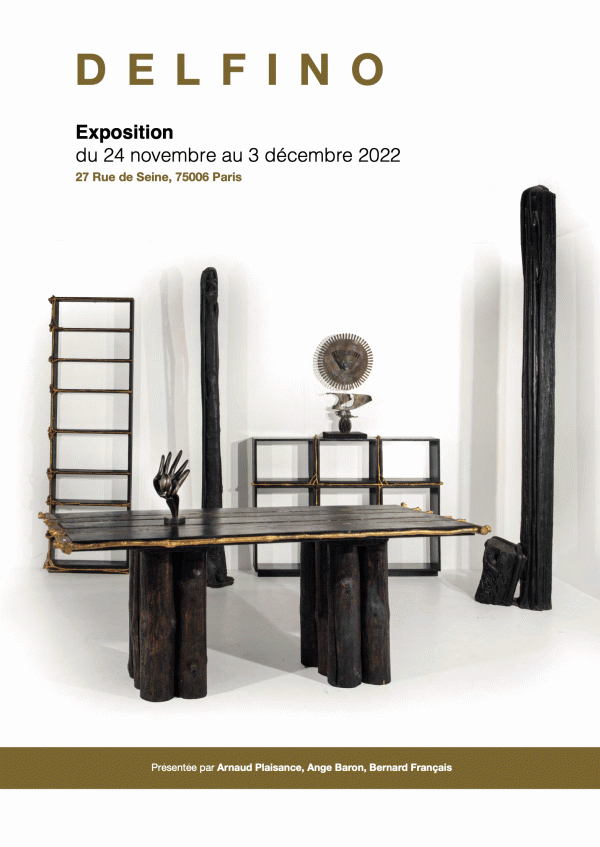
  • Leonardo Delfino

    Leonardo Delfino

    From 24 November to 3 December 2022
    Galerie Les Yeux Fertiles, 27 rue de Seine, Paris 6e

    The Galerie Les Yeux Fertiles is pleased to invite you to discover the furniture, sculptures and drawings of Leonardo Delfino (1928-2022). A catalogue is available at the gallery, or as a PDF on request.

    Leonardo Delfino was born in Turin in 1928 into a traditional Italian family.
    His father was himself an artist, and his childhood was marked by the Mussolini era and the economic hardship that drove the family to emigrate to Argentina in 1936.
    He was a pupil as brilliant as he was unruly. Expelled from school at fourteen, he prepared on his own for the entrance examination of the École des Beaux-Arts in Buenos Aires, which he passed brilliantly… before leaving after a few months. Art interested him from a very early age: he was only seventeen when he discovered a drawing by Jacques Hérold, the Surrealist artist whom he would later know in Paris.
    His vocation led him to use his manual skills to make a living; thus he built several studios while studying under an anarchist painter.
    Delfino was then strongly influenced by realism and socialism, and found his models among the people of the street.
    A self-taught artist, passionate about literature and poetry, he was all his life a great reader, admiring the classics (Tolstoy, London, Nietzsche, Dante, etc.) as much as his contemporaries.
    His first loves were drawing and painting, his original training.
    His reputation grew notably through exhibitions at the Rubbers gallery and his participation in cultural gatherings in the circle of Romero Brest, the art critic who then dominated artistic life in Buenos Aires. It was the time of the “frescoists” such as Diego Rivera and David Alfaro Siqueiros.
    He was not yet twenty-five.
    His meeting with the woman who would become his wife, Olga, transformed his life. From a Russian family, she was cultured, a music lover and a sculptor herself.
    They decided to marry and move to Paris. It was 1959, a time when Paris was bubbling with activity.
    The first days in the French capital were hard but, like him, other young Argentine artists had made the crossing and, very quickly, Delfino turned to sculpture and experimented with a new creative language, focusing on metal, the “scrap iron” he salvaged and worked with screws.
    Between 1961 and 1963, as part of the Biennale des jeunes, “thirty Argentines of the new generation”, he held his first exhibition with Pablo Curatella Manes at the Galerie Creuze, alongside Alicia Penalba and Guzmán.
    His work in steel and his taste for large formats attracted the attention of a young American gallerist, Darthea Speyer, marking the start of a long collaboration. Between 1970 and 1999 they organised eight exhibitions together, making Speyer THE gallerist of Delfino.
    The Musée d’Art Moderne de la Ville de Paris holds two works by the artist from this period.
    From his first sculptures, the central question was that of the organic and of “reality masked by the exterior”. Raoul Jean Moulin marvelled at these “knotted, tumultuous forms that open out all the better” and at these volutes that transfigure the poverty of the material.
    He also exhibited at the Salons de Mai (from 1966 to 1980) and in the gardens of the American Cultural Centre with Albert Féraud on the theme “Seven propositions for metal”.
    Like Féraud, and like the other “metal-poets” Guino, César and Hiquily, he revisited the techniques of assembly and welding, exploiting every possibility offered by metal to create a new language.
    His works are distinguished by a rhythm, a sinuous linearity and a suppleness that underline the artist’s perfect technical mastery of the material.
    He found his first Paris studio with the German sculptor Colas Geissler, on rue de Clignancourt, and divided it in two to share it with the painter Corneille. On his advice, the owner of the premises (originally a joinery) converted them, which allowed Peter Klasen and Breyten Breytenbach to move in as well.
    Very open, Delfino and his wife were in contact with many artists such as Eduardo Jonquières, also Argentine (whose paintings recall those of Vasarely), and Julio Cortázar.
    Around 1965 he gave up steel to return to a more classical practice of clay modelling, fixing his plaster casts with laminated epoxy resin, which required meticulous finishing work. This resin was to become his material of choice. Very strong, easy to mould and light, it requires many stages before achieving a finished material with bronze-like glints that heighten the bewitching aspect of his highly distinctive sculpture.
    He then developed anatomical works that delighted his contemporaries, who praised the “bouquets of muscles and viscera giving birth to hybrid creatures to which he imparts a fascinating lyricism”.
    The 1970s were the years of recognition, but also those in which he pursued his quest to create a phantasmagorical world in which black is a colour as sensual as it is funereal.
    Delfino held one exhibition after another, in Paris and the provinces and internationally (Venice and Budapest biennials, open-air sculpture exhibitions in Seoul…), and above all received prizes and commissions: sculpture-tables and seats for the Musée d’Art Moderne; a sculpture commissioned by Jacques Toubon for the Place Nationale…
    He was allocated a studio-flat on passage Ricaut, where he mixed with Jacques Hérold, Edgard Pillet and Andrée Honoré while continuing to work in his studio on rue de Clignancourt.
    Naturalised French in 1975, he travelled widely, in Europe as well as South America and Egypt.
    He overturned the representation of the body, driven by a fertile imagination that allowed him to reinvent reality. He isolated anatomical elements, took them out of context and combined them while modifying them. Sculpture is a language, and Delfino sought to create a language of his own, combining interiority and objective reality.
    With the development of open-air sculpture museums and cultural policies, some towns committed themselves to artistic development, and many artists accompanied them, such as Ipoustéguy, Viseux and… Delfino.
    In 1978 the town of Vitry-sur-Seine granted him a plot of land on which to build his studio.
    He worked there until 2017… when health problems combined to curb his creative drive, forcing him first to give up large formats and then to devote himself to drawing once more.
    In 1980 one of his works was installed on the Quai Saint-Bernard in Paris, in the open-air sculpture museum.
    He received the commission for a monumental work for La Défense, on the forecourt of the Technip company. He worked on it for four years, and it was inaugurated in 1984 by Jack Lang, then Minister of Culture, further enhancing the artist’s aura. “Lien du corps” stands out through its monumentality in a business district then in full property, but also artistic, development, since works by Calder, Miró, Agam and César stand beside the ever-rising towers.
    The 1990s marked a development in his creative language. His search for balance between tubular and knotted lines was accompanied by the introduction of geometric forms. Combining geometric, organic and natural elements, he created “a new harmony of opposites”. His technique was renewed too, and he gave up casting for assembly. While the glossy black remained, red made its appearance. The appearance of totems, and more broadly the multiplication of vertical elements, reflects his search for balance.
    The red of Life stands against the black of Death, while the use of hands, blood vessels and other realistic details evokes a certain violence, but also “time consuming itself, life dissolving into the void”.
    At the end of the 2000s Delfino withdrew from the art scene. He left the passage Ricaut studio and settled on rue d’Arcueil. Exhibitions became rarer…
    Two successive knee operations forced him to reduce his creative activity. He began by reducing the size of his works before returning to his first love: drawing. He then alternated precise drawings and more inward works.
    The expiry of the lease on his Vitry studio, in 2018, led him to move all his works to rue d’Arcueil.
    His friends and family then approached the Académie des Beaux-Arts to produce a superb monograph, a retrospective of the work of an exceptional artist.
    His recent death makes a tribute to the career of this complete artist absolutely essential, to bring back into the full light one who was among the most accomplished creators of the second half of the twentieth century

    Diane de Karajan

  • Latin American Art

    Latin American Art

    From 14 October to 19 November 2022
    Galerie Les Yeux Fertiles, 27 rue de Seine, Paris 6e

    Opening on Thursday 13 October 2022, 5 to 9 pm

    The gallery pays a special tribute to Joaquín Ferrer (1928-2022). Also in the exhibition are the “Latino” artists who were at times his friends and companions in creation, in Cuba as in Paris.

    “I see abstract forms in nature, lines and more lines… Trees, for example, are as interesting as human forms. I take pleasure in transforming them into abstract forms and introducing them into the architecture of my paintings.” J. Ferrer in 2016, quoted by Serge Fauchereau in the Maison de l’Amérique latine catalogue, Hermann, 2017.

    « Je vois dans la nature des formes abstraites, des lignes et des lignes… Des arbres, par exemple, ont le même intérêt que les formes humaines. Je jouis de les transformer en formes abstraites et de les introduire dans l’architecture de mes tableaux. » J. Ferrer en 2016, cité par Serge Fauchereau in cat. Maison de l’Amérique latine, éd. Hermann, 2017.

    Works shown

    • Joaquín Ferrer, L’Arbre S, 1979, oil on canvas, 128 x 128 cm
    • Joaquín Ferrer, A distance du réel, 1979, oil on canvas, 114 x 146 cm
    • Joaquín Ferrer, Série Promenade, 1967, watercolour on paper, 34 x 26 cm

    Artists: Joaquín Ferrer, Ramón Alejandro, Roberto Álvarez Ríos, Jorge Camacho, Gerardo Chávez, Mauro Mejiaz