
From 20 April to 27 May 2023
Galerie Les Yeux Fertiles, 27 rue de Seine, Paris 6e
Opening on Thursday 20 April 2023
An exhibition featuring mainly pieces from the 1950s and 1960s, the artist’s finest periods. A catalogue of the works has been published.
Christian d’Orgeix comes from a noble family of the Ariège (the Thonel d’Orgeix), Orgeix being a small commune near Ax-les-Thermes.
At first close to post-Cubism, he drew inspiration from Albert Gleizes. Having moved to Paris at the end of the 1940s, he worked there with Hans Bellmer and assisted him in creating his second Doll (1949). This encounter was decisive, as it allowed Christian d’Orgeix to frequent the Surrealists in Paris. He also mixed with Anna de Noailles and Henri-Pierre Roché.
Exhibited in Germany before being shown in France (from 1955), he discovered in Berlin the painting of Friedrich Schröder Sonnenstern and Richard Oelze. Later he became friends with Wols and Sam Francis, and became the mentor of Konrad Klapheck. He was also close to Roberto Matta and to Simon Hantaï, his former roommate. In the post-war context, d’Orgeix chose neither true membership of Surrealism nor true commitment to the artists of the Informel. This non-choice left Christian d’Orgeix’s painting somewhat outside the expected history of art, but it embodies at its best the pictorial issues being worked out in the Paris of the 1950s and 1960s.
Christian d’Orgeix took part in documenta II (1959) and documenta III (1964) in Kassel. He also took part in the “Phases” group.
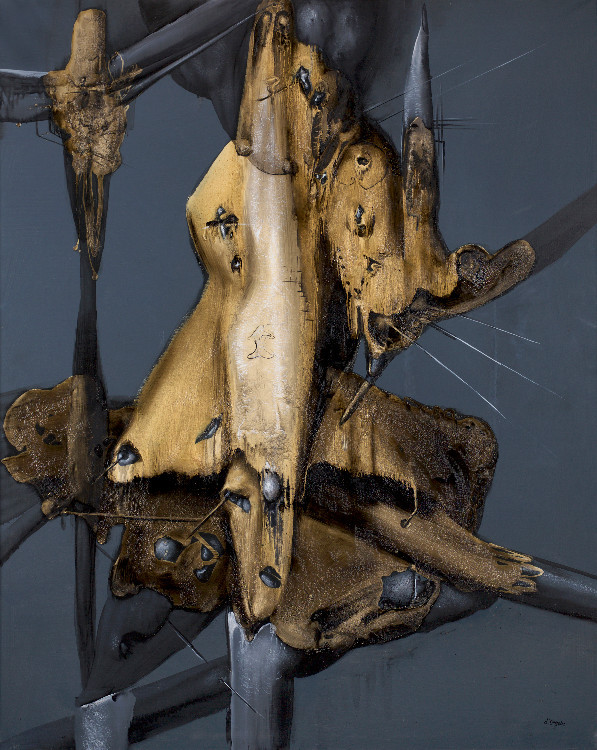
D’Orgeix’s pictorial world seems at first sight dreamlike, while possessing a quality of fleshly texture close to that of Francis Bacon. But the content of his works, always revealed by very precise, though often humorous, titles, is deliberately anchored in reality. His painting Le Général is a ferocious attack on Charles de Gaulle, who is easily recognisable. His painting also strikes a balance between the different tendencies encountered by the avant-gardes in post-Second World War Paris. At once abstract, or at least non-figurative painting, that is, close to the Informel artists, the mechanical or biomorphic motifs glimpsed here and there also undeniably link his painting to a Surrealist-leaning conception. Gesture is present, and the grounds are most often built up using the automatism Hans Bellmer had taught him. This oscillation between Lyrical Abstraction and the painting of the marvellous places d’Orgeix’s work at the crossroads of these very different pictorial currents and gives it its aesthetic interest.
As a sculptor, d’Orgeix recycled found objects, pebbles or stones whose shape inspired him, often obtaining astonishing results. In the manner of Joan Miró, the found stones are interpreted in paint to give them a poetic dimension. This poetics recalls the work of André Breton, who placed stones within the Surrealist workshop.
Article by Philippe Dagen in Le Monde on the exhibition.
Artist: Christian d’Orgeix