From 19 June to 23 July 2021
Galerie Les Yeux Fertiles, 27 rue de Seine, Paris 6e
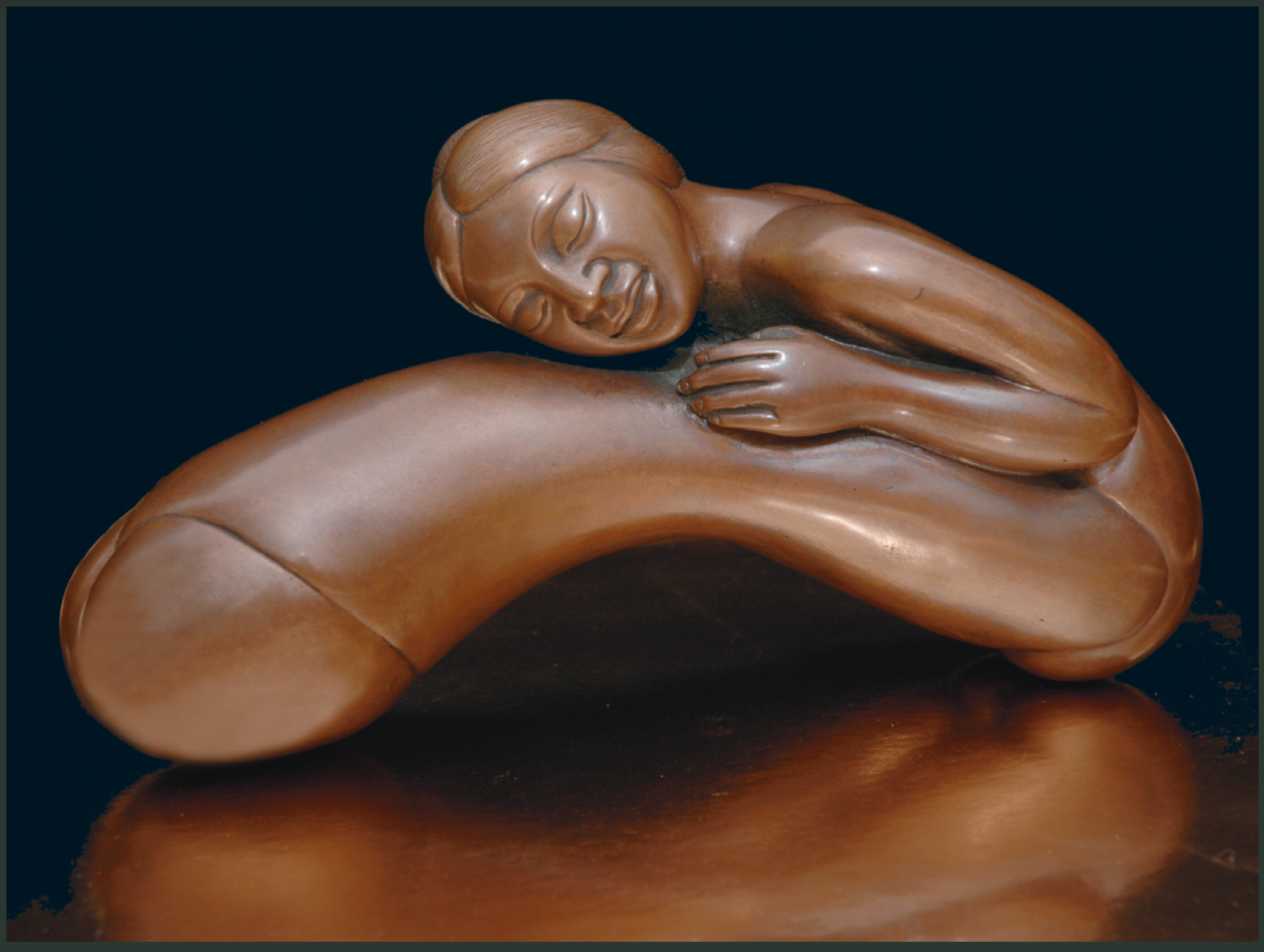
I first met Virginia Tentindo in 1997, when I joined the editorial board of the review Supérieur Inconnu, of which she was a member. I remember, on my first visit to her studio, together with Sarane Alexandrian, being struck by the convulsive beauty of this art, directly in touch with the Marvellous. Virginia always welcomed us with rare generosity and a truly Argentine hospitality, like a “priestess of Tierra del Fuego” in her dreamlike sanctuary of terracottas, bronzes and marbles, with its fauna and flora, all of it born of a most fertile imagination. In 1986 the Surrealist writer José Pierre described this studio as “the factory of the gods”. Virginia Tentindo’s sculptures, at once sensual and terrible, combine the heads of felines with the bodies of men and women, whose legs merge into a single one, long and flexible as a snake. These “humanimals”, as Sarane Alexandrian calls them, look like carnivorous plants. They are not hybrids of the kind made by artists given to easy, outlandish effects, for Virginia’s originality lies precisely in not making arbitrary assemblages. Julio Cortázar could thus write (in Voyage vers un temps pluriel) that with Virginia Tentindo “everything is or may be mandrake, Gorgon, hermaphrodite, phallic rite, hierogamy and why not epiphany”. For nothing is given on a single plane, and for several of her sculptures the multiplicity of essences is like an invitation to come closer and touch; one then discovers that these pieces neither began nor ended at their visual outline, but that touch is there to open a second, low door. Tentindo’s art is never appearance but always inwardness. It is as if, Cortázar writes again, “nature were then questioning its persistent monotony and seeking through art something more than the imitation Oscar Wilde assigns to it, a renewal capable of tearing us away from genetic routine. There, everything is substitution, completion and opening onto new constellations of forms.”
Virginia Tentindo was born in Buenos Aires in 1931. Her grandparents were Italian emigrants who, like so many others, had settled in Argentina not out of a taste for the exotic but for many reasons, among them the exodus of part of the population of the Kingdom of the Two Sicilies. As a teenager she frequented the working-class districts of Buenos Aires. From childhood she went with her mother and father to night-time dances. Music and, above all, dance would play an important role in her life as in her work, which she would define as “a practice of the body in space”.
Virginia’s father was a violinist in a tango orchestra. Virginia Tentindo trained at the Manuel Belgrano, Prilidiano Pueyrredón and Ernesto de la Cárcova schools, before passing the entrance examination and successfully completing the course of the Escuela Superior de Bellas Artes. On leaving art school, Virginia Tentindo and a friend ten years her senior rented a mezzanine in central Buenos Aires which had the advantage of a kiln and two shop windows onto the street, in which to show her sculptures. Thus at eighteen, two years after first exhibiting her work at the Galería Peuser in 1947, she was able to open her own gallery, given the sweet name of Vahiné. To make the venture pay, besides exhibiting her own works and those of her fellow students from the Escuela Superior de Bellas Artes, the young artist gave modelling classes. Virginia felt the need to take on exile, which the tango sings and dances. Before leaving her country, she showed her sculptures and gouaches at the Galería Krayd in 1952, in an Argentine exhibition entitled “Eight Young Surrealist Artists”.
In 1953 she left Buenos Aires with her friends Oski (the greatest comic-strip artist of the 1950s) and his wife Ruth Varansky. Virginia Tentindo travelled to Naples by way of Genoa, where part of her family lived. During her stay in Naples she deepened her knowledge of ceramics and learnt enamelling techniques at Vietri sul Mare. Her wish, however, was to settle in France. In September 1953 Virginia Tentindo arrived in Paris. The Argentine emigrant was poorly received. The struggle began, first of all simply to survive: she modelled terracotta objects and worked off the books in difficult conditions, before returning in the evening to a room with no electricity or comforts. She would wage this struggle alone for ten years. Then, alongside various jobs, such as decorating sweet boxes for the confectioner Fouquet, Virginia Tentindo became secretary (documentation assistant) to the Surrealist poet Philippe Soupault, notably carrying out research in libraries for him. In Paris Virginia Tentindo found her first love again: the Greek-Argentine Surrealist painter Juan Andralis (1927-1994). Two years later, in 1955, she also met again the Argentine painter and sculptor Julio Silva, whom she married in 1959 and with whom she had two children, Olivier and Stella.
In 1960 Virginia broadened the range of her art, becoming a creator of small-format figures (30 cm), thanks to the film-maker Abel Gance, who for his film Austerlitz commissioned fifty sculpted figurines from her after The Coronation of Napoleon (1805-1807) by the painter Jacques-Louis David. Nine years later, in 1969, she made the dolls for Nelly Kaplan’s remarkable film La Fiancée du pirate. The Silva-Tentindo couple set up a studio in the family home and worked together on graphic works, advertising and various illustrations. But soon, after several turbulent periods, the couple separated for good. Virginia regained her independence and had to provide alone for herself and her two children. She thus began a career as a graphic designer and layout artist for various publishers, including the magazine Science & Vie.
In 1974 Virginia Tentindo moved to Pietrasanta in Tuscany, where she learnt to work marble at Torano, near the famous Carrara quarries. In the foundries of Pietrasanta, and later Bologna, she began making her bronzes. In 1979 Virginia Tentindo set up her studio in the famous Bateau-Lavoir in Montmartre, in the 18th arrondissement of Paris. It was there that Virginia would work, as did one of her friends, the Hungarian Surrealist painter Endre Rozsda. From then on her work, praised and admired by figures as demanding as Nelly Kaplan, Julio Cortázar, Dolfi Trost, Théodore Brauner, José Pierre, Pierre Alechinsky and Sarane Alexandrian, was shown in many international group and solo exhibitions (130 exhibitions by 2013).
In 2011 the University of Florence and the Accademia delle Arti del Disegno, with the support of the Institut Français de Florence and the Centre de recherche sur le surréalisme, devoted a conference to her, entitled “The Surrealist Chimeras of Virginia Tentindo”, together with a retrospective, “Virginia Tentindo, Sculptures, Drawings”, at the Accademia delle Arti del Disegno. On this occasion Fabrice Maze and Jean-François Rabain’s film Minimes Innocences was screened, devoted to Virginia Tentindo, the inventor of a world ruled by myth, poetry and eroticism; a dreamlike world that never stops exploring further, ever further, both matter and the mysteries of being, while extending Surrealism, of which she is one of the representatives in sculpture, as Françoise Py wrote and, before her, José Pierre (in L’Univers surréaliste, Somogy, 1983).
El fuego! That is Virginia Tentindo: the tango of the Fire of life and passion; the Fire of desire and poetry; the Fire of metamorphosis and that of the alchemist who brings emotional gold in terracotta out of his athanor: an October Cat or a Lioness of the Earth-Moon Days. Virginia, with hands of flame, sculpts the fire beneath the ashes.
Christophe DAUPHIN
Artist: Virginia Tentindo