Author: admin

  • August Walla

    August Walla

    Austrian Art Brut creator, born on 22 June 1936 in Klosterneuburg, near Vienna, died on 7 July 2001 in Gugging.

    Life

    After his father’s death, August Walla was brought up by his mother, Aloisia, and his grandmother, Rosina. At sixteen, after threatening suicide and setting fire to the house, he was committed. On his release he lived with his mother, who watched over him, in several successive flats in Klosterneuburg; he covered their walls with inscriptions, emblems and signs, as he did the family allotment on the banks of the Danube.

    In 1970 he was admitted to the Maria Gugging psychiatric hospital. In November 1983 he moved with his mother into the House of Artists (Haus der Künstler) at Gugging, where he lived and worked until his death.

    The work

    Walla built himself a private mythology, with its own language, symbols and deities. At its centre stand the “Ewigkeitende” (the end of eternity) and Satttus, protector god of humanity; around them, gods, demons, saints, prophets and miracle workers. This struggle against death runs through the whole of his work. He collected dictionaries of foreign languages, drew words from them which he combined to coin his own terms, and closely intertwined drawing and writing.

    He set no hierarchy between media: easel painting, mural painting, drawing, text, sculpture, installation, photography, performance. He painted the walls and ceiling of his room, his furniture and objects, the walls of the hospital and neighbouring houses, and drew in chalk on the road. For him, his works were talismans against spirits, people and death.

    Exhibitions and collections

    • Collection de l’Art Brut, Lausanne (permanent collection).
    • “From the World of Darkness to Rebirth through Creation and Art”, Galerie Les Yeux Fertiles, 10 June to 23 July 2022: World flow, double-sided drawing, black and coloured pencils, 38 x 28 cm.
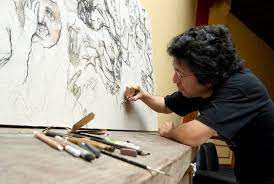
  • Jorge Vigil

    Jorge Vigil

    Peruvian painter and draughtsman, born in 1963 in Lima. He has lived in Paris since 1990.

    Life

    A graduate of the National School of Fine Arts of Peru, Jorge Vigil settled in France in 1990. There in 1992 he received second prize at the Salon Lefranc Bourgeois (South-West region), then in 2000 a prize at the first festival of the town of Nay. In 2012 the Enlace Arte Contemporáneo gallery in Lima presented his solo exhibition La cuarta cifra, bringing together the works of the two years before his fiftieth birthday.

    The Galerie Les Yeux Fertiles has shown his work regularly since 2022.

    The work

    His compositions combine elements of his surroundings with an imaginary world, between reality and dream. Saturated to the point of horror vacui, they nonetheless leave room for calm figures, among which the eye can follow several narratives. Vigil works mainly in drawing: graphite, watercolour, charcoal, acrylic, mixed media on paper, sometimes on maps.

    “La línea y el color pertenecen a la misma tragedia” (line and colour belong to the same tragedy). (Jorge Vigil, Arte por Excelencias)

    Exhibitions and collections

    • La cuarta cifra, Enlace Arte Contemporáneo, Lima, December 2012 to January 2013.
    • “Itinerary of a Dreamer”, Galerie Les Yeux Fertiles, 20 January to 5 February 2022: Aguas tranquilas, 2016, graphite, 30 x 42 cm; Saint George et le Dragon, 2016, drawing on a map, 31 x 24 cm.
    • The Enchanted World of Jorge Vigil, Galerie Les Yeux Fertiles, July 2023.
    • “Beyond My Dreams”, with Olena Donichenko, Galerie Les Yeux Fertiles, 3 May to 1 June 2024: Vestiges, 2015, watercolour, charcoal and acrylic on paper, 27 x 19 cm; Coïncidences, 2019, mixed media on paper, 31 x 45 cm.
    • “A Journey through Latin America”, Galerie Les Yeux Fertiles, 18 April to 31 May 2025.
  • Jean-Pierre Vielfaure

    Jean-Pierre Vielfaure

    French painter, printmaker, lithographer and filmmaker, born in 1930 in Algiers, died in 2015.

    Life

    Jean-Pierre Vielfaure was born in Bab El Oued, in Algiers, into a family of stationers, booksellers and publishers. In 1938 his parents settled in Rodez, where he began drawing on his own at around twelve. His first exhibition, in Rodez in 1950, brought together drawings of landscapes of the Rouergue.

    In 1952 he divided his life between Éméville (Oise) and Montmartre. In 1956 he met the German painter Carl Buchheister, whom he would call his “spiritual father” and whom he welcomed to Éméville six months a year until his death in 1964. Linked to Édouard Jaguer from 1958, he joined the Phases movement and contributed original prints to no. 10 of the review. In 1960 he signed the Manifesto of the 121; in 1961 he received the foreign art critics’ prize at the 2nd Paris Biennale.

    In 1965 he joined the Inter group, made up mainly of Scandinavian artists: the start of a long relationship with Copenhagen, of exhibitions and editions of his prints. From 1968 he stayed in Ibiza and Formentera. In 1977 a first long stay in New York and Canada produced the series Journal new-yorkais and a film of the same title, completed in 1979. At the end of 1988 he set up his studio in the former eyelet factory in Ivry-sur-Seine.

    The work

    From 1968 Vielfaure undertook Opéra Civilisation, a set of seventy-two paintings (collage, acrylic, mixed media) forming a single work some forty-two metres long; at the same time he was illustrating for Rock & Folk. Then came Les Portes d’Ibiza (1970-1973), more than fifty canvases shown in 1973 in Ibiza, Copenhagen and Helsinki, and, in 2007, the series L’Appel aux esprits, in which he evokes his spirituality: “Shamanism is my true religion.”

    “In art, meaning can only appear veiled, and its revelation can only take place in the fractures.” (Jean-Pierre Vielfaure, working notebook, 22 June 1998)

    Exhibitions and collections

    • Galerie du Fleuve, Paris, 1960; 2nd Paris Biennale, 1961; L’Appel aux esprits, Camille-Lambert contemporary art space, Juvisy-sur-Orge, 2007; contemporary art centre of the Château de Kerguéhennec, Bignan, 2018.
    • Centre Pompidou, Musée national d’art moderne: notably Herbes magie (1960), Le Passe-muraille (1962), Personnage aux deux soleils rouges and Le Prophète de l’abîme (15 October 1962); his archive is held at the Bibliothèque Kandinsky.
    • Other public collections: MAC VAL, Vitry-sur-Seine; Musée d’arts de Nantes; National Gallery of Art, Washington; Kunsthalle Bremen; ARoS Aarhus Kunstmuseum; Château de Kerguéhennec.

    Looking back at their exhibitions

  • Paul-Émile Victor

    Paul-Émile Victor

    French polar explorer, ethnologist and draughtsman, born on 28 June 1907 in Geneva, died on 7 March 1995 in Bora Bora (French Polynesia).

    Life

    A student at the École centrale de Lyon, Paul-Émile Victor then served in the Navy and the air force. In 1934 he persuaded Jean-Baptiste Charcot to take him to Greenland aboard the Pourquoi-Pas ?; he spent a year with three companions among the Inuit of Ammassalik. In 1936 he crossed the ice sheet by dog sled with Robert Gessain, Michel Perez and Eigil Knuth: 825 kilometres in 44 days, from west to east.

    During the Second World War he served in the United States Air Force. In 1947 he founded the Expéditions polaires françaises, which would carry out some hundred and fifty missions in the Arctic and Antarctic, notably in Adélie Land. He later retired to Bora Bora, where he died.

    The work

    “Tell me what you draw, and I’ll tell you who you are”…

    So many pieces of the puzzle of his personality, his drawings carry within them what he was. Tender and never unkind, they exude humanity. Precise and lively, they prove his gift for observation. Colourful and teeming, they burst with his unfailing life force, the force he drew from within to pick himself up wherever he had fallen. Whimsical and even zany, they also show how well he knew not to take himself seriously.

    Inspired by other painters or wholly original, PEV’s drawings are the fruit of his insatiable curiosity and his constant openness to something else. Graphite pencil, ballpoint, pen and ink, dry or wax crayon, felt-tip, paint, raw ink, liquid glue…

    Try everything, attempt everything. To learn, to understand, but also to have fun… At the risk of going off in all directions, of which Paul-Émile Victor was perfectly aware: not without humour, he created an art movement (with himself as its only member) which he called “Acanthomism”, because “the acanthus leaf (known to everyone for its use in architectural ornament) is a plant with deeply cut leaves symbolising a multiple approach in every direction.”

    Exhibitions and collections

    • Galerie Les Yeux Fertiles, July 2023: Paul-Émile Victor’s Polynesian drawings.
    • Summer exhibition, Galerie Les Yeux Fertiles, 10 to 26 July 2025: “The ethnologist, explorer and pataphysician Paul-Émile Victor”.
  • Claude Verlinde

    Claude Verlinde

    French painter, printmaker and illustrator, born in 1927 in Paris, died in 2020 in the same city. A leading figure of Fantastic Realism.

    Life

    Flemish on his father’s side, Claude Verlinde drew from childhood. A teacher urged him to sit the entrance examination for the École des arts appliqués à l’industrie; he passed, but the war swept the plan away and the family withdrew to Saint-André-sur-Orne, in Normandy. Apprenticed in a workshop of religious sculpture, he then assisted Drouin, director of the École des beaux-arts in Caen, in restoring the church of Saint-Pierre. Drouin, who was passing surveys of the Atlantic Wall to London, was shot on D-Day. During the fighting Verlinde sheltered in the iron mines, where he drew underground life and the refugees; the family home was destroyed.

    The family was rehoused in Montigny-lès-Cormeilles, in a house without water or electricity; there Verlinde met Dr Guy Dulon, a collector of African and pre-Columbian art, who supported the painter all his life and bought his first sculpture, Le Joueur de luth. At seventeen, staying with his father’s family in Belgium, Verlinde discovered Bosch and Bruegel the Elder: the encounter was decisive.

    After his military service at the Dijon air base, where he painted a fresco in the officers’ mess, he frequented the Galerie des Antiques and Souverbie’s studio at the École des beaux-arts in Paris, as well as the anatomical drawing sessions at the Grande Chaumière. In 1955 he settled in Vallauris: a decorator for potters in the morning, a painter in the afternoon. There he met Robert Tatin, under whose influence he briefly tried his hand at Art Brut before following his own path. He returned to Paris in 1960.

    The work

    A humanist painter in his own words, Verlinde belongs to a lineage running from Bosch, Bruegel and Cranach to Ensor. As well as painting and drawing, he practised engraving, lithography (printed at Mourlot) and sculpture (resin, bronze, terracotta, plaster). As an illustrator he designed book covers, the poster for the Avoriaz festival (1983), theatre sets and costumes, notably for Marivaux at the Comédie-Française, and bibliophile editions of Pantagruel (2001) and La Fontaine’s Fables.

    Exhibitions and collections

    • Galerie Duncan, Paris, 1948; retrospectives at the Galerie de la place Beauvau, Paris (1980), and in six Japanese cities (1985); Palais Coburg, Vienna (2005); guest of honour at Art Capital, Grand Palais, Paris (2019).
    • Collections: Musée départemental de l’Oise, Beauvais; Musée Daubigny, Auvers-sur-Oise; museum devoted to the artist in Vitznau (Switzerland), on Lake Lucerne.
    • “At the Sources of Convulsive Beauty”, Galerie Les Yeux Fertiles, 25 October to 30 November 2024: L’Ibis sacré, 1971, oil on canvas, 54 x 73 cm.
    • “The Subversion of Images”, Galerie Les Yeux Fertiles, 24 January to 8 March 2025: Dans le fauteuil, 1996, oil on panel, 80 x 55 cm.
    • “The Fantastic Realism of Claude Verlinde”, summer exhibition, Galerie Les Yeux Fertiles, 10 to 26 July 2025.
    • “The Gallery’s 25th Anniversary”, Galerie Les Yeux Fertiles, 22 May to 19 June 2026: Jeu d’échecs, 1970, oil on canvas, 38 x 55 cm.
  • Germain Van der Steen

    Germain Van der Steen

    French painter, born in 1897 in Versailles, died in 1985.

    Life

    As a teenager, Germain Van der Steen (or Vandersteen) was already drawing and painting in watercolour. Called up during the First World War, he was gassed and suffered lasting after-effects, including sleep disorders.

    Between the wars he ran an artists’ colour shop in Paris with his wife (from 1925 according to Le Delarge, from 1931 according to the museum in Laval) and painted at night. Encouraged by the critic Anatole Jakovsky, he exhibited at the Salon d’automne from 1944, then at the Galerie Louise in Paris (1950) and at Hutter in Basel (1951). His work was later shown in France, Belgium, Germany, Austria, the former Yugoslavia, the United States, Brazil and Israel.

    The work

    Self-taught, classed sometimes among the naive painters, sometimes among the authors of Art Brut, Van der Steen went through three periods: a non-figurative period inspired by the music of the composers of his time; that of imaginary plants, trees or flowers with detached, many-coloured leaves and drapery stretched between the trunks; and finally that of the bestiary, above all cats and birds, which sometimes earned him the nickname “emperor of cats”. His palette is very bright.

    Deprived of sleep by the after-effects of the war, he said he painted the dreams he could no longer have, seeing suffering as the source of “the true creation of the mind”.

    Exhibitions and collections

    • Salon d’automne, Paris, from 1944.
    • Centre Pompidou, Musée national d’art moderne: Entente cordiale, before 1955, oil on cardboard, 54 x 65 cm, given by the artist to the State in 1955.
    • Musée d’art naïf et d’arts singuliers (MANAS), Laval: Le Chat à la pelote, 1944, oil on plywood; Le Bureau de tabac de Chatenay, 1944, oil on panel; Oiseau fantastique, gouache and oil on hardboard; Chat, pastel.
    • Croatian Museum of Naive Art, Zagreb.
  • Suzanne Van Damme

    Suzanne Van Damme

    Belgian painter, born on 22 September 1901 in Ghent, died on 11 January 1986 in Ixelles.

    Life

    Suzanne Van Damme trained at the academies of Ghent and Brussels, then at the independent studio L’Effort in Brussels. In Ostend she came under the influence of James Ensor, who became her mentor: she painted his portrait in 1925, and he painted hers in 1938. Her early work belongs to Post-Impressionist painting.

    In the early 1930s she settled in Paris, where she met the Italian painter and poet Bruno Capacci, whom she married. She would then divide her life between Paris, the south of France, London and Florence.

    In 1941 she came into contact with the Surrealists. André Breton photographed many of her first Surrealist canvases. In 1947 she took part in the International Surrealist Exhibition organised in Paris by Breton and Marcel Duchamp.

    The work

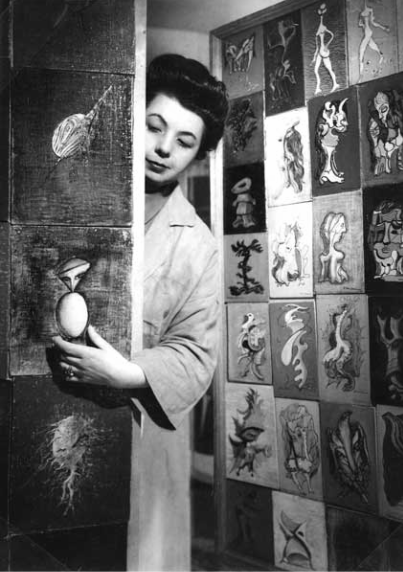
    Her paintings of the 1940s are in dialogue with Picasso, De Chirico, Kurt Seligmann and Toyen. Settled in Florence, she turned towards abstraction, then developed a personal language of ideograms composed of “mini-paintings” mingling abstract and figurative elements.

    Exhibitions and collections

    • Venice Biennale, 1935, 1954 and 1962; São Paulo Biennial, 1953.
    • International Surrealist Exhibition, Paris, 1947.
    • United States, 1950s and 1960s: Marshall Field Gallery, Chicago (1959); Thibault Gallery, New York (1961); Calhoun Gallery, Dallas (1961); Saks Gallery, Denver (1969).
    • Museum of Fine Arts, Ghent (MSK): a large Surrealist oil entitled The Oppressor of Silence in the museum’s record, 156 x 122.5 cm, on deposit from the Flemish Community since 1949.
  • Damian Valdes Dilla

    Damian Valdes Dilla

    Cuban Art Brut creator, born in 1970 in Havana.

    Life

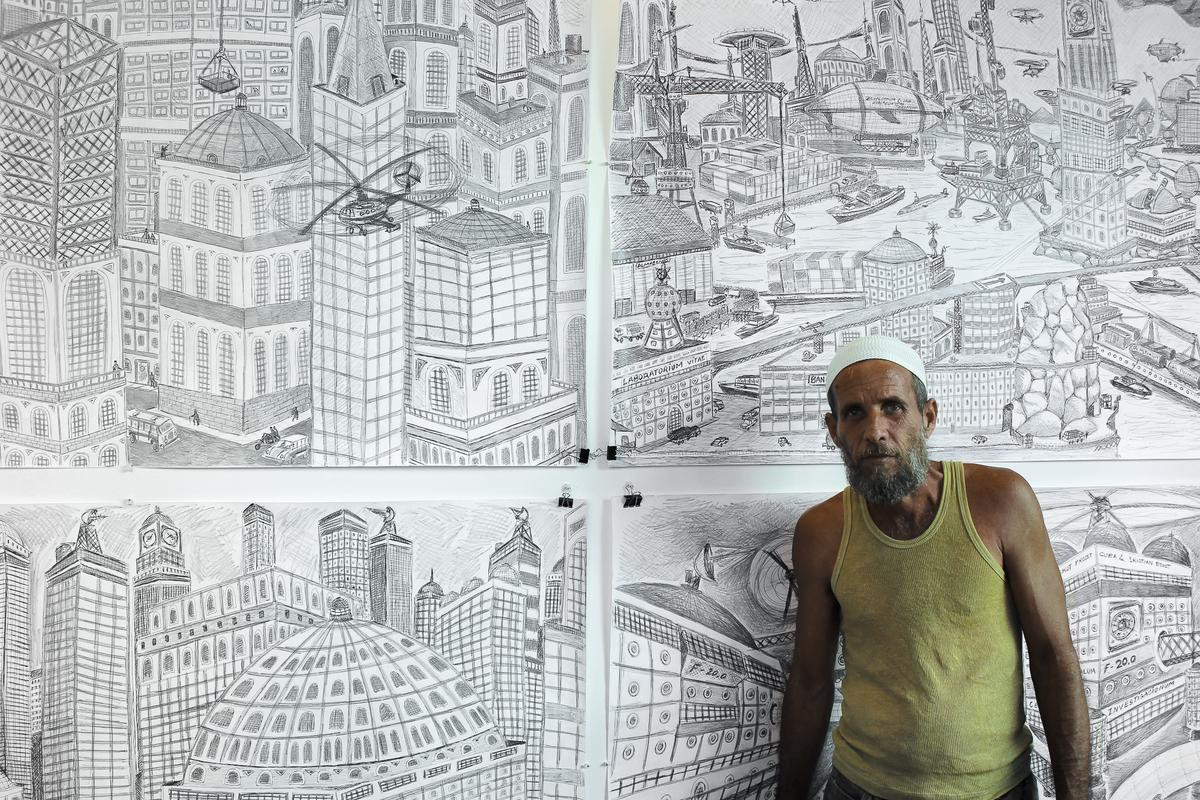
    Damián Valdés Dilla left school at seventeen because of serious psychological disorders; schizophrenia was diagnosed in adolescence. Under treatment, he held various jobs, irregularly. After the failure of his marriage he went back to live with his mother in a small flat in Alamar, a dormitory suburb of Havana made up of five-storey Soviet-style blocks.

    A convert to Islam, which he has adapted to his own philosophy, he always carries a Koran, a prayer mat and a prayer cap.

    The work

    He began by building models of cities from small pieces of wood, then, as wood became hard to find, from salvaged materials: buildings, towers, blocks of flats and a whole fleet of flying machines assembled from scraps picked up in the street, perhaps intended to save his island, which he depicts as sinking.

    Since 2014 he has been drawing, in ballpoint pen, meticulous and orderly cities, the opposite of the disorder of his assemblages: tightly packed towers topped with pyramidal roofs and clocks, monumental metropolises with fantastical perspectives, vehicles of every kind (aeroplanes, helicopters, ships, buses). No human figure ever appears.

    Exhibitions and collections

    • Collection de l’Art Brut, Lausanne: Sans titre, 2015, ballpoint pen on paper, 40.5 x 100.8 cm; exhibition “Art Brut CUBA”, 6 December 2024 to 27 April 2025.
    • Musée national d’art moderne, Centre Pompidou: untitled assemblages (c. 2000) from Bruno Decharme’s abcd collection, donated in 2021.
  • Václav Tikal

    Václav Tikal

    Czech painter and ceramicist, born on 24 December 1906 in the Plzeň region, died on 26 November 1965 in Prague.

    Life

    Partly self-taught, Václav Tikal first painted as an amateur, a “Sunday painter”. From 1937 he studied at the Academy of Fine Arts in Prague, until the institution was closed during the war.

    In the midst of the war he joined a circle of young artists, where he met Karel Teige and other Surrealists. After the Liberation he was one of the painters of the Ra group, with Josef Istler, Bohdan Lacina and Václav Zykmund. The group published its founding text and held its first group exhibition in 1947; it was officially banned in 1948.

    After Teige’s death, Tikal withdrew for several years and almost stopped painting. From 1964 he took part in the international Phases movement, as did Josef Istler. In the last years of his life, solo exhibitions and his inclusion in exhibitions of modern art, in Czechoslovakia and abroad, brought him wider recognition.

    The work

    Tikal is one of the leading representatives of post-war Czech Surrealism; he is often likened to Salvador Dalí and Giorgio de Chirico. His landscapes express inner states, with a Romantic colouring. During and after the war they host cruel scenes and fragments of human bodies. Lyricism and a “nostalgia for the marvellous” run through the whole of his work.

    The late works slide towards abstraction: imaginary and constructive elements combine geometry with natural forms. Tikal also designed models for ceramics and porcelain.

    Exhibitions and collections

    • National Gallery Prague: Surrealist Object (Head), 1945; Prometheus Unbound, 1945.
    • “Surrealist Prelude”, Galerie Les Yeux Fertiles, 7 June to 6 July 2024: Sans titre, 1957, graphite drawing, 34 x 23 cm.

    Looking back at their exhibitions

  • Jean Terrossian

    French painter, born in 1931. A member of the Surrealist group from 1961.

    Life

    Armenian was the language of Jean Terrossian’s early childhood; French became the language of his culture. Before calling himself, self-mockingly, a “painter”, he readily lists his failed careers: tap dancer, cook, bar pianist.

    In 1961 he joined the group gathered around André Breton. He took part in the café meetings and collective games, discovered Breton’s poem-objects, and there developed his attention to the “ricochets” of thought. His first published drawing appeared in 1963 in no. 5 of La Brèche, the review edited by Breton. The same year he co-signed the tracts La Voie inique (8 February) and the Lettre ouverte à Messieurs Duhamel, Mauriac, Maurois… (15 April). In December 1965 he appeared in the catalogue of the exhibition L’Écart absolu at the Galerie de L’Œil.

    A painter, illustrator and maker of objects, he was the subject of a retrospective in Maubeuge in 2000 (catalogue La mémoire mise à sac). In 2010 the review L’or aux 13 îles devoted a feature to him.

    The work

    Terrossian himself distinguishes two manners: a first, of graphic and pictorial spontaneity, close to a classical beauty; a second, based on the Surrealist “beautiful as” and on involuntary mechanisms (slips, associations, puns). He paints in acrylic on canvas, sometimes with collage elements repainted by hand, as in Duchamp libre. His subjects come from everyday life: objects he dislikes (sports equipment, telephones), beaches and the sea, tributes to Marcel Duchamp, words painted in French. He is often likened to Narrative Figuration, from which he stands apart.

    “My paintings start from and speak of my daily life, and it is the failures that drive them.” (Jean Terrossian, interview, Contretemps no. 8)

    His work is slow: he sketches several compositions before choosing one, in what he describes as “a process of fermentation, then crystallisation”.

    Exhibitions and collections

    • L’Écart absolu, Galerie de L’Œil, Paris, December 1965.
    • Retrospective, Maubeuge, 2000.
    • Galerie Les Yeux Fertiles, July 2023: Duchamp libre, c. 1974, acrylic on canvas, 117 x 80 cm.
    • “Surrealist Prelude”, Galerie Les Yeux Fertiles, 7 June to 6 July 2024: En chute libre, c. 1965, oil on canvas, 81 x 100 cm.

    Looking back at their exhibitions