Author: admin

  • Icons Opus II, Arnaud d’Aunay

    Icons Opus II, Arnaud d’Aunay

    From 1 December 2016 to 15 January 2017
    Galerie Les Yeux Fertiles, 27 rue de Seine, Paris 6e

    A travelling painter from a family rooted in the Nivernais and Paris, Arnaud d’Aunay is a former banker turned “globe painter”. In 1984, noticed by Pierre Cardin, who sponsored his first exhibition, he immersed himself in his childhood dreams. In 1985 he exhibited in New York and met Andrew Wyeth, who confirmed him in his adventure and encouraged him in the technique he champions: tempera.

    He travels the world, capturing and translating discoveries, encounters and travel impressions in watercolour, ink and tempera. Since 2001 Gallimard has successfully published his sketchbooks: Les Indes françaises, Au fil du Mékong; Escales d’Artistes, Vézelay, Napoléon, Empereur des îles, Empereur d’exil, Vauban, génie maritime. He exhibits in Paris, New York, San Francisco, Tokyo, Brussels and Lausanne.
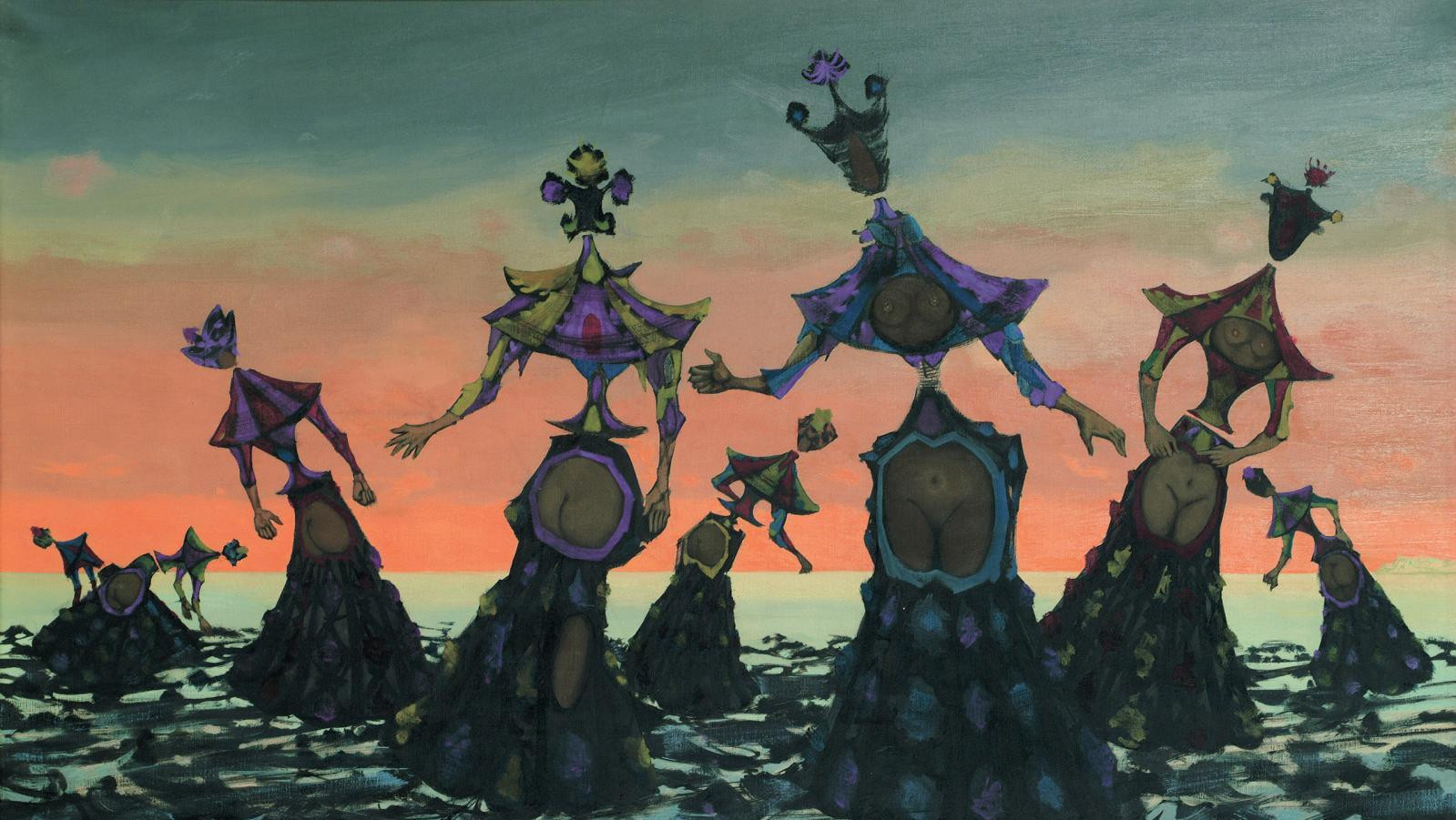
  • The Impossible Objects of Jacques Carelman

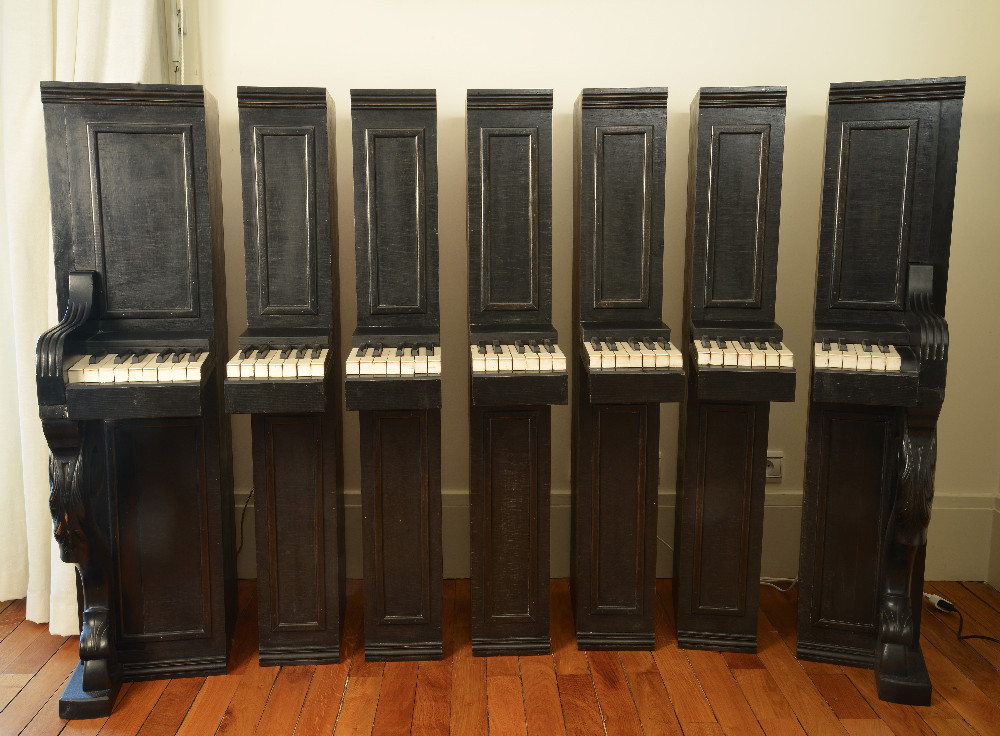
    The Impossible Objects of Jacques Carelman

    From 13 May to 25 July 2016
    Galerie Les Yeux Fertiles, 27 rue de Seine, Paris 6e

    The gallery presents a selection of the original drawings behind the famous Catalogue des Objets introuvables, published in 1969 and translated into 19 languages, from which the objects themselves derive, made for the 1972 exhibition at the Musée des Arts Décoratifs.

    Artist: Jacques Carelman

  • A Journey into the Imagination

    A Journey into the Imagination

    From 21 January to 12 April 2016
    Galerie Les Yeux Fertiles, 27 rue de Seine, Paris 6e

    WITH
    Lucien COUTAUD
    Guy HARLOFF
    Stanislao LEPRI
    Didier MAZURU
    Jules PERAHIM
    Jorge VIGIL
    Jan SVANKMAJER
    Jean-Claude SILBERMANN

  • Patrice Cadiou, Talismanic Nights

    Patrice Cadiou, Talismanic Nights

    From 1 June to 1 July 2012
    Galerie Les Yeux Fertiles, 27 rue de Seine, Paris 6e

    Solo exhibitions:

    2012 Talismanic Nights, Galerie Les Yeux Fertiles, Paris, France
    2007 Galerie Joëlle Possémé, Paris, France
    2000 Fort de Bellegarde, Le Perthus, France
    1999 Galería de Arte de la Riba, Cadaqués, Spain
    1998 Galerie Ridel, Paris
    1997 Fondation Taylor, Paris
    1990 FIAC, Galerie Jaquester
    1989 Salon d’Angers
    1989 Sigma, Bordeaux
    1989 FIAC, Galerie Faris, Paris
    1987 Galerie Keller, Paris
    1986 Galerie Ridel, Paris
    1984 Galerie Site-Art Présent, Raymond Cordier, Paris
    1981 Galerie Gérard Laubie, Paris
    1978 Galerie Gérard Laubie, Paris
    1977 Galerie d’Art Papelier, Metz
    1976 Galerie d’Art de la Place Beauvau, Paris
    1975 Galerie Huguerie, Bordeaux
    1972 Galerie Condillac, Bordeaux
    1970 Galerie de l’Académie, Lausanne
    1969 Galerie Moyon Avenard, Nantes
    Numerous group exhibitions from 1976 to 2006, in France and abroad:

    Espace Cardin, Halle Saint-Pierre, museums of Bouffémont, Dieppe, Pau and Belfort, Palais Bénédictine.
    FIAC: successively with the Galeries Jaquester, Raymond Cordier and Gérard Laubie.
    SIGMA Bordeaux, Arelis Grand Palais, etc.
    Galeries Manséra, Ecofrica and Galerie du Casino in Spain, etc.

    Public collections:
    Musée d’Art Moderne de la Ville de Paris
    Musée de Belfort
    Musée Prince Murat
    FRAC Normandie
    Musée Hermès

    Private collections:
    France, Canada, Belgium, Switzerland, Germany, USA, Japan, Italy
    Sculpted doors made for architects and private commissions

    Artist: Patrice Cadiou

  • Carlo Zinelli

    Carlo Zinelli

    Italian Art Brut creator, born on 2 July 1916 in San Giovanni Lupatoto (province of Verona), died on 27 January 1974 in Verona.

    Life

    The sixth child of Alessandro Zinelli, a carpenter, and Catterina Manzini, who died in childbirth in 1918, Carlo Zinelli worked in the fields from the age of eight. At eighteen his father sent him to work at the municipal slaughterhouse in Verona; he loved music and dancing.

    Called up in May 1938 to the 11th Alpini regiment, in March 1939 he joined the Italian volunteer corps sent to support Franco’s troops; landing in Cádiz on 25 March, he left Spain thirteen days later. The first signs of schizophrenia appeared at this time. Demobilised in December 1941, he was committed in 1947 to the San Giacomo alla Tomba psychiatric hospital in Verona.

    In 1957 the sculptor Michael Noble opened a free-expression studio in the hospital, with the psychiatrist Mario Marini and the agreement of the director, Cherubino Trabucchi. Zinelli painted there for up to eight hours a day. The psychiatrist Vittorino Andreoli studied his work and brought it to the attention of Jean Dubuffet. In 1969 the hospital’s move to Marzana disoriented him: he painted far less until his death from pneumonia at the Chievo sanatorium.

    The work

    Some 1,900 paintings and a few sculptures. Zinelli worked in tempera and coloured pencils on white paper. From 1962 to 1968 he painted his sheets on both sides, which read like continuous narratives. Profiled silhouettes, often pierced with holes in place of eyes, repeated until they saturate the ground; primary colours; memories of the countryside of his childhood.

    Exhibitions and collections

    • Galleria La Cornice, Verona, 1957; Insania Pingens, Kunsthalle Bern, 1963.
    • Touring exhibition in France: Musée international des arts modestes, Sète (2004); LaM, Villeneuve-d’Ascq (2005); Musée de l’Abbaye Sainte-Croix, Les Sables-d’Olonne (2005-2006).
    • American Folk Art Museum, New York, 2017; “Recto Verso”, Collection de l’Art Brut, Lausanne, 2019.
    • Collections: Collection de l’Art Brut, Lausanne; LaM; Zander Collection, Cologne; Fondazione Culturale Carlo Zinelli, San Giovanni Lupatoto.
    • “Art Brut” exhibition, Galerie Les Yeux Fertiles, 10 June to 23 July 2022: Sans titre, 1966, gouache on paper, double-sided, 70 x 50 cm.
  • Frantz Zéphirin

    Haitian painter, born in December 1968 in Cap-Haïtien.

    Life

    The son of an architect and a nurse, Frantz Zéphirin was brought up by his grandmother, an embroiderer; as a very small child he was already drawing flower motifs. He began painting in 1973, at the age of five, with his uncle, the painter Antoine Obin, a master of the Cap-Haïtien school. At seven he was selling small landscapes to tourists from cruise ships.

    In 1983 he went to continue his schooling in Port-au-Prince, then gave up his studies to devote himself to painting and joined the Galerie Monnin. From 1988, at the Centre d’Art in Port-au-Prince, he asserted his own themes and style. A Vodou priest, he lives and works in his temple, the Temple of the Seven Virgins, on a mountain above Mariani, on the outskirts of Port-au-Prince.

    The work

    Zéphirin draws on history, politics, the environment, the Bible, Creole culture and Vodou. His dense, brightly coloured compositions bring together human figures with the heads of wild or domestic animals (monkeys, elephants, crocodiles, giraffes), mystical characters and parallel worlds. Through them he caricatures Haitian society, and above all its ruling class. He describes himself as a “historical animalist”.

    His paintings have been on the covers of The New Yorker, Time, The New York Times and Smithsonian Magazine.

    Exhibitions and collections

    • Swiss Prize and European Prize for modern primitive painting, Kasper Pro Arte, Morges (Switzerland), 1994; gold medal at the 3rd Biennial of Caribbean and Central American Painting, Museum of Modern Art, Santo Domingo, 1996.
    • Sacred Arts of Haitian Vodou, Fowler Museum, Los Angeles, 1995, then a tour of the United States.
    • Le dernier voyage d’André Malraux en Haïti, Musée du Montparnasse, Paris, 2009.
    • Kafou: Haiti, Art & Vodou, Nottingham Contemporary, 2012-2013; In Extremis, Fowler Museum, UCLA, 2012-2013.
    • Collections: Afrika Museum, Berg en Dal (Netherlands).
  • Ludwig Zeller

    Ludwig Zeller

    Chilean poet and visual artist, born in 1927 in Río Loa, in the Atacama Desert, died in 2019 in Mexico.

    Life

    The son of an immigrant employed in the mines of northern Chile, Ludwig Zeller was first shaped by German Romanticism, which he studied and translated from the age of twenty; he published Las grandes elegías de Friedrich Hölderlin with the university press in Santiago. From 1952 to 1968 he ran the gallery of the Ministry of Education. In the 1960s he also worked at the Centre for Medical Anthropology of the Faculty of Medicine of the University of Chile.

    In Buenos Aires he met the poets of Argentine Surrealism. With his wife, the artist Susana Wald, he founded the review Casa de la Luna in Santiago and, at the end of the 1960s, organised the exhibition Surrealismo en Chile. In 1971 the couple moved to Toronto with three of their four children; there Zeller set about founding Oasis Publications. In France he was in contact with the Phases movement. The family later left for Mexico and settled in Oaxaca, where he lived until his death. His archive is held at Library and Archives Canada.

    The work

    For Zeller, poetry and image are inseparable. Collage accompanies his entire career, from two collage murals made in 1955 and 1957, now destroyed, to the Oaxaca years, when he devoted himself to it more fully. His books are often objects: Paloma que se sueña (1960) is printed on paper folded into the shape of a dove; Las reglas del juego (1968) appeared in Spanish, English, German and French. The video poem The Alchemical Body (1986), in which his collages and Susana Wald’s paintings are projected onto a naked body, was shown at the 42nd Venice Biennale.

    Exhibitions and collections

    • 42nd Venice Biennale, with The Alchemical Body.
    • Library and Archives Canada: Ludwig Zeller fonds.
    • “At the Sources of Convulsive Beauty”, section “Édouard Jaguer and the international Phases movement”, Galerie Les Yeux Fertiles, 25 October to 30 November 2024.
  • Jean-Michel Wuilbeaux

    Jean-Michel Wuilbeaux

    Painter born in 1968 in Valenciennes. Since 1990 he has worked at the La Pommeraie studio in Belgium.

    Life

    Since 1990 Jean-Michel Wuilbeaux has attended the visual arts studio of La Pommeraie in Belœil, in Hainaut. Founded in 1972, La Pommeraie is a residential centre for adults with disabilities, spread across several villages, including Ellignies-Sainte-Anne. Its studio, whose artists are promoted by the Fondation Paul Duhem, has exhibited in France, Hong Kong and Russia.

    The Trinkhall Museum in Liège devoted his first monographic exhibition to him, organised with the Fondation Paul Duhem and Bruno Gérard, head of the La Pommeraie studio.

    The work

    Wuilbeaux paints and writes, directly on the canvas as on loose sheets. Paintings, drawings and words circulate freely there, between received ideas and awareness.

  • Scottie Wilson

    Scottie Wilson

    British draughtsman, born Louis (or Lewis) Freeman in Glasgow in 1891 (1888 according to some sources), died in London on 26 March 1972.

    Life

    From a modest Jewish family in Glasgow, Scottie Wilson left school at eight to help his family. Enlisting in the Scottish Rifles in 1906, he served in India and South Africa, left the army in 1911, then re-enlisted in 1914 and fought on the Western Front.

    After the war he emigrated to Canada, landing in 1920, before settling for good in Toronto in 1932. A junk dealer, he kept a small shop on Yonge Street. It was there that he began to draw, with a fountain pen taken from his stock. Supported by the collector Douglas Duncan, he first exhibited in Toronto in 1943.

    In 1945 he moved to London and a few months later exhibited at the Arcade Gallery. Yet he continued to sell his drawings in the street, for a fraction of gallery prices. In the early 1950s, at Jean Dubuffet’s invitation, he stayed in France; Dubuffet and Picasso owned works by him. In the 1960s he designed a dinner service for Royal Worcester inspired by totem poles, produced until 1965. He died in Kilburn, in north London.

    The work

    Meticulous pen drawings, peopled with characters of his invention, the “evils” and the “greedies”, set against symbols of goodness and truth: fish, birds, flowers, trees, self-portraits, totem figures. The Surrealists admired his work.

    Exhibitions and collections

    • Tate, London; National Galleries of Scotland, Edinburgh; National Gallery of Canada, Ottawa; Carleton University Art Gallery, Ottawa.
    • Collection de l’Art Brut, Lausanne; Metropolitan Museum of Art, New York; Zander Collection, Cologne.
  • Philip West

    Philip West

    British Surrealist painter, born in 1949 in York, died in 1997 in Zaragoza (Spain).

    Life

    Born after the dispersal of the first British Surrealist group, that of E. L. T. Mesens and Roland Penrose, Philip West took part in the British Surrealist revival: all his work dates from after the early 1970s. He first joined the small group gathered by the writer John Lyle around the review TRANSFORMAcTION, then contributed to the Dutch review Brumes blondes.

    From 1973 he took part in the events of Édouard Jaguer’s Phases movement, in France, the Netherlands, Portugal and Belgium. He then left Britain for Spain, stayed in Venezuela, then returned to Spain, where he pursued Surrealist activities in association with Eugenio F. Granell.

    The work

    A painter of the object and of a highly personal bestiary, Philip West stands in the line of René Magritte and Toyen. His images, drawn from a “bag of rebuses”, pay tribute to “all the prophets of nonsense”, from Lewis Carroll to Benjamin Péret. He also composed compartmented works in which separate scenes unfold. Édouard Jaguer saw him as a fearless explorer of nonsense.

    Exhibitions and collections

    • Phases exhibitions: Brussels, 1974; Estoril, 1977; Lyon, 1980; Montluçon, 1987; “Greffages 2”, Paris, 1989.
    • “Brumes blondes”, Amsterdam, 1977; “Imagination”, Bochum, 1978.
    • Avis Mundi, Zaragoza, 1996.
    • “Philip West. Bestiaire”, Eugenio Granell Foundation, Santiago de Compostela, from 26 September 2008.
    • “At the Sources of Convulsive Beauty”, section “Édouard Jaguer and the international Phases movement”, Galerie Les Yeux Fertiles, 25 October to 30 November 2024: Sans titre, 1981, oil on canvas, 70 x 50 cm.