
French draughtswoman, born in 1931 in Magalas (Hérault), died in 1980.
Life
The daughter of a coal miner, Thérèse Bonnelalbay grew up in a modest milieu. She left for Marseille, where she worked as a nurse. In 1959 she married the schoolteacher Joseph Guglielmi; the couple, deeply committed, attended Communist Party meetings, and they had two children.
In 1963, during one of these meetings, she began spontaneously drawing in ink on a sheet of paper. Her husband, struck by the forms that emerged, encouraged her to continue. The family later moved to Ivry-sur-Seine. On 16 February 1980 Thérèse Bonnelalbay disappeared; her body was found a month later in the Seine.
The work
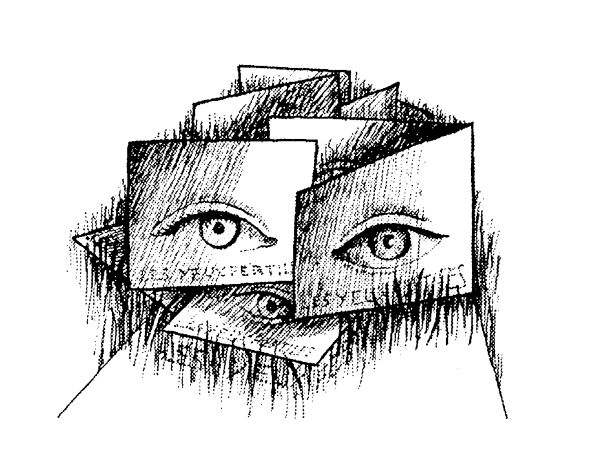
She worked in pen and Indian ink on white paper, letting her hand run freely. The first drawings, figurative (profiles, plant forms, recognisable motifs), evolved towards abstraction and a network of signs between drawing and writing, suggesting an imaginary alphabet; critics have likened her to Henri Michaux.
Jean Dubuffet admired her work, and her drawings were included as early as 1967 in the historic exhibition L’Art brut at the Musée des Arts décoratifs in Paris. A feature was devoted to her in fascicle no. 11 of the Collection de l’Art Brut.
Exhibitions and collections
- L’Art brut, Musée des Arts décoratifs, Paris, 1967
- In abstracto #2, Galerie Christian Berst, Paris, 5 March to 30 May 2020
- Collection de l’Art Brut, Lausanne
- LaM, Villeneuve-d’Ascq
- abcd / ART BRUT, Bruno Decharme collection