
Polish Art Brut draughtsman, born on 12 November 1897 in Wożuczyn, died on 8 April 1962 in Tomaszów Lubelski.
Life
The sixth child of a carpenter, Edmund Monsiel was brought up by an uncle who was an organist. He entered the seminary in Chełm, which he left without a diploma, then helped his mother run a shop before opening his own in Łaszczów. The Germans closed it in 1942.
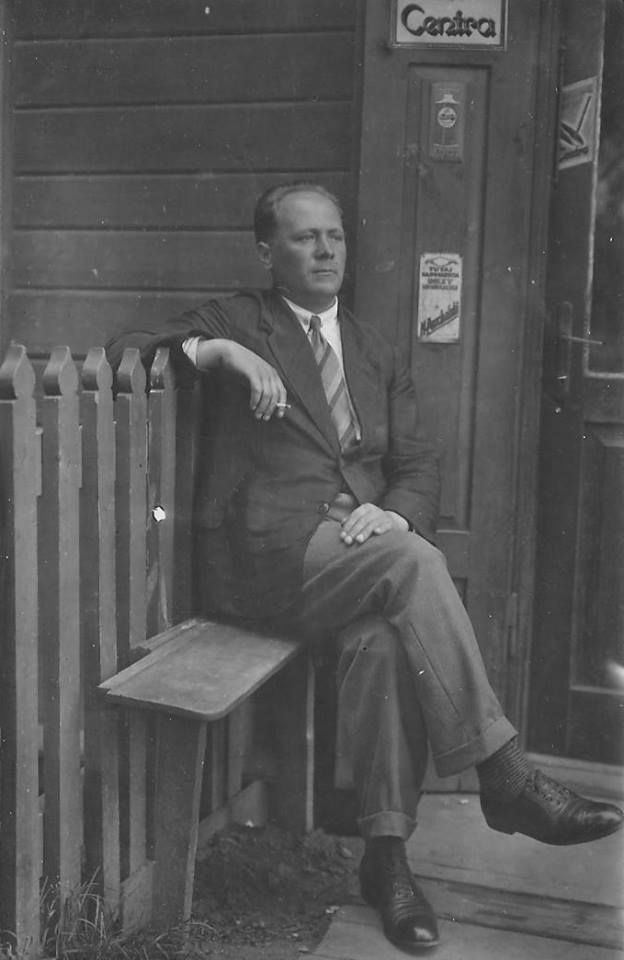
On 25 December 1942 he narrowly escaped a reprisal execution in which his brother-in-law and dozens of inhabitants were killed before his eyes. In the spring of 1943 he took refuge in the attic of his brother’s house in Wożuczyn and gradually cut himself off from the world. In the 1950s he lived in an abandoned house, then rented rooms until his death. His neighbours remembered a pious, cultivated and elegant man, one of the first amateur photographers in the region.
The work
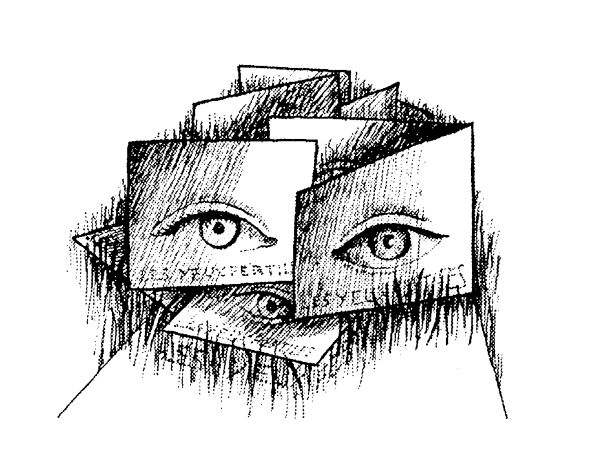
His first dated drawings go back to Holy Week 1943. After his death his family discovered more than five hundred drawings, some locked in a chest secured by three padlocks. Monsiel worked mainly in hard graphite, sometimes with collage, on scrap sheets, book covers, forms or envelopes.
His compositions combine popular and religious iconography. They obsessively repeat faces, notably that of a moustachioed man covered in eyes, sometimes by the thousand on a single sheet. Each drawing is signed “EM” and bears a moral maxim.
The gallery showed a Sans titre of 1947 (mixed media, 15 x 10 cm) in the exhibition “Favourites: Art Brut, Naive Art, Art Singulier” (15 March to 18 April 2024); Monsiel had already been included in its 2022 “Art Brut” exhibition.
Exhibitions and collections
- “Inner Worlds Outside”, Whitechapel Gallery, London, and Irish Museum of Modern Art, Dublin, 2006
- Galeria Gardzienice, Lublin, 15 October to 15 November 2010
- “Art brut. Dans l’intimité d’une collection”, Grand Palais, Paris, 2025
- Musée national d’art moderne, Centre Pompidou (Bruno Decharme donation, 2021); Collection de l’Art Brut, Lausanne