

French collagist, lives and works in Paris.
Life
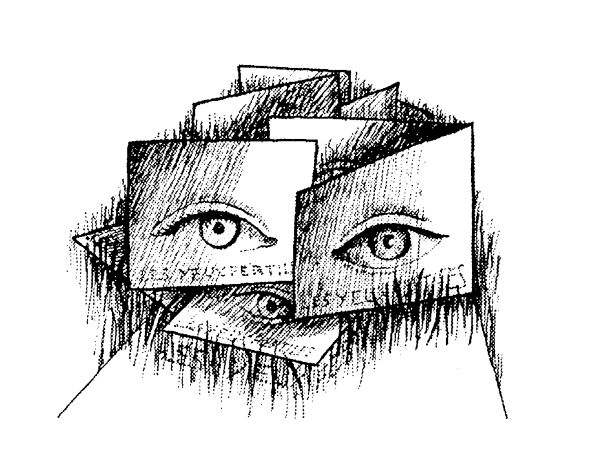
Mr Djub lives and works in Paris (France). He made his first collages in 1983. Claude Roffat, recognised and respected for his work with French singular artists and founder of the reference review of Art Singulier and Art Brut L’Œuf sauvage, exhibited the artist in his Paris gallery at the very end of the 1980s. From 2010 Mr Djub made his collage technique more complex, deciding to create solely with “old papers”: engravings printed between 1840 and 1890 in popular publications covering art, culture, politics and news items. Seeking the truth of a weakened paper that is generally hard to preserve, his creations reject any gesture (reprography, colour rebalancing, ink highlighting) other than those imposed by a pair of scissors and a scalpel. Mr Djub is also Djubaka (music programmer for the national radio station France Inter) and one half of the activist duo Anne & Julien, founders of the art project HEY! modern art & pop culture in 2010.
Text: Anne Richard
The work
“I made my first collage in 1983. I was fourteen, I was a punk, I made fanzines. It was a time when all layouts were made the traditional way… In France the punk and Situationist legacy was already well rooted. So collage was a natural practice, but applied above all to politics, in the spirit of the slogan. Collage has a fascinating history. Some trace it back to Charles Dufresny in the eighteenth century. For my part, I am emotionally connected to the Dadaists Raoul Hausmann, Hannah Höch and John Heartfield, and of course to the Surrealists, particularly Max Ernst: it is that precise period I am most attached to. Then I love the way Art Brut people moved things on by combining techniques, going from paper to objects to tell their stories. Collage is more a shared practice than a movement as such; it is a reality. On the other hand, one state of mind binds collagists together: the Stakhanovism of the business. They are all scalpel fanatics who want to make a new meaning, a mischievous diversion, spring from foreign material. And the real trick remains how far you are able to push the exercise. I also think one must know how to distinguish collagists from computer addicts and digital assemblage. I work only on newspapers published between 1840 and 1880, for reasons of coherence. One of the advantages of collage is precisely its lack of landmarks. In that sense no dogma confines its practice, so it has no defined school, and I love that, since I proudly claim to be self-taught, having been thrown out of the state education system at sixteen. Ernst said: ‘If it is the feathers that make the plumage, it is not the glue that makes the collage.’ In art, nothing can be reduced to a technique.” (Mr. Djub)
Further reading: Les Mondes Promis, illustrations by Mr Djub, texts by Rosita Warlock (Éditions Rackham).
Exhibitions
- Galerie Les Yeux Fertiles: “At the Sources of Convulsive Beauty”, section “The permanence of the contemporary Surrealist gaze”, with Lou Dubois and Yoan A. Gil, 25 October to 30 November 2024 (closing event with “Le Mage Mr. Djub”)
- Galerie Les Yeux Fertiles: “Charivari”, a small cabinet shown with “Didier Mazuru, Surrealist Fragmentations”, 5 June to 4 July 2025, alongside the exhibition “Paname” with the artist 13bis at the Galerie Roger-Viollet, 6 rue de Seine
- Galerie Les Yeux Fertiles: the gallery’s 25th anniversary exhibition, 22 May to 19 June 2026