Category: Art Singulier

  • Josette Rispal

    Josette Rispal

    French sculptor and visual artist, born in 1946 in Aurillac (Cantal). She lives and works in Paris.

    Life

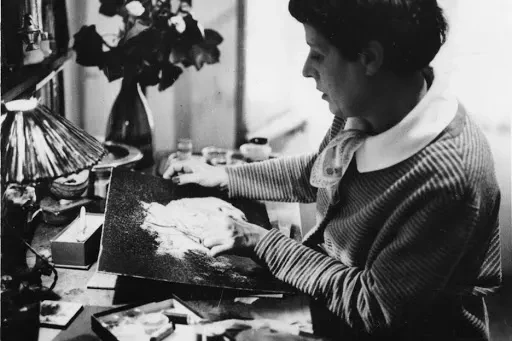
    The daughter of the gallerist Antonin Rispal and Joséphine Ajalbert, Josette Rispal grew up in Paris. Self-taught, she made her first light-masks in 1977. From 1980 to 1983 she lived in New York, where she made collages with Jean Dupuy. From 1981, with Henri-Hugues Lejeune, she lived partly in Venice, where she began working with glass and met Egidio Costantini.

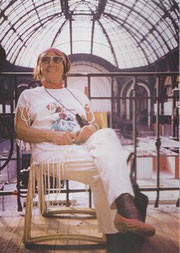
    In 1983 the Salon national des arts presented her “house of Light Masks” at the Grand Palais. In 1992 she made her first stained-glass window with the Ateliers Loire; Les Jardiniers (1993), a sculpture in slab glass heightened with grisaille and enamel, was shown at the SAGA fair at the Grand Palais in 1993.

    She has received several commissions: Cascade de lumière, a 16-metre sculpture inaugurated on 15 October 1994 at the entrance to the Puymorens tunnel; a cross, a tabernacle, Stations of the Cross and candlesticks for the church of Saint-Pierre-du-Gros-Caillou in Paris; a sculpture in reinforced concrete and glass for the motorway linking Clermont-Ferrand to Périgueux.

    In 2005 a group of Art Nouveau furniture and objects from the Antonin Rispal gallery entered the Musée d’Orsay by donation, which published it in 2006 (Un ensemble Art nouveau : la donation Rispal). Josette Rispal is a Chevalier of the Légion d’honneur (2009) and an Officier des Arts et des Lettres (2014).

    The work

    Since 1975 Josette Rispal has worked in bronze, iron, terracotta and Murano glass. Light holds a central place in her work. Like her friend Chomo, whom she met in July 1984 in his Village d’Art préludien at Achères-la-Forêt, she seeks to turn discarded things into works of art. She became his accomplice and patron, and in 1991 organised an exhibition for him throughout Milly-la-Forêt.

    Exhibitions and collections

    • Obsidians in Motion, Galerie Les Yeux Fertiles, 2014.
    • Constellation Rispal, Galerie Les Yeux Fertiles, 1 December 2018 to 12 January 2019.
    • Josette Rispal and Chomo, Galerie Les Yeux Fertiles, in collaboration with Maître Aymeric Rouillac, 27 November 2025 to 8 January 2026, including Témoins de l’Humanité (2013-2015, brushed metal and Murano glass, from 160 to 207 cm).
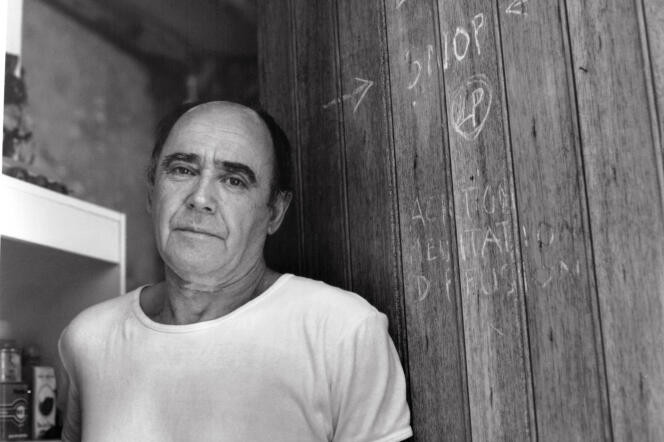
  • Louis Pons

    Louis Pons

    French draughtsman and maker of assemblages, born on 30 April 1927 in Marseille, died on 12 January 2021.

    Life

    After the École des Chartreux in Marseille, Louis Pons trained as a fitter at the École des métiers d’Endoume, without ever practising the trade. At the Liberation he drew for the Marseille newspapers born of the Resistance. At twenty-one he spent a year and a half at the Hauteville sanatorium.

    He then lived in villages of Haute-Provence, the Alpes-Maritimes, the Bouches-du-Rhône and the Var: Montfroc, Simiane-la-Rotonde, Vence, Saint-Paul-de-Vence, Aix-en-Provence, Antibes, Sillans-la-Cascade. The works of Joë Bousquet and Louis Soutter, like Lichtenberg’s aphorisms, confirmed him in his vocation. He settled in Paris in 1973.

    Alphonse Chave, in Vence, exhibited him from 1952; then came the Galerie Le Point Cardinal (1969-1983), followed by the Galerie Claude Bernard in Paris (1984-2003). Agnès Varda filmed him in The Gleaners and I.

    The work

    Between 1948 and 1969 Pons made some two thousand drawings in Indian ink, made of interwoven, superimposed lines from which ambiguous beings emerge, half-human, half-animal or plant. In 1959 he composed his first assemblages, reliefs built from discarded objects, shown in 1962 at Alphonse Chave’s. Where others see a heap of rubbish, he saw a reservoir of possibilities. His work oscillates between nightmare and fantasy, often tempered by humour.

    “Art should shut people up.” (Louis Pons, “Louis Pons par Louis Pons”, 1983)

    The gallery presents Grands docks (1998, mixed media, 182 x 126 cm), a large format chosen for the poster of the 2023 retrospective and reproduced in its catalogue, shown in the exhibition “Favourites: Art Brut, Naive Art, Art Singulier” (15 March to 18 April 2024).

    Exhibitions and collections

    • “Louis Pons, braconnier de l’art”, Musée Hébert, La Tronche, 2013
    • Retrospective, Lympia, departmental cultural centre, Nice, then Marseille, 2023 (Silvana catalogue)
  • Yolande Fièvre

    Yolande Fièvre

    French painter and sculptor, born on 25 January 1907 in Paris, died in 1983 in Paris.

    Life

    As a young woman, Yolande Fièvre travelled to America and lived for a few years in Egypt. She trained at the École des beaux-arts and the Académie de la Grande Chaumière in Paris, then taught at the École des beaux-arts in Orléans.

    In the 1930s she discovered Surrealism and met André Breton, who led her to abandon landscape for automatism. Her friends included Jean Paulhan, Jean Dubuffet, Raymond Queneau and Bernard Réquichot, whose suicide in 1961 devastated her. Her husband died in 1968.

    The work

    She first practised automatic painting and drawing. In the 1950s she turned to the object and pursued research into often organic materials: driftwood and “shipwrecked stones” (1957-1961), then “relief boxes”, in which fragments of wood, clay and pebbles, sometimes inhabited by small figures, evoke mysterious cities. The Oniroscopes are among her series.

    In 1961 she paid tribute to Réquichot with Rêve pour un jeune mort, an assemblage of driftwood, pebbles, bones, metals, shells and potsherds (93 x 167 x 15.7 cm), which entered the Musée national d’art moderne with the Daniel Cordier donation in 1989.

    Exhibitions and collections

    • Solo exhibitions from 1957, notably at Simone Collinet’s and Daniel Cordier’s in Paris, at the Svensk-Franska Konstgalleriet in Stockholm and at the Galerie Bonnier in Geneva
    • Halle Saint-Pierre, Paris, 2007-2008
    • Collections: Musée national d’art moderne, Centre Pompidou (Hommage à Bernard Réquichot, 1961, on deposit at Les Abattoirs, Toulouse)
    • Galerie Les Yeux Fertiles: “Automatic Paintings, Oniroscopes”, with Ursula, 14 March to 12 April 2025; work shown: Sans titre, c. 1950, automatic painting, 23 x 16 cm

    At the gallery

  • Mirabelle Dors

    Mirabelle Dors

    Painter and sculptor of Moldavian origin, based in France from 1952, died in November 1999.

    Life

    Mirabelle Dors came from Moldavia in 1952 with the Romanian poet Ghérasim Luca, then her partner. Welcomed in Paris by André Breton, she settled first in Montmartre. Her date of birth, often given as 1913, remains uncertain; the sale catalogues that give her death as 1991 are mistaken.

    In the early 1950s she met the painter Maurice Rapin (1927-2000), whom she married in 1954. The couple settled in Vélizy-Villacoublay. Together they led artists’ collectives outside the official circuits, the Jeune Peinture and then Figuration critique, and from 1971 to 1980 co-signed joint publications with the Tendance populaire surréaliste led by Rapin.

    The work

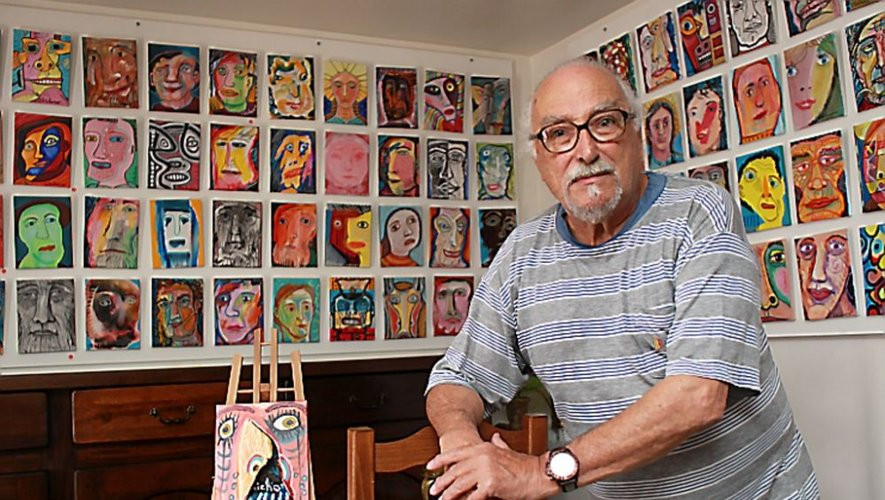
    Her work fills space with masks, totems, dolls and chimeras. The “populations of images”, which recur throughout her work, are its most characteristic form; the auction house responsible for her studio describes this work as surreal, repetitive and “popular”. She worked in low and high relief, sculpture, mixed media, heightened collage and oil on panel or hardboard.

  • Louis Auguste Déchelette

    Self-taught French painter, born in 1894 in the Lyon area, died in 1964.

    Life

    Louis-Auguste Déchelette drew from childhood. A plasterer and house painter, he travelled around France as a journeyman (compagnon) between the ages of sixteen and thirty-one. Supported by Georges Henri Rivière, he was exhibited twice during the war by Jeanne Bucher, who showed his clandestine so-called “resistance” paintings. After the war Jean-François Jaeger exhibited him several times between 1947 and 1960.

    The State bought some ten canvases from him between 1943 and 1965, including Église Saint-Étienne-du-Mont. Paris, acquired in 1949, the very year it was painted, and now in the Musée national d’art moderne.

    The work

    Déchelette painted mainly allegories on social and political subjects, served by puns and a very lively humour. His paintings of the Occupation denounce Fascism, Nazism and, more broadly, social conflict; Nonchalant was painted in 1943, at the height of the resistance to Nazism in Paris. In 1949 he painted a wedding in front of the façade of Saint-Étienne-du-Mont (oil on canvas, 92 x 65 cm).

    Exhibitions and collections

    • Galerie Jeanne Bucher, Paris, two exhibitions during the Second World War
    • Galerie Jeanne Bucher, under the direction of Jean-François Jaeger, several exhibitions between 1947 and 1960
    • “Compagnons de route”, Galerie Jeanne Bucher Jaeger, Paris, 23 May to 20 July 2019
    • Collections: Musée national d’art moderne, Centre Pompidou (Église Saint-Étienne-du-Mont. Paris, 1949)
  • Mario Chichorro

    Mario Chichorro

    Portuguese painter and sculptor, born in 1932 in Portugal, died in 2023, based in France from 1963.

    Life

    Mário Chichorro studied architecture at the School of Fine Arts in Porto. In 1963 he settled in Perpignan, and from then on pursued most of his career in France. In 1968 he lost his job after being recognised at a demonstration against the employers: he then devoted himself entirely to his art.

    His first Paris exhibition took place in 1974 at the Atelier Jacob, with the support of Jean Dubuffet, who included him in his “annexe collection”, today’s Neuve Invention collection in Lausanne. In his lifetime he never exhibited in Portugal: a posthumous tribute was paid to him at the Centre for Arts and Performance in Figueira da Foz, with a space devoted to his brother, the painter Heitor Chichorro.

    The work

    His work oscillates between painting and low-relief sculpture. Bright colours, absence of perspective, irreverent humour: his compositions combine figures and scenes in an allegorical imaginary, sometimes tinged with eroticism.

    “I am for irreverence, insubordination, unrealism, reverie, utopia, desire.” (Mário Chichorro, translated from the Portuguese)

    Exhibitions and collections

    • Atelier Jacob, Paris, 1974
    • “Lusofolia: A Beleza Insensata”, Centro de Arte Oliva (Portugal), 9 November 2019 to 11 October 2020
    • Posthumous tribute, Centre for Arts and Performance (CAE), Figueira da Foz (Portugal)
    • Collections: Collection de l’Art Brut, Lausanne; La Fabuloserie (France); Centro de Arte Oliva (Portugal)
  • Aristide Caillaud

    Aristide Caillaud

    Self-taught French painter, born in 1902, died on 26 September 1990 in Jaunay-Clan.

    Life

    Aristide Caillaud spent a childhood as a young peasant in Moulins, in the Deux-Sèvres, which shaped his character. It was during the Second World War, as a prisoner of the Germans, that he discovered his talent: he painted his first works on fragments of wooden crates, alongside a fellow prisoner, the master glassmaker Max Ingrand.

    In 1949 he took part in the exhibition L’Art brut organised by Jean Dubuffet at the Galerie René Drouin, then held solo shows in Parisian galleries. André Malraux supported him and had his work shown. Two retrospectives were devoted to him, at the Musée d’Art moderne de la Ville de Paris in 1976 and at the Musée Sainte-Croix in Poitiers in 1978. His uncompromising character and his taste for solitude nonetheless kept him away from society life. He died in his small house in Jaunay-Clan, in Poitou, leaving an abundant body of work.

    The work

    Christian Gendron places his painting between Art Brut and Naive Art: a highly worked body of work born entirely of the imagination. Caillaud said he had no preconceived idea: “the painting makes itself”.

    In 2024 the gallery showed a large Sans titre of 1958-1959 (oil on panel, 174 x 114 cm).

    Exhibitions and collections

    • L’Art brut, Galerie René Drouin, Paris, 1949
    • Retrospective, Musée d’Art moderne de la Ville de Paris, 1976
    • Retrospective, Musée Sainte-Croix, Poitiers, 1978
    • Retrospective, Niort (Hôtel de ville, Pilori, Donjon), 28 June to 24 September 2001, with the book Aristide Caillaud l’enchanteur (Somogy), text by Jacques Lacarrière
    • Favourites: Art Brut, Naive Art, Art Singulier, Galerie Les Yeux Fertiles, Paris, 15 March to 13 April 2024
  • Patrice Cadiou

    Patrice Cadiou

    French sculptor, born in 1947, died in 2015.

    Life

    Patrice Cadiou first trained in classical dance before becoming a sculptor. His meeting with the dealer Gérard Laubie marked a turning point: it opened the doors of Raymond Cordier, the Galerie Keller, the Galerie Ridel and the Musée d’Art moderne de la Ville de Paris.

    The collector Jean-Claude Volot, mayor of Auberive, assembled a group of his works and encouraged him to settle in the Haute-Marne; several of his sculptures are shown at the contemporary art centre of the Abbaye d’Auberive. In 2012 the gallery devoted the exhibition Talismanic Nights to him.

    The work

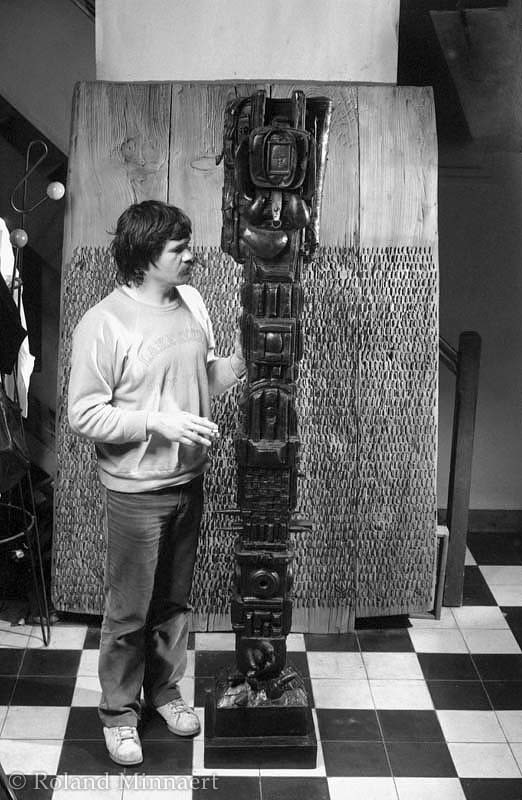
    Cadiou assembled materials found in the rubbish tips near his home: wood, leather, canvas, iron, brass, often with a black patina. His sculptures, which have been likened to Kongo nail fetishes, also include large carved doors.

    “When one of my sculptures has not yet delivered its message, when it does not yet speak to me, I try to listen to it, to modify it so that it reveals its whole secret to me.” Patrice Cadiou, quoted in Esprit singulier : fonds de l’abbaye d’Auberive, Flammarion, 2016, p. 102.

  • Pierre Bettencourt

    Pierre Bettencourt

    French writer, printer and artist, born on 28 July 1917 in Saint-Maurice-d’Ételan, died on 13 April 2006 in Stigny (Yonne).

    Life

    After secondary school in Le Havre and Savoie, Pierre Bettencourt attended Paul Valéry’s course in poetics at the Collège de France from 1936 to 1938. In 1941 he acquired a hand press and printed, in the family house then occupied by the Germans, his own texts and unpublished works by Henri Michaux (Tu vas être père), Antonin Artaud (Le Théâtre de Séraphin), Francis Ponge (Le Galet) and Jean Dubuffet (Plukifekler). He signed his erotic writings with the pseudonym Jean Sadinet.

    A great traveller, he journeyed through Africa in 1946 and 1947, Oceania and India in 1951 and 1952, then the Americas, Egypt and Asia. He met Jean Dubuffet in 1947. In June 1962 he married the writer and artist Monique Apple; the following year they settled in Stigny, where he worked until his death.

    The work

    In August 1953, invited by Dubuffet to the south of France to hunt butterflies, he composed small portraits with butterfly wings. At that moment, he said, his life was to rush off in an entirely new direction. In the autumn, for want of butterflies, he gathered flints and bark in the woods and glued them onto plywood to form faces and scenes. So began the series of 388 high reliefs, completed in 1991: on painted grounds, slate, coffee beans, eggshells, stones or pine cones trace figures in which Eros and Thanatos rub shoulders. Le Divin Marquis (1954), no. 6 of this series, made of particularly raw materials, is a historic work.

    Daniel Cordier exhibited and collected him in the 1950s and 1960s. Long kept away from the market, his visual work is matched by a substantial literary output.

    Exhibitions and collections

    • Galerie Daniel Cordier, Paris
    • The Hold of the Senses, Galerie Les Yeux Fertiles, Paris, 2022 (with Le Divin Marquis, 1954, and Le Mystère du temps, 1970, high relief, 124 x 175 cm)
    • Favourites: Art Brut, Naive Art, Art Singulier, Galerie Les Yeux Fertiles, 2024
    • Musée national d’art moderne, Centre Pompidou: La Voie lactée, 1964, assemblage of various materials and paint on plywood, 275 x 154 x 15 cm (Daniel Cordier donation, 1989)
    • Other public collections: Centre national des arts plastiques; Les Abattoirs, Toulouse; Musée de Grenoble; Musée des Beaux-Arts de Rennes; MAMC+ Saint-Étienne; MAMCS Strasbourg; Abbaye d’Auberive; Cérès Franco collection, Montolieu; MAC’s Grand-Hornu (Belgium)
  • André Bauchant

    André Bauchant

    Self-taught French painter, born in 1873 in Château-Renault (Indre-et-Loire), died on 12 August 1958 in Montoire-sur-le-Loir (Loir-et-Cher).

    Life

    André Bauchant left school at fourteen to work on the family farm, then became a livestock breeder, fruit grower and nurseryman, hence his nickname of “the gardener painter”. Called up during the First World War, he was sent to the Dardanelles, Greece and Turkey. Having passed an examination as a rangefinder operator, he made topographical surveys and panoramic sketches that revealed a talent he had not suspected.

    Demobilised in 1919, at the age of forty-six, he found his farm ruined and his wife, Alphonsine, seriously ill. He withdrew to Auzouer-en-Touraine and began to paint. In 1921 he exhibited at the Salon d’automne; Le Corbusier bought a first canvas from him in 1922. Amédée Ozenfant, Jacques Lipchitz, Jean Lurçat and Serge Diaghilev were among his Parisian supporters.

    Jeanne Bucher gave him his first solo exhibitions in 1927 and 1928; Wilhelm Uhde discovered him there and counted him among the “modern primitives”. In 1928 Diaghilev commissioned him to design the sets for Apollon musagète, to music by Stravinsky, for the Ballets Russes. Now able to live from his painting, he had a house built at Les Tourneboeufs. In 1949 the Galerie Charpentier presented a retrospective of 215 canvases. Weakened by a stroke in December 1956, he painted until September 1957.

    The work

    History paintings, mythological and religious scenes, festivities, portraits, Loire landscapes and still lifes make up his work, with assertive foregrounds, imperfect perspectives and successive planes. From around 1950 he painted mainly flowers and fruit, turning the still life (nature morte) into a “living nature” (nature vive) by showing flowers still planted in the earth. He also designed, on a State commission, a tapestry cartoon for the Gobelins.

    Dina Vierny, who at his request acquired the contents of his studio, organised many exhibitions of his work and in 1997 published his catalogue raisonné.

    Exhibitions and collections

    • Salon d’automne, Paris, 1921
    • Galerie Jeanne Bucher, Paris, 1927 and 1928
    • Les Maîtres populaires de la réalité, Kunsthaus, Zurich, 1937
    • Retrospective, Galerie Charpentier, Paris, 1949
    • Musée d’art et d’archéologie de Senlis: Paysage fleuri, 1955, oil on canvas
    • Favourites: Art Brut, Naive Art, Art Singulier, Galerie Les Yeux Fertiles, Paris, 15 March to 13 April 2024